
Author Melissa Doman On ‘Mental Well-being Non-Negotiables’ and Why Corporate America Must Rethink Stress

…Another one I would suggest is communicating capacity. A lot of leaders are discouraged from communicating their capacity. When they do communicate it, it doesn’t always go well, or they may be in environments where it isn’t safe to do so. I recommend focusing on a zero to 100 capacity scale and understanding what that means. If you are operating at 30%, you need to know what must be done, what can wait, why it is okay to be where you are, and how you will take care of yourself during that process. Make sure you are clear on your own capacity management so you can clearly communicate it to others…
I had the pleasure of talking with Melissa Doman, MA. Long before she was training corporate giants like Google and Estée Lauder, she was simply the kid who refused to take things at face value. She describes her younger self as the perpetual “but why?” child, someone deeply attuned to the quiet frequencies of human behavior. “I have always been extraordinarily empathetic, sometimes to my own detriment, and just very aware of the human condition,” she recalls. That intense observation naturally pulled her toward a Master’s degree in counseling psychology. For her, learning to help people navigate their inner lives felt like the only logical path. As she puts it, “I thought that would be a really good use of my time on this pale blue dot as we float around the universe.”
Yet, the clinical world quickly revealed its limitations. Doman found that her clients were entirely compartmentalizing their pain, treating the therapy room as the only safe harbor for their struggles. The idea of discussing mental health at work or in public was strictly off-limits. Frustrated by the boundaries of this dynamic, she realized, “I don’t think I’m really moving the needle if I’m treating clients in a broken system and a broken narrative.” She needed to attack the problem at its root. In 2013, she made the difficult leap from clinical practice to industrial-organizational psychology. Her goal was to rewrite the rules of corporate team dynamics and emotional intelligence, but the corporate world wasn’t quite ready. Whenever she brought up stress or mental health, people would proverbially hiss at her. “I said, these are not bad words,” she remembers. “Why can’t we talk about this?”
Her transition was anything but smooth. Early on, a manager bluntly told her that she lacked the traditional background for in-house roles and shouldn’t even pursue them. At the time, the critique stung bitterly, feeling like a direct attack on her competence. Looking back, however, Doman views it as a “poorly delivered favor” that pushed her out of the traditional corporate machinery. “I had to build my own path and do it my own way,” she says. That path led to her authoring two impactful books, Cornered Office: Why We Need To Talk About Leadership Mental Health and Yes, You Can Talk About Mental Health at Work (Here’s Why and How To Do It Really Well), and building a career dedicated to teaching companies how to communicate about mental health without the corporate red tape.
The modern workplace, Doman argues, is a breeding ground for a new, more severe kind of psychological strain. While work has always been difficult, the sheer volume of tasks and the blistering speed of modern expectations are entirely unprecedented. “The expectations of us at work have exponentially increased, but sometimes the support hasn’t,” she explains. We are tethered to screens, perpetually reachable, and expected to execute flawlessly with zero margin for error. The biological reality, however, hasn’t caught up with our technology. “Our brains, despite being incredibly adaptable, are still running on cave-person hardware, even though we have had these modern-day software updates,” she notes.
To survive this modern pressure cooker, Doman insists that deliberate self-care is not a luxury, but a biological imperative. “Honestly, you cannot deal with the stress that comes with work without self-care. Period,” she states flatly. To that end, she developed a concept called the Mental Well-being Non-Negotiables™. This is a rejection of the one-size-fits-all wellness industry. “If yoga doesn’t work for you, don’t do it. If meditation doesn’t work for you, don’t do it,” she says. Her own non-negotiables are highly specific: spending time in the Colorado nature, playing with her dogs, and salsa dancing. Even when multiple leg surgeries left her relying on a knee scooter and crutches, she adapted. “We would put on bachata music and I would shimmy around the house so I didn’t lose my mind,” she laughs.
That need for release ties directly into another modern crisis Doman observes: the loss of the “third space” and the rise of profound isolation. With the shift to remote work, the boundaries between the office and the bedroom increasingly dissolve, taking essential ‘out in the world’ social interactions down with them. Doman warns that the resulting loneliness is far more than just a sad feeling; it is a critical health risk. “Loneliness is a form of stress,” she explains. “Loneliness and under-stimulation impact mental and physical health; it is completely underestimated in terms of what it can do to people.” While endless Zoom meetings and social media feeds offer the illusion of connection, they actually drain our cognitive reserves, forcing our brains to hyper-focus on a two-dimensional image rather than natural human cues.
Doman’s philosophy is rooted in radical honesty about our own limits. She urges leaders to accurately communicate their capacity rather than projecting false invincibility. “If you are operating at 30%, you need to know what must be done, what can wait, why it is okay to be where you are,” she advises. The core of her message is an urgent call to stop pretending everything is fine when it isn’t. Quoting a hard important truth from her sister, Doman summarizes her entire mission: “My sister says that being alive is the ‘cost of doing business’. That cost can be incredibly stressful, hard, and lonely. We cannot waste any more time avoiding honesty about that.”
Yitzi: Melissa, it’s so nice to meet you. Before we dive in and talk about self-care and mental health, our readers would love to learn about your personal origin story. Can you share with us the story of your childhood, how you grew up, and the seeds for all the amazing work that has come since then?
Melissa: Good to meet you too. I don’t get asked that question very often, and I appreciate being able to look that far back. If we go way, way, way back to when I was a kid, I was always the “but why” child. I was always asking why things were said or done a certain way because I’ve always been very observant of relationships, behaviors, communication, and feelings. It has always felt quite natural to me. I have always been extraordinarily empathetic, sometimes to my own detriment, and just very aware of the human condition. That led me to pursue a Master’s degree in counseling psychology because I wanted to teach people how to help themselves. I thought that would be a really good use of my time on this pale blue dot as we float around the universe. I am thankful I got that training because it provided the academic and clinical frameworks to help with human suffering, and even with unintentional self-destructive behaviors. I loved that education and doing that clinical work. However, what I found is the conversations we would have about those struggles were only allowed in certain spaces. Really, all of my clients felt they could only talk about their struggles in therapy or in other very small social circles. Definitely not at work, and definitely not in a public sphere. I thought, well, I don’t think I’m really moving the needle if I’m treating clients in a broken system and a broken narrative. I needed to make an impact at the source. I made the very difficult decision to leave clinical work in 2013 and transition into traditional industrial-organizational psychology, really focusing on the front end of behaviors around communication, team dynamics, and emotional intelligence. But I found that whenever I would say the words mental health or stress, people would proverbially hiss at me, and I didn’t understand why. I said, these are not bad words. Why can’t we talk about this? It really led me to do this work now, normalizing why we have to talk about mental health in the workplace as a critical business conversation. It is incredibly tough out in the world and within ourselves, and I don’t understand how we can survive any of it without having the permission to talk about it and the tools to do so.
Yitzi: Tell us a bit more about the work you do right now. Tell us what your day-to-day looks like, and the exciting things you are working on.
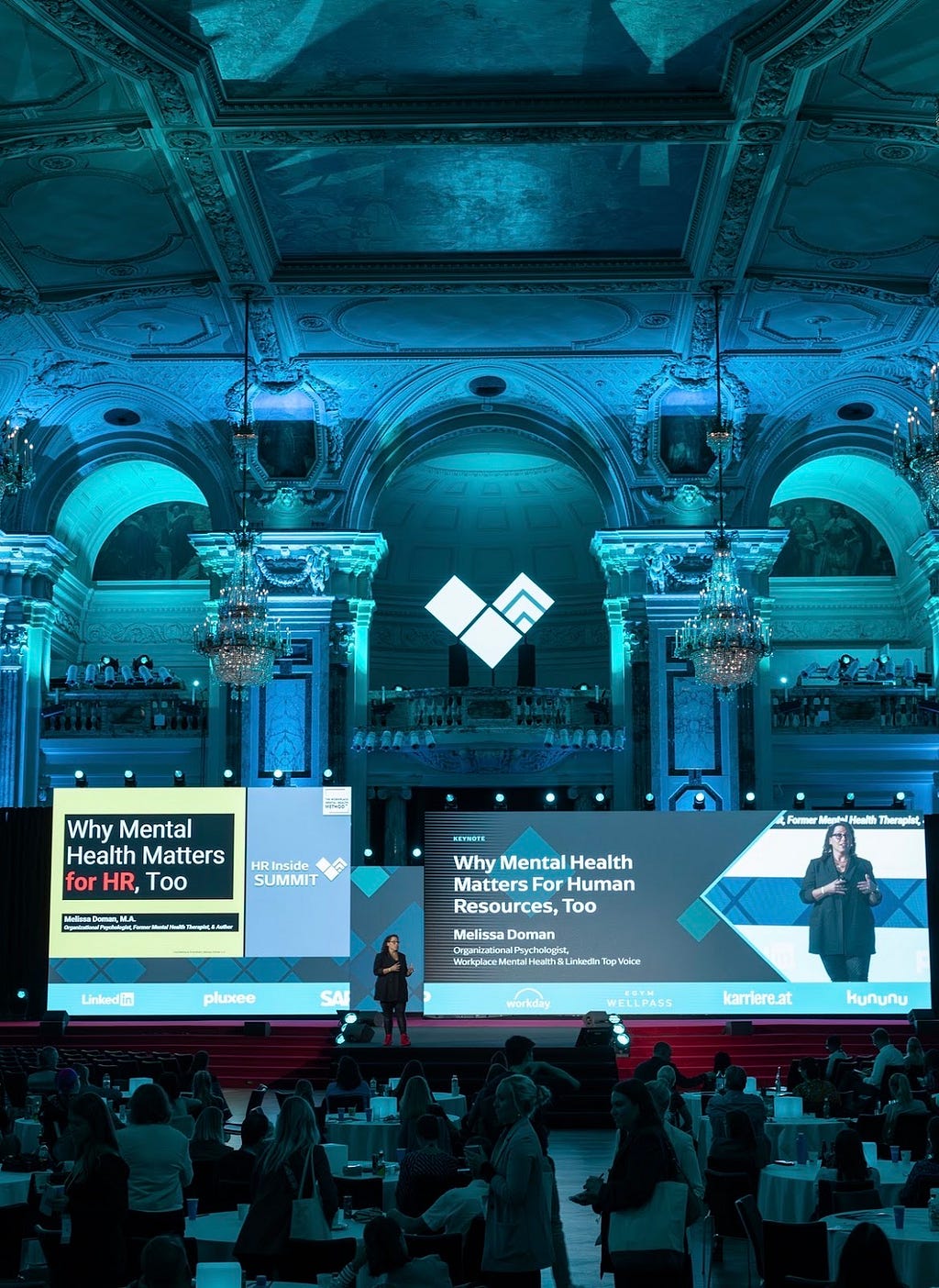
Melissa: I teach companies, leaders, and individuals the skill set to have constructive conversations about mental health, communication, and team dynamics in the workplace. My clients are companies ranging from really large organizations like Google, Progressive, Dow Jones, and Estée Lauder, to mid-size companies like the MLS soccer team — the Orlando City Soccer Club, to small companies and everything in between across industries around the world. I provide services to individual companies. I speak at conferences and summits, and I provide fireside interviews, workshops, facilitations, strategic consulting, and panels. I try to give this education in as many learning formats as possible because people learn in different ways. Everything I talk about is solution-oriented and very action-oriented. I think these topics tend to get lost in theory and soapbox performances and don’t focus enough on implementation. The clients that work with me are the ones who are ready to do the work.
Yitzi: You probably have some amazing stories from your successful career, the different places you have been to, and the different places you have taught at. I am sure this is hard to single out, but can you share with our readers one or two stories that stand out in your mind from your professional life?
Melissa: Actually, one of them felt very negative at the time, but turned into a huge positive. I remember doing some work on a contract before I had specialized in workplace mental health or gone out on my own to become self-employed. A manager I was working with basically told me that doing traditional in-house roles was not a good fit for me. They said I didn’t have the traditional background and that I shouldn’t pursue it. At the time, because I had done very well in that role, it felt like a personal attack. It felt very uncomfortable, as if they were trying to bring me down. But actually, they were giving me a poorly delivered favor. I look back on that, and I am immensely appreciative that this poorly handled conversation happened. They were right. They were completely right. I had to build my own path and do it my own way to accomplish what I was trying to do. That one conversation, while deeply unpleasant, was the biggest favor that person could have ever done for me. While they weren’t very nice and their delivery wasn’t great, the message was still helpful and true. The other story, which is more of an amalgamation of moments, is how I completely underestimated the impact that writing books on mental health at work would have on people. Over the years, the number of people who took the time to tell me that these books changed the way they look at mental health at work, and how they talk about it, is the biggest honor of my career. I never would have anticipated it would impact people in that way, or that they would see it in a way that could change the trajectory of how they show up at work. I am endlessly in awe whenever people come to me saying that.
Yitzi: Let’s now move to the centerpiece of our discussion. Do you think the mental health challenges that come with work are more salient today, or have they always existed and we just didn’t really talk about them?
Melissa: I think the answer is yes to both, to be honest. The mental health struggles that come with work are not new; they have always been around. I will say that the kind of mental health challenges we have now are more plentiful and more challenging. If we look at work even 30 years ago, it was a very different world. Even 10 years ago, it was a very different world. The challenges have always been there, but we didn’t have the permission to talk about them, and in some circles, we still don’t. I would say that the types of mental health challenges, the amount, and the severity are definitely getting worse.
Yitzi: Can you explain a little bit about how it is more severe and more common?
Melissa: Happy to explain. I think the expectations of us at work have exponentially increased, but sometimes the support hasn’t. The speed at which we are expected to work has increased. The tolerance for errors and learning curves has decreased. The number of things we are supposed to manage and master has increased. The number of things we are expected to deal with simultaneously, and to do well without failing, has increased. The connection to constant information and screens regarding all of it has also increased and become the norm. The expectation of being able to detach from that is often non-existent; if anything, the pressure is just going up. I don’t understand how those things can happen without emotional and cognitive consequences. Just because we can do it doesn’t mean it goes without a negative impact. Our brains, despite being incredibly adaptable, are still running on cave-person hardware, even though we have had these modern-day software updates.
Yitzi: That is a great analogy, thank you. The contrast to these mental health challenges, or at least one approach, is the focus on self-care. Can you give some examples of how proper self-care can mitigate the stress that comes with work?
Melissa: Honestly, you cannot deal with the stress that comes with work without self-care. Period. You just can’t. Stress in itself is neutral. It happens when we encounter a stimulus that requires adjustment or a response. You can have lots of good stress or lots of bad stress, but the impact on us is the same when you have too much of either. There is no option to not manage the stress that comes from work because your mental health, professional functioning, social health, or interpersonal relationships — something will get dinged if you don’t manage it. I have yet to meet someone who was an exception. Deciding how you mitigate that stress has to be very personal, depending on your scenario. For some people, that can just be doing their favorite hobbies. For others, it might be going to counseling, finding community, or it may require medical intervention. For some, it may require all of the above. With the amount of inputs we are taking in, if you have a finite space building pressure with no release valve — which is what stress management is — you will pop. I have a concept I talk about in my work and in my second book called the Mental Well-being Non-Negotiables™. It encourages people to personalize how they manage their stress based on what they actually like doing, what works with their schedule, and what produces a positive mental result, not as dictated by the wellness industry. The wellness industry doesn’t have individual circumstances in mind. If yoga doesn’t work for you, don’t do it. If meditation doesn’t work for you, don’t do it. Just decide what emotionally makes you feel good and doesn’t bring harm to yourself or other people. Do it at an achievable cadence and stick to it, barring cases of severe emergencies or illness. I am not kidding. You have to have at least one thing that you do, and you have to stick to it and adapt it. Let me give you some examples. My Mental Well-being Non-negotiables™ are that I have to be in nature at least once a week. I live in Colorado, so that is not hard to do. I have to play with my dogs every night, even though they treat me like a human jungle gym and I am covered in bruises. I also go salsa dancing at least twice a month because I’ve been doing that for 20 years and it is my form of meditation; traditional meditation doesn’t work for me. When the pandemic hit, dancing wasn’t exactly social distancing-friendly. I thought to myself, well, I have hardwood floors, a mostly willing husband, and salsa music, and that will have to do. And it did, for a couple of years. When I had three surgeries on my left leg, which is basically a decorative limb now, it made dancing hard. Whenever I was on crutches or a knee scooter after ankle surgery, we would put on bachata music and I would shimmy around the house so I didn’t lose my mind. All that to say, if you don’t have at least one thing you do for your mental health that you genuinely enjoy doing, rather than doing it out of obligation, you have no chance of managing work stress. You have the accountability and responsibility to decide what that is, when you are going to do it, and it is up to you to keep it up. That would be my recommendation.
Yitzi: For these non-negotiables, do you recommend it should be something done every day, or could it be enough to do it every week, or even once a month?
Melissa: That’s the beauty of it: someone needs to decide what is actually feasible. I am setting the bar at five minutes a day. It could be one hour a week, or it could be a few hours a couple of times a month. Every individual needs to decide what is possible based on their circumstances, their life, their energy levels, and their support system. For example, I have something I do once a week, I have something else a couple of times a month, and I play with my dogs every night because they live with us. I decided on that schedule because only I know what is feasible for me.
Yitzi: Do you think if people simply committed to not working on the weekends and not checking any work emails, that would be a huge benefit and a great example of self-care? Just making sure not to work?
Melissa: I think it is a form of self-care. But what I will say is, even though having boundaries around work is very important — and you can’t work all the time, despite the fact that some people do — even in the absence of that stimuli, the impact doesn’t go away. I think you have to have both. You need to have some reasonable boundaries around the fact that when you are not working, you are truly not working, which is incredibly difficult in today’s world. You also need to address the impact the job has on you while you are working. I think it requires both.
Yitzi: I noticed one of your books is called Cornered Office. Today, the office doesn’t have to be in an office building; it could be in your home. Do you think working from home is less stressful, or maybe even more stressful?
Melissa: I think the answer is yes to both. In some ways, it is definitely less stressful because you don’t have a commute, and you save money from not commuting and avoiding all the associated costs. If you work better without the distractions of an office and other people, all of these things are a net benefit. However, we also experience the loss of the third space between work and home. Depending on their home setup, some people may not be able to have a dedicated office. This creates a lack of boundaries between work and life. Those things become integrated, rather than balanced. For some people, it is a very slippery slope that leads to working on their laptop in bed at 10 p.m. It can be very difficult to maintain those boundaries if you work from home and don’t have separate spaces. I think in some ways it increases stress, and in other ways, it lowers it.
Yitzi: That is amazing. You mentioned the “third space,” which has become a prominent topic these days. Can you articulate why it is necessary to have a third space? Maybe it’s enough to have two separate spaces for work and home. Why is a third space inherently important?
Melissa: While many humans are creatures of comfort and familiarity, we really need to experience different contexts. That is why co-working spaces can be so helpful; you can be around other people while maintaining flexibility. I would even argue that a third space for social health is incredibly important and a vital part of mental health. When I go salsa dancing — I just went last night — I recognize the regulars. It gives me time away from my home, which doubles as my home office. Having different spaces for different experiences provides the social stimulation we need. Unfortunately, social health and community are undervalued.
Yitzi: Can you articulate the contrast — what would happen if we didn’t have a third space? What happens if our life is just work, sleeping, and eating, without that social aspect?
Melissa: We see the loneliness epidemic, which is already happening. Loneliness can be a social determinant of health. Despite the fact that we are more connected than ever, we are lonelier than ever. At the same time, especially during such a period of social division, loneliness can feel more tolerable to people than dealing with the discomfort, division, anger, fear, and rage of being around others. But those are two pretty bad choices: choosing to be lonely or being out in the world, constantly bracing yourself for the next conflict. The genie is out of the bottle in many ways, which is really scary, but perpetual loneliness is not the answer. It may feel more self-protective, and in some ways it is, but it is not without consequence. Loneliness is a form of stress. Loneliness and under-stimulation impact mental and physical health; it is completely underestimated in terms of what it can do to people. When you feel like you are choosing between two bad options, I understand why people pick loneliness over conflict. However, getting out into the world and making sure you find communities you feel connected to, and missions that make the people and the world around you better, is a third option. It just requires a lot more energy to find, pursue, and maintain.
Yitzi: I think in a certain way, all these screens are like drinking salt water. You think you are quenching your thirst, but you are really making it worse. You have a sense that you are connected — connecting with people online or on LinkedIn — but the screen isn’t what we truly crave. It tricks our brains into thinking we are being social, but it isn’t what we actually need.
Melissa: Actually, especially during the pandemic, people talked a lot about Zoom fatigue. It is very real because, even as we are communicating now during this interview, the type of focus you and I have to use to interpret each other, understand each other, and pay attention to the flow of conversation is not natural for our brains. We are meant to be in person, looking at each other’s body language and taking other environmental factors into account. Instead, we are hyper-focusing on an image on a screen and the sounds coming from it. Yes, we are connecting, but in a very exhausting way. It really drains people in a manner that creeps up on you over time.
Yitzi: That is very profound. I really love what you said about loneliness being a form of stress. I understood the idea, but never had the particular lexicon to articulate it. Can you unpack that a little bit?
Melissa: Oh yes, absolutely. There is something called the stress curve, also known as the Yerkes-Dodson Law. It describes the optimal levels of stress, which really means the optimal levels of engagement, stimuli, and focus. This is where you feel connected to what you are doing, motivated, and inspired. It is the optimal level of stimulation. But when you go past a tipping point in either direction — being over-stimulated or under-stimulated — there is a significant impact. On that model, when you go into the red zone of being over-stimulated, you become aggressive, angry, and experience burnout or breakdowns. In the other direction, when you are under-stimulated, lack sufficient contact, or don’t feel connected to what you are doing, the impact can look the same. Having too much stress is harmful, but not having enough stimulation is just as stressful, albeit for different reasons. I discuss that model all the time, especially during the practical stress management workshops I do with companies. I tell them that not having enough to do, not being around people enough, or simply not getting enough stimuli might sound like a good idea in theory, but in practice, it is not so good. Loneliness and under-stimulation are also very stressful.
Yitzi: Would you go so far as to say an analog to “loneliness is stress”, that boredom is stress? Or could someone argue that it is sometimes healthy to be bored or to embrace boredom.
Melissa: There is definitely a place for the healthiness of boredom. I was actually just talking to my husband and his friend about that last weekend. I am an Elder Millennial in my early 40s, and we are the last generation with an analog childhood and a digital adulthood. I would say that boredom doesn’t necessarily mean you aren’t getting stimulated. Back in the day, if we were bored, we went outside, played games, read books, and visited friends. Our boredom allowed us to sit with our own thoughts and be okay with less stimulation. In addition, the way we chose to deal with it was largely outside of screens and self-isolation. The function of analog boredom is not the same as being bored in an over-connected environment.
Yitzi: You are saying the boredom we experienced as kids was healthy, but the boredom where you stay inside and don’t replace it with something nourishing is stressful.
Melissa: Yes, because the boredom we had as kids was usually replaced with healthy coping strategies; that is what was available to us. Now, boredom can even stem from having too many choices, too many options, and too much stimulation. This modern boredom arises from not getting the consistent dopamine hits our world is designed to provide. That is very stressful. I think the way boredom was dealt with decades ago was far less stressful because our coping mechanisms were generally healthier. However, I have to be honest: I don’t think the main problem today is boredom. That isn’t what I am seeing. What I am seeing is people’s discomfort with simply being by themselves or with other people. I am not hearing many complaints about boredom. I am hearing complaints about a discomfort with self and others, feelings of disconnection, and a lack of purpose. I don’t see as many issues around boredom in my work.
Yitzi: This is the centerpiece of our interview. Can you please share a few self-care routines that are needed in order to succeed and thrive as a high-performing leader?
Melissa:
- Definitely the Mental Well-being Non-Negotiables™. You have to decide what that is, why you want to do it, when you are going to do it, and how to set yourself up for success. You must stick to it. So, Mental Well-being Non-negotiables™ are key.
- Another one I would suggest is communicating capacity. A lot of leaders are discouraged from communicating their capacity. When they do communicate it, it doesn’t always go well, or they may be in environments where it isn’t safe to do so. I recommend focusing on a zero to 100 capacity scale and understanding what that means. If you are operating at 30%, you need to know what must be done, what can wait, why it is okay to be where you are, and how you will take care of yourself during that process. Make sure you are clear on your own capacity management so you can clearly communicate it to others.
- The third routine is being very clear about your internal narrative. You might be surprised by the messages you carry about self-care as a leader, where they came from, and whether they are damaging you. I recommend focusing on Mental Well-being Non-negotiables™, capacity communication, and gaining clarity on your internal narrative, as the latter drives the first two.
Yitzi: This is our final aspirational question. Melissa, because of your amazing work and the platform you have built, it is not an exaggeration to say that you are a person of enormous influence. If you could spread an idea or inspire a movement that would bring the most amount of good to the most amount of people, what would that be? You never know how far your idea can spread.
Melissa: My sister says that being alive is the ‘cost of doing business’. That cost can be incredibly stressful, hard, and lonely. We cannot waste any more time avoiding honesty about that. Whether you are an individual contributor or a leader, it is really tough out in the world and within ourselves. We should just accept that and focus on constructive ways to help ourselves and each other.
Yitzi: Melissa, how can our readers continue to follow your work, purchase your books, engage your services, or attend your teachings? How can they support your work in any possible way?
Melissa: I appreciate that question. My website is www.melissadoman.com, and people are welcome to contact me there for services. Whether within a business, or at a conference or summit, I do fireside interviews, keynotes, workshops, team off-sites, facilitations, panels, and strategic consulting. People are also welcome to connect with me on LinkedIn. My Instagram handle is @thewanderingmel. Both of my books, Cornered Office: Why We Need To Talk About Leadership Mental Health and my first book, Yes, You Can Talk About Mental Health at Work: Here’s Why… and How to Do It Really Well, are available across all major retailers, in-store and online.
Yitzi: Melissa, it has been an absolute pleasure meeting you. I hope we can stay in touch, and I wish you continued success, good health, and blessings. I am excited to share this with our readers.
Melissa: I am really appreciative. I love what Authority Magazine does, and it is an honor to be included. I truly hope that what I shared today inspires people to act.
Yitzi: I am confident that it will.
Author Melissa Doman On ‘Mental Well-being Non-Negotiables’ and Why Corporate America Must Rethink… was originally published in Authority Magazine on Medium, where people are continuing the conversation by highlighting and responding to this story.