Joe Sellman Leava Of Worklight Theatre: 5 Things I Wish Someone Told Me When I First Became An Artist

Start a project by working towards a minimum viable product. Sorry if that sounds very corporate, but I think it’s useful! In theatre we would call this ‘scratch’ — a 5-to-10-minute performance, which is sort of a microcosm of what you hope the finished thing might look like. I used to find it impossible to imagine how someone got from an idea to a finished project. Breaking it down into smaller chunks, with regular deadlines, means you’ll keep making progress, constantly refining and building as you go.
As a part of our series about “5 Things I Wish Someone Told Me When I First Became An Artist” I had the pleasure of interviewing Joe Sellman Leava.
Joe is a writer of Anglo-Indian heritage, who grew up in Gloucestershire and Devon, on a diet of Roald Dahl books, Beano comics and Nintendo games. He studied drama at the University of Exeter, where he co-founded Worklight Theatre.
Joe’s solo play — Fanboy — enjoyed a successful run at Edinburgh Festival Fringe 2022 followed by a short regional tour and a week at the Soho Theatre. Fanboy returned to The Pleasance, Edinburgh Fringe in August 2024 and ran alongside Joe’s It’s The Economy, Stupid! It’s The Economy, Stupid! is now touring in the UK. Labels, Joe’s debut solo show won a Scotsman Fringe First in 2015, as well as four other international awards, and has toured extensively in the UK, and abroad. His second solo show, Monster, premiered at Edinburgh in 2017, and has also toured extensively. Both had a limited run at The Wardrobe, Bristol and the VAULT Festival — where Joe’s short, rapid-response piece commissioned for Extinction Rebellion’s ‘Decolonise; Decarbonise’ also played.
In telly, Joe has written extensively for animation, working on episode scripts for series including Pip and Posy, Pip and Posy: Let’s Learn (Magic Light Productions), The Adventures of Paddington (Heyday Films), Lu and the Bally Bunch (Lubird Productions), The Very Small Creatures S3 (Aardman/Sky Kids) and Nikhil&Jay (KingBanana/CBeebies).
Thank you so much for doing this with us! Can you tell us the story of how you grew up?
I grew up in the southwest of England, and we moved around quite a lot when I was young. My siblings and I are very close, so we spent a lot of time playing video games and watching films. Something significant in my early life, which formed part of the story of our show It’s The Economy, Stupid!, was that my family went through a bankruptcy during the Early 90s Recession. I was too young to remember it, but heard the story in fragments as I got older. I became very interested in what that felt like for my parents, with young children, and also how different the country and world was then. At that time, there was a stronger welfare state — more social housing, fewer restrictions on benefits (including in-work benefits), which supported families like mine, if you fell on hard times. I’m often thinking about my own life experience in the context of the wider world, when I’m developing a story.
Can you share a story with us about what brought you to this specific career path?
I always loved writing and drawing; I grew to love being in school plays after I was sort of put in one without being asked! As I studied drama, film, literature and animation more and more, I knew I wanted to do something in that field for a living, if I could. I did a drama degree because I loved collaborating with people. That led to making lots of theatre projects, which then led to working in TV. But any kind of collaborative storytelling is what I really love — right now that’s a balancing act of making shows with Worklight Theatre, writing animated children’s TV and also developing screen projects for older audiences.
Can you tell us the most interesting story that happened to you since you began your career?
Last year we premiered It’s the Economy, Stupid! in Edinburgh Fringe. After one performance we were doing our usual speedy clearing up (you have about 5 minutes before the next show comes in!), when someone from the audience introduced us to Joesph Stiglitz — a Nobel-winning economist. We were slightly starstruck — thankfully he seemed to have enjoyed the show!
What are some of the most interesting or exciting projects you are working on now?
An animated series I’m really excited about is Zog — a spin-off based on characters from the Julia Donaldson and Axel Scheffler books. In theatre, I’m currently touring It’s The Economy Stupid (I’m writing this while we’re at HOME, Manchester), and Worklight are in the early stages of making our next play. I’m also working on another TV project, which I’d love to talk about but can’t just yet, so watch this space…
Who are some of the most interesting people you have interacted with? What was that like? Do you have any stories?
I’m lucky enough to know and work with a lot of people who have very different skills and creative processes. James Rowland has made six solo shows and counting, but doesn’t sit and write them — he builds them over the course of the year or two, by constantly performing and refining them, bringing in collaborators and outside eyes. Jonny and the Baptists are musical comedians whose shows work more like plays; they bring such a wonderful liveness that every performance feel different. My long-term collaborator Dylan Howells (co-creator and co0performer in It’s The Economy, Stupid!) brings three very distinct things to this project: stage magic, technical design, and performing. That’s equally true of our director and dramaturg, Katharina Reinthaller. I love working with people whose creative Venn diagrams form a kind of spirograph with yours — it means that together you create something unique.
Where do you draw inspiration from? Can you share a story about that?
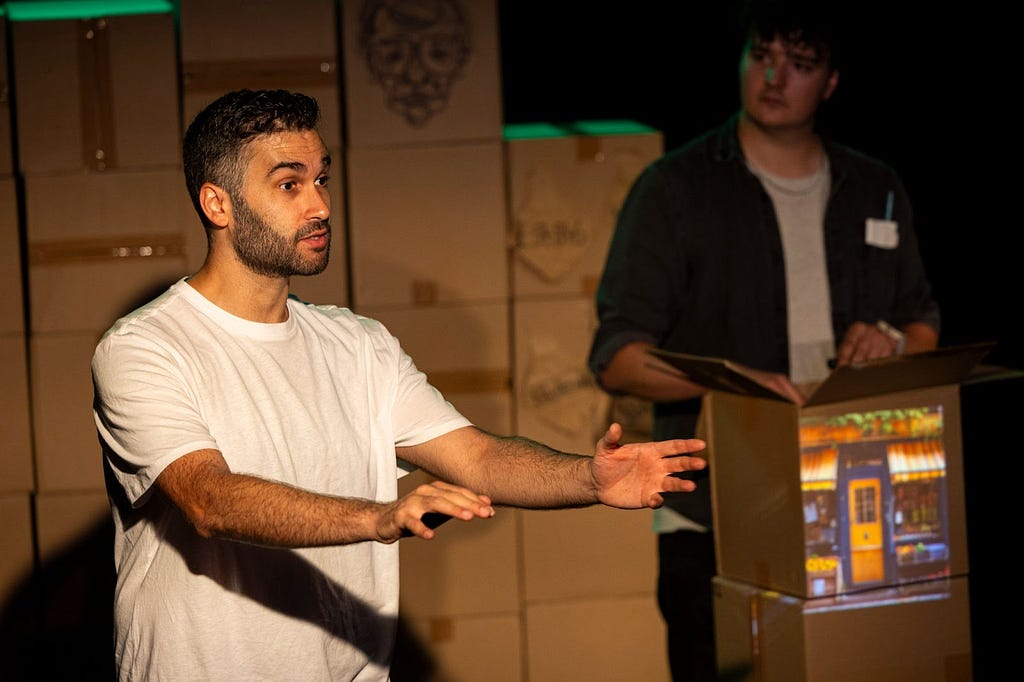
For me, inspiration generally falls into 3 categories: personal experience, the wider world and media (books, films, plays, games, documentaries). With my theatre shows, there’s often a blend of personal experience with something from the wider world and a visual motif or theatrical gesture. For example, with It’s The Economy, Stupid! it’s the story of my family going through a bankruptcy in the Early 90s Recession, combined with the politics and economics that led to this, using stage magic and projection mapping to bring that story alive.
With writing for animation for a younger audience, inspiration is more often memories from my own childhood or of being an uncle now, combined with an influence from the kinds of stories I loved as a kid. When I’m writing TV for grown-ups, it’s more about how a particular genre might tease out the feelings or themes of a particular experience, in a fresh and unique way.
How have you used your success to bring goodness to the world?
I feel very lucky to have made my living from jobs I really love, for some time now. It’s also true that, like most artists, I’m a freelancer in a precarious industry, earning below the median wage. Most people on low and middle incomes (in the UK, USA and around the world) are doing the best we can in the face of growing inequality and its impact on our economy and politics. No one can change the world on our own, but we all contribute in different ways. For me, it’s trying my best to entertain people, help make sense of the world or offer a shared space for catharsis and conversation.
What are your “5 things I wish someone told me when I first started” and why. Please share a story or example for each.
1 . Get some basic training on tax returns, funding applications and business studies. These things are more straightforward to learn the basics of than most people think. They’re often not taught in schools or higher education (they weren’t for me anyway!), but would have really helped, especially early on.
2 . It’s easier to stay ready then get ready. A sleep, food and exercise routine that works for you is better than a short-lived ‘health kick.’ Likewise, if you’re a writer, keeping some form of regular writing routine, regardless of the projects and deadlines on your plate, is generally more sustainable in the long run. I currently have It’s the Economy, Stupid! very fresh in my head, because we’re touring it, but I also have two previous shows mostly memorised, which just need a few hours of re-rehearsal to be ready again. Similarly, actors often have go-to monologues they can brush up on, at short notice, for auditions. If pitching is part of your job, short bursts of daily practice is probably better than one session of intense preparation.
3 . Start a project by working towards a minimum viable product. Sorry if that sounds very corporate, but I think it’s useful! In theatre we would call this ‘scratch’ — a 5-to-10-minute performance, which is sort of a microcosm of what you hope the finished thing might look like. I used to find it impossible to imagine how someone got from an idea to a finished project. Breaking it down into smaller chunks, with regular deadlines, means you’ll keep making progress, constantly refining and building as you go.
4 . Stay open to new skills and interests; nourish your existing ones. We’re encouraged to specialise throughout education, yet fewer people now have one career for life — most of us will switch, multiple times. Especially if you’re a freelancer, and/or running your own business, you’re way more likely to survive and progress if you have a diversity of skills, and are willing to go out of your comfort zone.
5 . “The ones that ‘make it’ are the ones who keep going.” Actually, someone did tell me that, but it’s easy to say and sometimes hard to remember! So I’m repeating it here in the hope it helps others: persistence often beats perfection.
You are a person of great influence. If you could inspire a movement that would bring the most amount of good to the most amount of people, what would that be?
Making theatre, on a smaller scale, as I have for most of my shows (usually for venues of between 60 and 150 people) mean you can be quite nimble — make work quickly, tour more easily, and have more direct conversations with audiences. You’re reaching a smaller number of people than in commercial theatre or TV and film, but you have a closer connection with your audience, and there’s more space for dialogue afterwards.
With It’s the Economy, Stupid for example, we’ve been really encouraged people from all ages and demographics have seen the show and said how much it resonates with them. We’re seeing a shift in public consciousness around wealth inequality and the social, political and economic cost of that. There are campaigners on this issue like Gary Stevenson, with bigger platforms. But movements, by definition, involve many people — especially if they are to achieve positive change. So I hope to play a part in that, however small.
We have been blessed that some of the biggest names in Business, VC funding, Sports, and Entertainment read this column. Is there a person in the world, or in the US whom you would love to have a private breakfast or lunch with, and why?
That’s a tough one…it would probably be Janelle Monáe. I think she’s a fascinating person and artist. I’d love to talk to her about her influences and creative process, and the way she combines art with activism.
What is the best way our readers can follow you on social media?
Instagram is probably the easiest way to follow me, either @joesellmanleava, or @worklighttheatre.
This was very inspiring. Thank you so much for joining us!
Joe Sellman Leava Of Worklight Theatre: 5 Things I Wish Someone Told Me When I First Became An… was originally published in Authority Magazine on Medium, where people are continuing the conversation by highlighting and responding to this story.