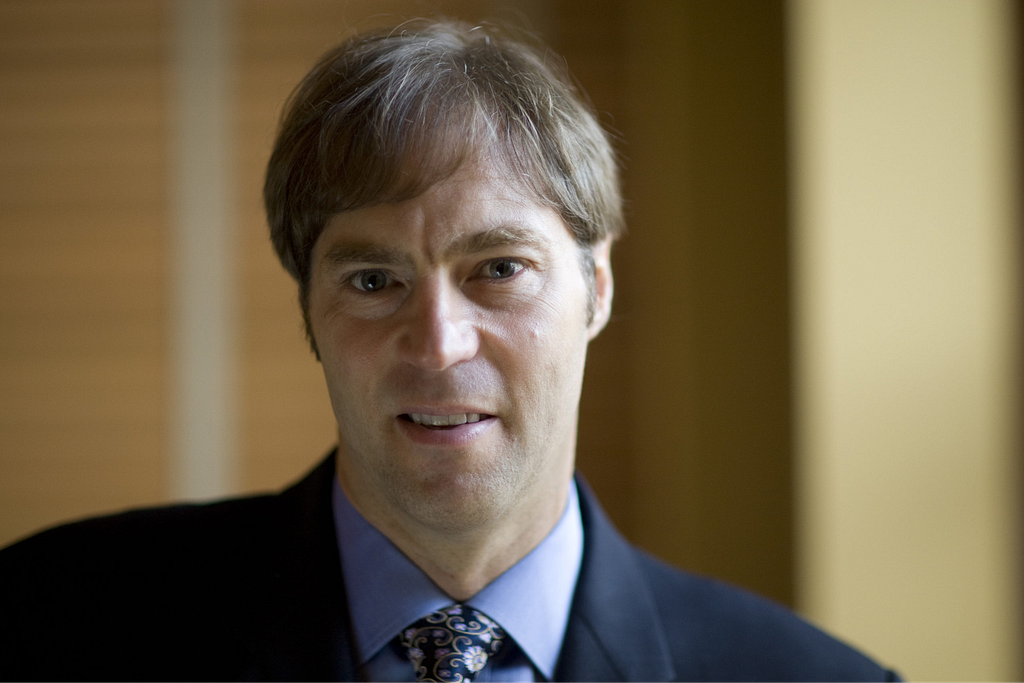
…There is a famous quote from Francis Bacon stating that a little philosophy inclines a man’s mind toward atheism, but depth in philosophy brings a man’s mind and heart back to God. We have lived through a period where a little philosophy turned a lot of people away from God. However, I think we are returning to a period where we are uncovering more layers and realizing that a deeper understanding comes from learning more about science. I believe that is turning men and women’s minds and hearts back to their Maker. My hope is that the work I do contributes to that…
I had the pleasure of talking with Stephen Meyer. Before he became the intellectual face of the intelligent design movement, Meyer was just a teenager in a leg cast, spiraling into a profound existential panic. Born in New York in 1958 but raised in the damp, evergreen sprawl of Seattle, Meyer was a self-described science nerd from the jump. “Apparently, as a 10-year-old, when other kids were having lemonade stands, I created a bug collection, labeled them with proper anatomical and Latin names, put little pins in them on a corkboard, and tried to charge 10 cents per admittance,” he told me, noting that his sister still mercilessly brings this up at holidays. “No one came.”
That childhood fascination with trilobites and triceratops eventually gave way to heavier, darker philosophical questions. At fourteen, sidelined by a skiing accident, he read a book his father gave him about baseball greats. Instead of being inspired, Meyer was struck by the ultimate futility of it all. The players amassed records, retired, enjoyed fleeting celebrity, and died. “What was left of his life? Some numbers on a piece of paper,” Meyer recalled. “I got this sinking feeling that the thing I most wanted to do had no lasting meaning or value.”
His mother, not a sports fan, suggested he become a doctor to do something genuinely meaningful. But Meyer’s hyperactive mind took that to its bleakest logical conclusion. Even if he saved lives, those patients would eventually die. In a hundred years, everyone is forgotten. “I was having these existentially despairing thoughts,” he admitted. He worried about time slipping away, moment by moment. The dread compounded until he suffered a full-blown panic attack. He feared the thoughts, and he feared the fear they caused. “I persisted in this state while in a leg cast, with my mind spinning for about six months.”
It took his younger, extroverted brother to drag him out of the house and back into the world. During this recovery, Meyer began reading the Bible, seeking answers to the void. A turning point came while reading the book of Exodus, when God reveals his name to Moses as “I Am that I Am.” For the young Meyer, it was a philosophical anchor. “I had this thought… that there must be something that doesn’t change, or else everything else that does change cannot possibly have any lasting or enduring meaning or value,” he said.
This realization didn’t hit him with a wave of religious euphoria. Instead, as he explained, “It caused me to psychologically settle and feel normal for the first time. It gave a grounding for my overactive, overthinking mind and a basis for sanity I hadn’t had before.”
That quest for a grounding reality defined his unusual career trajectory. He earned degrees in Earth Science and Physics from Whitworth College in 1981, spent a few years as a geophysicist for the Atlantic Richfield Company interpreting seismic surveys, and then crossed the ocean to Cambridge University. There, he earned his Ph.D. in the history and philosophy of science, examining how scientists infer past causes from present clues.
Today, Meyer directs the Center for Science and Culture at the Discovery Institute in Seattle. He is best known for a trio of books — Signature in the Cell, Darwin’s Doubt, and Return of the God Hypothesis — that argue complex biological and cosmological realities point to a designing intelligence rather than undirected material processes. It is a highly controversial stance in the mainstream scientific community, which largely operates on methodological materialism. Meyer himself notes that Wikipedia still describes him as a pseudoscientist. Yet, he points out that his arguments are finding an audience among disillusioned intellectuals and a public grappling with what he sees as a global crisis of meaning.
“The reason to believe in God is not simply that it provides us with personal meaning,” Meyer said, emphasizing that he believes the scientific evidence stands on its own merits. “However, the meaning question is still crucial… Unless there is a person whose existence precedes ours and whose life and existence can extend beyond ours, there is no possibility of ultimate meaning.”
He sees this search for an infinite reference point as a remedy for the modern loneliness epidemic, a time when society is marinated in social media yet fundamentally disconnected. For Meyer, a personal creator offers a cure to the cosmic alienation he once felt as a teenager. When asked about the current state of American culture, Meyer argues that the nation’s foundational principles are intrinsically linked to his philosophical conclusions. “Our system is grounded on the belief that there is a Creator who can be known by reason,” he explained, suggesting that reaffirming this worldview strengthens the country’s social fabric and its conviction in universal human rights.
He is currently promoting a new documentary, The Story of Everything, which explores the personal and scientific journeys of major thinkers who have grappled with the implications of an ordered universe. The film deliberately avoids a preachy narrator, instead using the scientists’ own words to build dramatic tension. Meyer hopes the project will tap into a shifting cultural tide.
“We are seeing a renewal of interest in the God question in very unexpected places,” he observed, pointing out that the percentage of religiously unaffiliated youth has recently dipped after decades of steady growth. He believes society is beginning to recognize the cost of its lost philosophical foundations.
Meyer views his life’s work as an attempt to bridge the gap between empirical observation and ultimate purpose. Quoting the philosopher Francis Bacon, he noted that while a little philosophy might incline a mind toward atheism, depth in philosophy brings it back. “My hope,” he said, “is that the work I do contributes to that.”
The film’s website is HERE and hits theaters on April 30.
Yitzi: Dr. Meyer, it is such an honor to meet you. Before we dive deep to talk about your work and the film, we would love to learn about your personal origin story. Can you share with us the story of your childhood, how you grew up, and the seeds and genesis for all the amazing work that has come since then?
Stephen Meyer: Thank you, Yitzi. That is a very nice question to start with. I was born in New York, but my parents moved to Seattle when I was an infant or toddler, maybe 18 months old, and I grew up in the Seattle area. I was always very interested in science. I was one of those kids absolutely fascinated with dinosaurs, prehistoric life, trilobites, and triceratops. My sister tells stories at holiday times about how nerdy her brother was. Apparently, as a 10-year-old, when other kids were having lemonade stands, I created a bug collection, labeled them with proper anatomical and Latin names, put little pins in them on a corkboard, and tried to charge 10 cents per admittance. No one came. She laughs and tells this story every year to illustrate what a nerd her brother was.
I was interested in science, but in my teen years, I began to have philosophical questions entering my mind. They ultimately scared me because I didn’t know where they were coming from or how to answer them. I had a question you might get if you read the book of Ecclesiastes: What will it matter in a hundred years? What has lasting meaning or value? Much of my life involved the routine of going to school, attending activities, doing homework, and getting up to do it all over again. I broke my leg when I was 14 in a skiing accident. My father gave me a book about the greats of baseball and the whole history of the sport, which I loved. But all the stories seemed the same: a talented young athlete would get scouted, come up to the major leagues, amass records, perhaps win a World Series or an All-Star game, or become an all-time leader in home runs or batting average. Then, the baseball player would retire, enjoy celebrity for a while, and die. What was left of his life? Some numbers on a piece of paper. I got this sinking feeling that the thing I most wanted to do had no lasting meaning or value. I talked to my mother about this. She hated sports and thought grown men were wasting their lives chasing a ball around. Her explanation was that, of course, I felt it was worthless because it is worthless; it is just playing a sport. She said I should be a surgeon or a doctor and do something meaningful. Then I got to thinking, what if I am a doctor? I will save some people’s lives, but then I will die, and they will eventually die. No graves go unvisited. Eventually, in a hundred or two hundred years, people will forget us all, and those people will eventually die. I was having these existentially despairing thoughts. I worried about the reliability of my mind, wondering if I was truly knowing the world the way it actually was. I was really freaked out when I thought about time, because one moment I could remember something happening and think back on it, but that moment was already gone. Where did it go? You get the picture; I was spinning.
One day, I had the thought that maybe this is what it means to be insane. Then, I had a surge of adrenaline and a panic attack about it. After that, every time these thoughts came into my mind, I would fear the thoughts and fear the fear that came from them. I was an absolute mess. I persisted in this state while in a leg cast, with my mind spinning for about six months. I have a wonderful younger brother who is my alter ego. He was popular at school, blond, funny, and is now an entrepreneur, whereas I am a philosopher and a scientist. He pulled me out of this by getting me out to do things with him and other kids. Eventually, I started reading the Bible and found that many of my questions were tacitly or explicitly addressed in the biblical worldview, both in the Hebrew Bible and the New Testament, which I was reading because we were a nominally Catholic family. For example, regarding my worry about time, one day I came across Exodus 3. Moses is at the bush, asking God what he should say when he gets to Pharaoh. God says, “Tell them that I Am that I Am sent you.” I thought that was amazing.
I had this thought, Rabbi, that there must be something that doesn’t change, or else everything else that does change cannot possibly have any lasting or enduring meaning or value. That God would reveal his personal name as a reflection of his character, as an eternal, self-existent person, was exactly what I sensed must exist. The biblical text began to speak deeply to these problematic and disturbing thoughts. When I got to college, I had a wonderful professor who understood these things. I remember coming across a paraphrase of the work of Jean-Paul Sartre, the famous atheistic existentialist philosopher, where he said, “Without an infinite reference point, nothing finite has any lasting or enduring meaning.” I realized that is what had been bothering me. I rushed to the front of the class afterwards, talked to the professor, and said, “I wasn’t insane; I was just a philosopher!” He chuckled and said, “That’s right, but there’s a fine line between philosophy and insanity, so you have to be careful.” Coming to belief in God didn’t give me the euphoric feeling many people have during a religious conversion, but it caused me to psychologically settle and feel normal for the first time. It gave a grounding for my overactive, overthinking mind and a basis for sanity I hadn’t had before. That is my story. I finally settled in faith about my first year out of university. Soon after that, I encountered scientists finding not only philosophical reasons to believe but scientific ones, which fascinated me anew.
Yitzi: Please tell us about this new film and explain why, in your unbiased opinion (laughs), our readers have to watch it.
Stephen Meyer: In my unbiased opinion, I think the producers did a fabulous job of converting the story of three great scientific discoveries, each of which has caused leading scientists to reconsider the God question or reaffirm theistic belief — belief in a transcendent, intelligent, active creator of the kind that Jews and Christians have long affirmed. It is a fascinating story of scientific discovery and personal investigation into the deepest questions. We look at the story of Einstein, the story of Allan Sandage, a great cosmologist who changed his whole worldview in response to the discovery that the universe had a beginning, and Sir Fred Hoyle, the great British astrophysicist and biologist, who was on the same trajectory. What filmmakers can do that you cannot do in a book is bring things to life visually. They also used a very creative storytelling device. Rather than having a host take you on a journey, which is an overused shtick in documentary filmmaking, or even having a narrator, they let the scientists and philosophers tell the story in their own words. They intercut their testimony to create a sense of pacing and build dramatic tension in the story. If your viewers have seen the film “The Big Short” about the financial crisis, those producers used the same device. I think it came out very well. It is very watchable and doesn’t have that cringe factor you sometimes feel when watching films trying to convey a religious point of view. It doesn’t come off as a sermon or a lecture. It is a compelling story brought to life by visuals. You are learning the science as you go, but you also get to immerse yourself in the mindset of the scientists wrestling with these great discoveries.
Yitzi: We are living in a time, 2026, where I think there is an existential global crisis for meaning. People are thirsting for meaning and grasping at straws in the most obscure, arcane movements. Why do you think this film is more pertinent, relevant, and urgent now than ever before?
Stephen Meyer: For the very reason you stated. The reason to believe in God is not simply that it provides us with personal meaning; that is a consequence of belief that I think is very important. That is one of the reasons the question matters. The evidence for God is separate from that; it comes from cosmology, physics, and biology. There are many good philosophical arguments for the existence and reality of God. However, the meaning question is still crucial. There is a woman in the UK, Ayaan Hirsi Ali, who was a longtime sidekick of Richard Dawkins and part of the New Atheist movement. She eventually concluded that scientific materialism, or the scientific atheist view, is a failed philosophy because it cannot answer that fundamental human question. In the last chapter of my book, I discuss Viktor Frankl, his famous book “Man’s Search for Meaning,” and how fundamental that concept is. I have often said that nothing can mean anything to a rock, a planet, an atom, or even a DNA molecule. Things only mean things to persons. Yet, we all die. Unless there is a person whose existence precedes ours and whose life and existence can extend beyond ours, there is no possibility of ultimate meaning. There is no way of answering that question from Sartre about the need for an infinite reference point. But if there is an infinite reference point, and that infinite reference point is a person who wants to know us, then that puts the question of meaning back on the table. The God question arises because of scientific and philosophical investigation, but it is also personally important to all of us because we have basically two choices. If we deny the existence of God, we affirm a worldview that denies the possibility of ultimate, personal meaning. The converse is also true: if we affirm the existence of God, the question of personal meaning is very much alive, and there is hope for what lies beyond the grave.
Yitzi: In your most aspirational hope, what do you hope the message of this film can accomplish? What is your furthest hope for what this can achieve?
Stephen Meyer: We are seeing a renewal of interest in the God question in very unexpected places. It is bubbling up to the surface of culture in figures in the UK like Ayaan Hirsi Ali or Tom Holland, the historian, or in this country with someone like Larry Sanger. On Wikipedia today, I am still described as a pseudoscientist because I challenge the principle of methodological materialism. Yet, the founder of Wikipedia, Larry Sanger, has had a profound Christian conversion. He gives a shoutout to my work and the work of other proponents advancing the theory of intelligent design. He said it was a factor in his coming to believe in God. This is an interesting reversal. There are many other figures, such as the social scientist Charles Murray, who wrote “Taking Religion Seriously.” I was on the Joe Rogan podcast, and Joe is considering these questions. The comic Jim Carrey and the talk show host Russell Brand are also exploring this. Intellectuals and people in the public eye whom you would never have thought are reconsidering the God question. I think something is shifting, and the data is interesting as well. I just saw the other day that for three years in a row, the group of young people pollsters call the “nones” — the religiously unaffiliated — has diminished. There are fewer and fewer of those individuals. For almost 20 years, that population was rising. Something is shifting, and we hope the film will foment that cultural trend and open hearts and minds across the country to the reality of God. The Hebrew Bible says the fear of the Lord is the beginning of wisdom. I think a lot of people sense that we have lost some very obvious wisdom as the wheels come off the culture. That is making people wonder if we need to rethink the fundamental question about whether or not God is real.
Yitzi: Pivoting to that very point, as you mentioned, the West broadly has this malaise and lack of confidence, and it is sadly eroding. How would you articulate why America would be much stronger if more Americans embraced Christianity?
Stephen Meyer: We hold these truths to be self-evident, that all men are created equal and endowed by their Creator with certain unalienable rights. This statement from the Declaration of Independence, which we are celebrating this year for the 250th anniversary of the country, is the basis of our belief in universal human dignity and equality. Derivative from that premise is our notion of human rights. Our system is grounded on the belief that there is a Creator who can be known by reason, which is self-evident in the sense that the evidence of the natural world attests powerfully to the existence of such a being. By reaffirming that belief and understanding that the most cutting-edge scientific evidence supports it, we strengthen both the epistemological foundation for belief in God and our conviction and confidence in our founding principles.
Yitzi: A related crisis that society faces is the loneliness crisis. People are disconnected, and their brains are marinated 20 hours a day on social media. How do you suggest your idea can address this problem?
Stephen Meyer: I think the most fundamental remedy for loneliness starts with a relationship with God. When you sense His presence in your life, you have someone who will never leave you or forsake you. Even other human beings will leave, forsake, betray, or let you down; we are all fallible. Knowing that God is with you is a tremendous remedy for that sense of cosmic alienation that I probably melodramatically indulged as a teenager. It also reaffirms the importance of personhood. The God of the Hebrew Bible and the New Testament is a personal God who made us in His image as persons. It is fine to communicate with others through our devices, but it is also vital to connect on an even more personal level. Getting back to our Judeo-Christian heritage will strengthen people’s faith, give them more wisdom about their life choices, and encourage them to be part of religious communities and families rooted in these values, where the greatest happiness on this planet can be found.
Yitzi: Just to support that point, the word for commandment, Mitzvah, has the same root as the word Tzavsa, which means to connect. The idea is that the commandment isn’t just an order, but a way to connect to the Almighty, our source, and ultimately to connect deeper to each other, and to our true selves.
Stephen Meyer: That is a nugget I will remember. That is wonderful, Rabbi. I didn’t know that the Hebrew word Mitzvah, meaning commandment, shares a root with Tzavta, meaning to connect. He commands us, but in obeying the command, we connect with Him, with others, and to our true selves. That contains a lot of richness.
Yitzi: Amazing. This is how we end all of our interviews. Because of your amazing work and the platform you have built, Dr. Meyer, you are a person of enormous influence. If you could spread an idea or inspire a movement that would bring the most amount of good to the most amount of people, what would that be? You never know what your idea can spread.
Stephen Meyer: Thank you for the compliment and the encouragement. I don’t know that it is the absolute most important thing, but it is the work to which I clearly felt called. That is to show that the deliverances of science — what we have learned about the most important scientific questions regarding where the universe came from and how it is beautifully structured to allow for life — point back to God. The cutting-edge evidence we find in living systems does not point away from God.
There is a famous quote from Francis Bacon stating that a little philosophy inclines a man’s mind toward atheism, but depth in philosophy brings a man’s mind and heart back to God. We have lived through a period where a little philosophy turned a lot of people away from God. However, I think we are returning to a period where we are uncovering more layers and realizing that a deeper understanding comes from learning more about science. I believe that is turning men and women’s minds and hearts back to their Maker. My hope is that the work I do contributes to that.
Yitzi: Dr. Meyer, how can our readers watch the film? How can they read and engage with your other works, and how can they support your work?
Stephen Meyer: Thank you very much. As we were just discussing, there will be a premiere of the film next Monday night, May 4th, in Washington, D.C., at the Museum of the Bible. You can get tickets for the film at the website thestoryofeverything.film. My own website is returnofthegodhypothesis.com. If you visit thestoryofeverything.film, you will find a lot of other information, including a whole network of reputable scientists arguing this new perspective.
Yitzi: Dr. Meyer, it is truly an honor to meet you. I wish you continued success, good health, and blessings. I hope we can do this again soon.
Stephen Meyer: And to you too. I hope we get a chance to meet in person. It has been a real pleasure talking with you.
Stephen Meyer on Intelligent Design, Faith and America’s Crisis of Meaning: “Something Is Shifting” was originally published in Authority Magazine on Medium, where people are continuing the conversation by highlighting and responding to this story.