The second thing I would encourage organizations to do — speaking primarily from the B2B side — is to recognize the significant impact that AI is going to have on their businesses. I would encourage every organization to take a deep look into the opportunity of becoming a hybrid model. Eventually, their traditional model is going to be usurped by many of the capabilities in AI. I think it’s going to come faster and be more explosive than most of us realize in the coming two to three years. Embracing the bandwagon would be second on my list.
I had the pleasure of talking with Pete Winters. Pete grew up in Forest Hills, Queens, the youngest of 11 children in a household shaped by the presence of many older siblings and attentive parents. Born into a large family, Winters has often said that his earliest education came less from formal instruction and more from observation. Surrounded by adults and near-adults from a young age, he developed a habit of listening closely and watching how people behaved, communicated, and solved problems. Looking back, he has described those years as a blend of nature and nurture, where his natural curiosity was reinforced by constant exposure to adult conversations and responsibilities.
His childhood included summers in Lake George, New York, an experience that added a different rhythm to his upbringing and left a lasting impression. Winters has described those years as formative, offering both freedom and perspective. He later realized that by the time he was 12, he had already absorbed a wide range of life experiences that many people encounter much later. That early awareness of people, patterns, and context would become central to his professional life.
In his early 20s, Winters married and started a family. He has two children, one living in Brooklyn, New York, and the other in Boston, Massachusetts. Today, he lives in Warwick, New York, about 70 miles north of New York City, where he continues his consulting and coaching work.
Winters began his career in the printing industry, running a successful small printing business with offices in Midtown Manhattan. By the late 1990s, he recognized that the industry was changing quickly as digital technologies reshaped how companies produced and distributed printed material. Rather than resist that shift, he pivoted into consulting, working with printing companies to help them rethink their business models before becoming obsolete.
That transition brought him into contact with major technology and manufacturing firms moving into digital printing, including Xerox, Kodak, Hewlett-Packard, Canon, and Océ. As he advised companies navigating disruption, Winters found himself drawn increasingly to the broader questions of strategy, communication, and leadership that extended beyond printing alone. Consulting became less about machinery and more about how organizations adapt, tell their story, and connect with the people they serve.
During that period, Winters became aware of Jeffrey Hayzlett, then a senior executive at Kodak and later the founder of C-Suite Network. Although their paths crossed indirectly at first, Winters followed Hayzlett’s career and the growth of the C-Suite Network, a membership organization for senior executives and business owners. Years later, those parallel tracks converged. Winters initially joined the network as a member and later became more deeply involved during the Covid-19 pandemic. He now serves as Vice President of Professional Services, working as a marketing strategist and coach for executives looking to scale their organizations.
Much of Winters’ work centers on helping leaders think clearly about growth, systems, and trust. He has spoken often about the changing nature of customer acquisition and the growing role of artificial intelligence in business. He encourages companies to rethink old playbooks, clarify their value propositions, and systematize what they do rather than relying solely on individual effort. He has also emphasized the importance of community, especially as digital tools become more pervasive and personal connection harder to sustain.
Alongside his corporate work, Winters has maintained a long-standing interest in the nonprofit sector. Years ago, while advising nonprofit organizations, he developed a concept he calls “Changing the Author.” The idea centers on shifting how nonprofits communicate, moving the focus away from the organization itself and toward the voices of the people it serves. He argues that stories told by beneficiaries are often more powerful and more authentic, and that they resonate deeply with both donors and the broader public.
That work led him into public speaking and teaching. At one point, Winters presented his ideas at Princeton University, where he was invited back to teach a course in the same classroom once used by Albert Einstein. He has described that experience as a meaningful milestone, not for its symbolism alone, but because it affirmed the relevance of his ideas across sectors.
Winters sees a growing opportunity for collaboration between corporations and nonprofits. He believes nonprofits excel at creating moments of human connection and meaning, while corporations are increasingly searching for ways to build trust and purpose into their brands. In his view, partnerships that respect both sides can lead to deeper impact and more sustainable support.
Throughout his career, Winters has returned repeatedly to the idea of impact. He speaks about influence not only in terms of business outcomes, but also in everyday roles, as a parent, a coach, and a mentor. He recalls learning early in life the idea that privilege carries responsibility, a lesson he traces back to his school years in Queens. That belief continues to guide his work.
A year ago, after spending time at the New York Stock Exchange, Winters reflected on how trust and community are becoming central economic forces. As technology accelerates change, he argues, organizations that foster real human connection will be better positioned to endure.
For Winters, the through line from Forest Hills to the C-Suite is observation, curiosity, and a belief in paying forward what one has been given. His career has moved across industries and roles, but it has remained anchored in a consistent question: how people and organizations grow, adapt, and make meaning in a changing world.
Yitzi: Pete Winters, it is such a delight to see you again. Before we dive in deep, our readers would love to learn about Pete Winters’ personal origin story. Can you share with us the story of your childhood, how you grew up, and the seeds for all the amazing work that has come since then?
Pete Winters: I’d be happy to share it. I grew up in Forest Hills, Queens. I was the youngest of 11 kids, and I realized later in life, in my 20s and 30s, that I had a lot of world experiences when I was 7 to 12 years of age. Much more so than other kids my age because of all the older brothers and sisters that I have. I remember thinking to myself, I probably grew up part nature, part nurture. I had a proclivity for observation, and then I had the experience of observation. My early formative years were shaped by a lot of elders around my house — older brothers, sisters, and parents — and I lived a fantastic life as a child. That experience of observation has carried through to where I am in the older years of my life now, in the kind of coaching that I do.
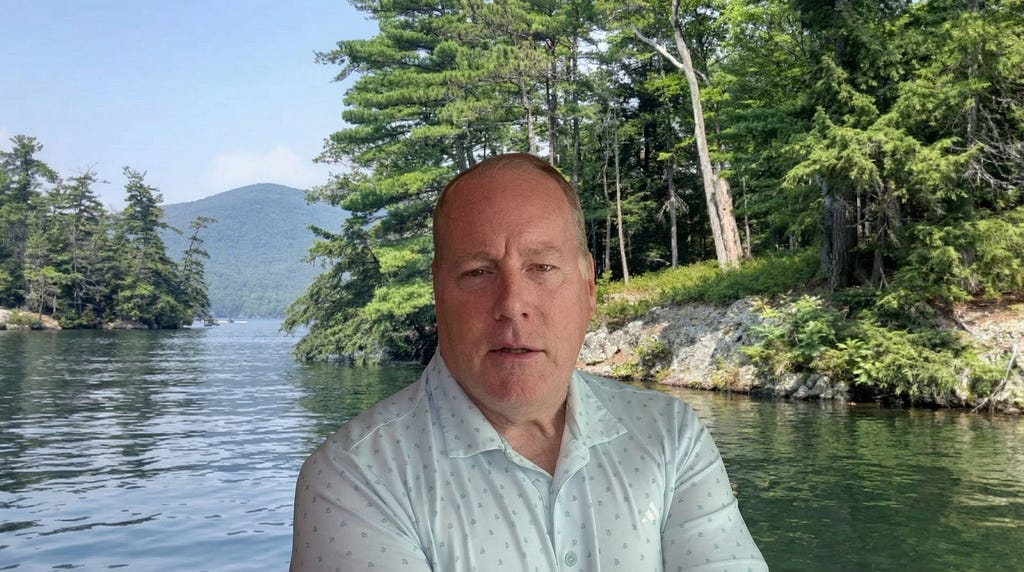
In my early 20s, I got married and had two children. One of them is living in Brooklyn, New York, and the other is living in Boston, Massachusetts. I’m here in beautiful Warwick, New York, which is about 70 miles north of New York City, not too far from West Point. I grew up in a beautiful area of the Adirondacks in the summertime in Lake George, New York. In fact, you can see on my screen in the background, that’s an image of Lake George there. So, I’ve had a lot of wonderful life experiences.
In my present day, I do a lot of business coaching. I am a marketing strategist for the C-Suite Network, which is a business member organization of primarily business owners and senior executives of mid- and large-sized corporations. I have the wonderful experience of working with those members that are in a position to scale their business. A lot of what I bring to the table is my passion for coaching, strategy, and implementation services. It’s just a really pleasurable experience to help other businesses grow.
Yitzi: Amazing. Tell us the story of how you got involved with the C-Suite Network.
Pete Winters: I was in the printing industry in New York City. I had offices in Midtown Manhattan and ran a very nice, successful small printing practice. I realized in the late 90s that the printing industry was slowly going away, so I began a career in consulting to the printing industry along the lines of, “Hey, wake up, you’ve got to remodel your business or you’re going to become extinct.” In that arena of coaching those businesses, I started to get involved with some big players in the market that were moving into digital printing, including Xerox, Kodak, Hewlett Packard, Canon, and Océ. Those organizations were all moving into the space of providing digital printing devices to printers.
Along that journey, there was a gentleman who was the Chief Marketing Officer of Kodak at the time, Jeffrey Hayzlett. I became aware of people in the space, and as I morphed into other areas of business consulting, I was aware of this mythical figure, Jeffrey Hayzlett, who ran a very successful business network called the C-Suite Network. I always tracked his career. Not coincidentally, our paths crossed over the years, and I became involved in the C-Suite Network first as a member. Then, when COVID hit, I actually became a part of the inner circle of C-Suite. Today, I’m the Vice President of Professional Services at C-Suite Network. It was a little bit by coincidence — and you know how coincidence works, a serendipity in life — tracking great people and choosing to be around those people manifested the position that I’m in today.
Yitzi: You probably have some amazing stories from your career. Maybe this is hard to single out, but can you share with our readers one or two stories that most stand out in your mind from your professional life?
Pete Winters: I’ll share two stories. One is, as I was morphing from coaching the printing industry, I started to move towards coaching the nonprofit industry. One of the things that I coined during that time was this notion of “Changing the Author.” Changing the author has to do with the dialect that a nonprofit organization uses. Instead of them speaking about themselves, get the beneficiaries — the recipients of the services — more involved in the conversation. “Changing the Author” was a theme that I started to do a lot of public speaking on.
In my printing career, I had the chance to speak on live stages in front of as many as 250 people, translated into five different languages across four continents at the same time. I really had a passion for public speaking. That lent itself very easily into the nonprofit community. One of the cool things that happened in my career is I ended up presenting on “Changing the Author” in the nonprofit space at Princeton University. They liked what I did so much that they invited me back the following year. I ended up in classroom 111, which was Einstein’s classroom. I actually presented a course at Princeton University in Einstein’s classroom, which I thought was pretty neat.
The second story I’ll share with you, Yitzi, relates to impact. I wouldn’t pick any one specific thing other than to say I recognize the impact I have on my children, the people around me, coaching in Little League, and in my business life. It is the impact I have in my career on guiding, counseling, encouraging, and being part of people’s evolution and growth patterns. For me, impact has been a big part of my life.
I remember growing up — you would know the phrase better than I do, but I’ll paraphrase — “To whom much is given, much is expected.” That came to me when I was in fifth grade going to Catholic school in Forest Hills. I just remember thinking to myself, “Boy, I’ve been bestowed with a lot of gifts, and it’s incumbent on me to pay it forward.” Impact for me is the other thing, and rather than something specific, it’s just a pervasive part of my life.
Yitzi: You brought up nonprofits. My intuition would be that your expertise would be primarily in for-profit. I’d love to hear more about your work with the nonprofit world.
Pete Winters: You’re correct. 99% of the work that I do in C-Suite is business-to-business, with a little bit of business-to-consumer. One of my passions that remains with me — and I’ll do this before I call it quits in my career — is taking what I intuitively understood in the nonprofit space 10 or 15 years ago and marrying it to the business work I do in the corporate world today.
I have the opportunity to work with many nonprofits and speak with founders and development officers, and I realized there’s a big disconnect between where nonprofits perceive themselves in the business world and what enterprise-level corporations are trying to achieve.
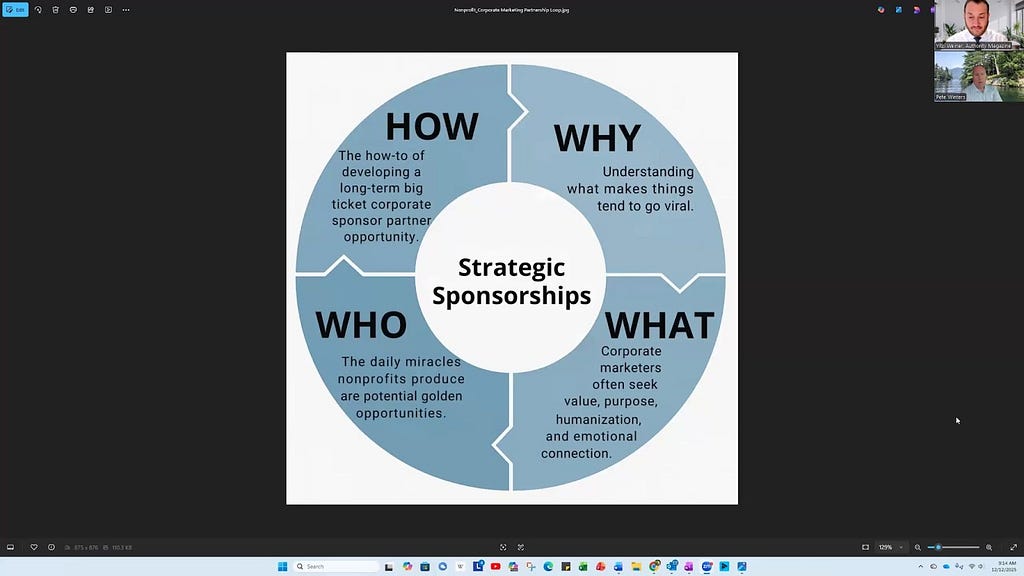
Very specifically, enterprise-level organizations are trying to make a connection. They’re trying to build trust and rapport with their customer and prospect base. What I discovered along my journey was that in the nonprofit world — specifically in the social media space — there were things that tended to go viral.
I’ll use the story of a school in the Dallas, Texas area. It was an impoverished area with a public school system that ran a “Breakfast with Dads” program once a month. The school administrators noticed that over the course of months, a good percentage of children — maybe 20% or 25% — would go to “Breakfast with Dads” every single month and never had a dad go with them. Long story short, the school called for volunteer dads to participate, looking for 25 dads. The auditorium that day was filled with about 250 dads who showed up to fill those 25 positions.
When you see that type of thing happen, very often in the world of media, things that tug at our heartstrings, compel us, appeal to our humanity, or make us feel part of a tribe tend to go viral. Even things that are humorous. If you look at the Ice Bucket Challenge from the ALS organization, they benefited hundreds of millions of dollars as a result. Or look at the continuing passion through Giving Tuesday. These are the types of things that tend to go viral.
Corporations are looking for ways to connect with their audience. They’re looking for ways to build rapport, deliver purpose, and bring humanization and storytelling into their space. They will spend billions of dollars a year trying to deliver that level of establishment — like the Budweiser commercials during the Super Bowl or Pepsi commercials at Christmastime.
Now, look at what nonprofits are in the space of. If you think about what nonprofits do on a day-in, day-out basis, they deliver miracles. Think about food insecurity for children in schools who suffer from not having enough nutrition; they don’t sleep well, don’t do well in grades, or may look like they have attention deficit disorder. Then, all of a sudden, a food pantry or food service comes into their life. Imagine the gratitude of the parents on the receiving end of that child who is now becoming a first-generation college candidate in their family history. Or imagine a child who is part of a Children’s Specialized Hospital initiative. Those day-in, day-out miracles are the stuff of genius as far as corporate marketing is concerned.
This gets us to the “How.” There is a huge opportunity for corporations that are looking for connection to leverage what nonprofits do to produce these types of miracles. I would call that the “How,” and it relates to “Changing the Author.” When a nonprofit can figure out the formula of what it takes to change the author, they now have a value proposition to bring to the marketplace and corporate marketers.
I’ll use this last story as an example. A good friend of mine, Dr. Scott Peck, is a curator of a Biblical Arts Museum in Dallas, Texas. He put together an amazing museum of the Old Testament, New Testament, and a Holocaust Museum. He took me through the Holocaust Museum on a virtual tour on his mobile phone via Zoom. I was blown away by the Holocaust Museum, which featured long, dangling curtains hanging from the ceiling with images of children on them.
I asked him at the end of the tour, “What do people feel when they come through the museum?” He gave me the arts answer — he mentioned the artists and the exhibits. I asked him again, “Tell me what they feel when they come through the museum.” He responded a second time, “Oh, I get it. People feel reconnected to their values when they come through my museum. People feel lost love and reconnection.” I said to myself, “That is exactly the type of thing corporate marketers are looking for.”
The opportunity for this corporate sponsorship or partnership is vast if nonprofits are courageous enough to understand that “Changing the Author” requires a new set of modalities. It requires a new way of approaching a corporation — not for the corporate giving department and not for a handout, but really a conversation at an enterprise level with a Chief Marketing Officer on what a multi-year partnership looks like. When that type of conversation occurs, you’re talking about millions of dollars as opposed to tens of thousands of dollars in sponsorships.
Yitzi: Let’s move to the centerpiece of our interview, our “Five Things” question. You’ve been blessed with a lot of experience and learned a lot from your successes. Based on what you’ve seen, can you share the five most important things a business needs to scale, grow, and eventually exit lucratively?
Pete Winters: It’s a large question, but yes, I can. I’m going to come at it from my area of expertise, which is marketing.
First and foremost, businesses should recognize that how they go about customer acquisition today is different than the experiences of past decades. Customer acquisition today is very different, so it really requires throwing out the playbook and understanding there’s a new method of going to the marketplace.
The second thing I would encourage organizations to do — speaking primarily from the B2B side — is to recognize the significant impact that AI is going to have on their businesses. I would encourage every organization to take a deep look into the opportunity of becoming a hybrid model. Eventually, their traditional model is going to be usurped by many of the capabilities in AI. I think it’s going to come faster and be more explosive than most of us realize in the coming two to three years. Embracing the bandwagon would be second on my list.
The third thing is: Do they really understand their value propositions? Why do those value propositions matter to the prospect base they’re going after? Is it still relevant?
The fourth thing is: Are they doing anything to systematize what they do in terms of growing their business? If it’s strictly a human resources play and just putting human energy into the space, it’s not going to get them where they need to go. Systematizing their approaches is very important.
The fifth thing is what I learned at the New York Stock Exchange a year ago. Ironically, it’s what the C-Suite Network brings to the table. The New York Stock Exchange has a $40 trillion market cap amongst its members, so they’ve got a good pulse on the business world. They talked about the value of trust and the need for community. As digital becomes more pervasive and AI takes over more components of the business world, trust is going to become increasingly important, and community will start to dissipate. It’s like the frog in the pot of boiling water. For individuals to be part of communities, start communities, or be the center of a community going forward is crucial to their business growth.
Yitzi: This is our aspirational question. Pete, because of your amazing work and the platform that you’ve built, you are a person of enormous influence. If you could share and spread an idea or inspire a movement that would bring the most amount of good to the most amount of people, what would that be?
Pete Winters: It would 100% be for anybody in the nonprofit community to think about and dwell upon what it means to “Change the Author.” That would have the biggest impact on humanity. Allowing the beneficiaries of the services that nonprofits deliver to have more of a voice will attract the attention of many people to get involved or participate in some meaningful way. “Change the Author” — that’s a no-brainer for me regarding the biggest impact that needs to occur.
Yitzi: That’s amazing. How can our readers get involved with the C-Suite Network? What’s the first step?
Pete Winters: Two things. Number one, the website is c-suitenetwork.com. Go and check it out. If you click on the events page, you will see an opportunity to register for “Friday Night Celebrates” or “Scotch Sunday.” For Scotch, we say bring water to whiskey; it doesn’t matter. But on Friday nights, we do what used to be the old-school pub crawl in a virtual world. It’s a very easy way for guests to come in, kick the tires, and see the passion, intelligence, and collective wisdom in the room. Scotch Sundays is an intimate version of the same on Sunday nights.
Yitzi: Are these virtual events?
Pete Winters: They’re virtual and open to the public. We say if you come two or three times, then it’s your time to bring a hot dish. But you’re welcome to come as our guest and check it out.
Yitzi: Okay, amazing. Pete, thanks so much for this conversation. I wish you continued success and good health, and I hope we can do this again soon.
Pete Winters: Yitzi, it’s always a pleasure to talk with you. Thank you so much.
Pete Winters on C-Suite Network, Strategic Consulting and the Future of AI in Business was originally published in Authority Magazine on Medium, where people are continuing the conversation by highlighting and responding to this story.