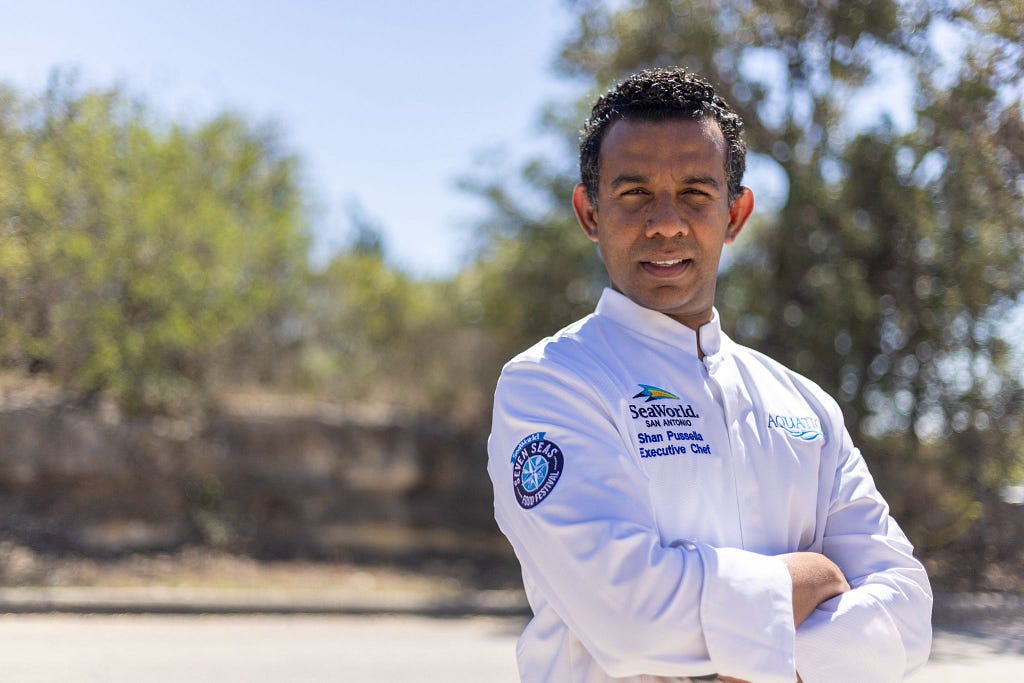
SeaWorld Chef Shan Pussella on Bringing Camel Burgers, Sri Lankan Curry and Global Cuisine to Texas Theme Parks
…For me, the best advice for a chef in the kitchen is not to watch the clock. If you only work for the hours on your shift, you will never reach a high position because you will miss out on so many learning opportunities. My message to anyone who truly wants to be a chef is this: do not count your hours…
I had the pleasure of talking with Shan Pussella. Chef Shan is a certified Continental Judge for Worldchefs representing the United States of America and is officially listed in the Worldchefs Approved Judges Directory. He holds multiple active Worldchefs judging certifications, including Vegan Continental Judge and Culinary Arts & Hot Kitchen Continental Judge certifications. Drawing from his international culinary background, years of experience working alongside Michelin-star chefs, and global judging expertise, he has completely revamped the park’s culinary program by introducing diverse international flavors and elevated dining experiences throughout SeaWorld San Antonio.
If you walk into a typical American theme park, your senses are usually assaulted by the familiar, heavy scent of deep-fried potatoes and standard-issue hot dogs. But walking through the gates of SeaWorld San Antonio these days offers a completely different aromatic experience. Instead of basic fast food, you are hit with the rich scent of smoked barbecue, Moroccan spices, and authentic curries. The man responsible for this culinary shift is Shan Pussella, an internationally recognized executive chef who is quietly bringing global gastronomy to a place usually known exclusively for roller coasters.
Pussella’s journey to the helm of a massive Texas entertainment park is anything but traditional. Originally from Colombo, Sri Lanka, he grew up in a strict military family. He initially assumed he would follow in those rigid footsteps, but the chaotic, high-adrenaline environment of professional kitchens pulled him in an entirely different direction. “First, I worked as a waiter, and then I saw that the kitchens were really fun and full of action,” he recalled. Abandoning the idea of college, he threw himself directly into the fire. “I joined the kitchen in 1994 at a small fine-dining restaurant in Colombo, Sri Lanka, called Don Stanley’s. I joined them when I was 17 years old. From there, I started my career.”
That youthful eagerness to learn came with some literal burns. Pussella shared a story from those early days at Don Stanley’s that still makes him wince. As a young commis chef, he was strictly forbidden from cooking on the main range. But when the kitchen was slammed and the head chef briefly stepped out, he jumped at the chance to help. Handed a batch of frozen seafood to fry, the inexperienced teenager skipped a crucial step. “I fried the prawns with the ice still on them,” he said. “The hot oil splashed right into my face. It was a bad experience, and my sous chef was furious.” It was a hard, painful lesson in patience, but the mistake did not extinguish his drive.
His relentless ambition soon pushed him to the Taj Hotel in Colombo, where he cooked for visiting international cricket teams, and eventually to Bahrain. At just 19 years old, he became the youngest chef at a fine-dining establishment called Mezzaluna. This served as his brutal introduction to the grueling world of Michelin-star kitchens. “It was really hard; they never gave you any chances,” Pussella said. “I made small mistakes, and they were extremely strict. There were times I was crying and wanted to give up, but I persevered. If I had given up back then, I wouldn’t be where I am today.”
Fans of the hit television show The Bear would easily recognize the intense, pressure-cooker environment that Pussella survived. He relates deeply to the raw depiction of culinary life on the screen, noting that the grind is universal. “The hard part is that I went through exactly what the main character went through,” he explained. “When I moved to Colombo, I had no transportation and had to sleep in a dormitory; there were many tough challenges just to work there.”
After two decades working in Dubai and a stint in France, his family’s desire for a new chapter brought him to Texas. When the opportunity at SeaWorld arose, he saw it as a massive blank canvas to introduce diverse cuisines to everyday people. Today, he runs an intricate culinary operation across a 250-acre park, refusing to be chained to an office desk. To combat the notoriously high burnout rate in the modern restaurant industry, Pussella has adapted his management style to fit a new generation of line cooks. “I don’t want to step in and act like an overly harsh chef; I prefer to work alongside them,” he said.
His menus reflect his massive global footprint. As a Worldchefs Certified Judge, he has completely revamped the park’s culinary program. He introduced Indonesian bao buns, Korean barbecue, and authentic Sri Lankan beef curry to his food festival lineups. His boldest move, however, was putting a camel meat slider on a Texas menu
“When I added it to the menu, everybody asked, ‘Chef, are you sure you want to do this?’” he laughed. Sourcing the lean meat was a logistical nightmare, and perfecting the burger took almost three weeks of relentless trial and error. He developed a complex secret sauce featuring date syrup, smoked paprika, and pomegranate molasses to balance the flavors. It is now a massive hit.
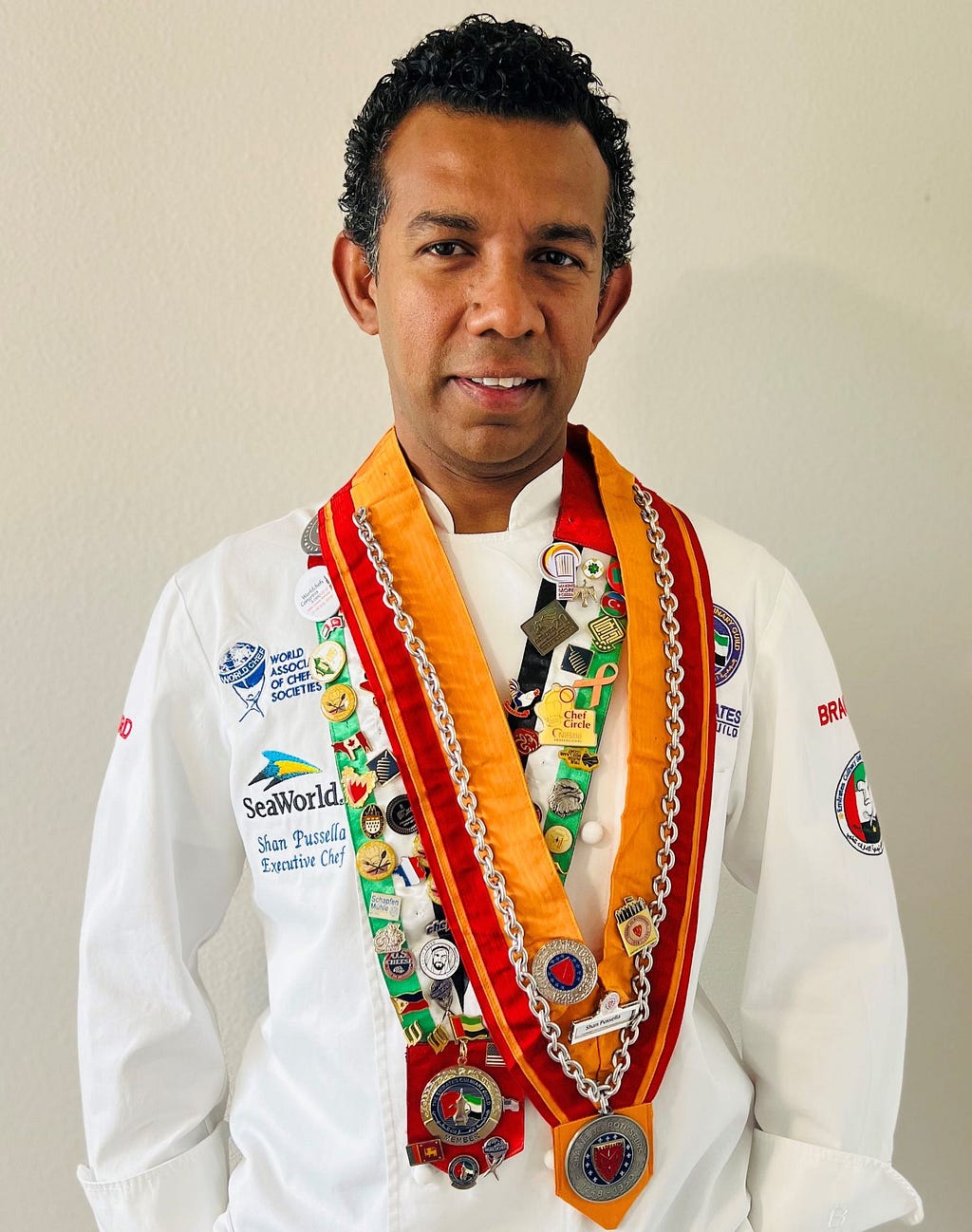
Pussella remains remarkably grounded for a chef with international gold medals and culinary society inductions. When asked for his ultimate secret to surviving and thriving in the cutthroat culinary world, his answer is incredibly simple, born from those early, exhausting days in Colombo. “For me, the best advice for a chef in the kitchen is not to watch the clock,” Pussella said. “If you only work for the hours on your shift, you will never reach a high position because you will miss out on so many learning opportunities. My message to anyone who truly wants to be a chef is this: do not count your hours.”
Yitzi: Shan, it is so nice to meet you. Let’s jump right in. Shan, before we dive in and talk about your work, our readers would love to learn about your origin story. Can you share with us the story of your childhood, how you grew up, and the genesis of all the amazing work that has come since then?
Chef Shan: I am originally from Sri Lanka, but I never thought I would be a chef. To be honest, my whole family background is military, and I wanted to be in the military too. However, many of my friends were in the culinary trade. First, I worked as a waiter, and then I saw that the kitchens were really fun and full of action. I joined the kitchen in 1994 at a small fine-dining restaurant in Colombo, Sri Lanka, called Don Stanley’s. I joined them when I was 17 years old. From there, I started my career. I didn’t even finish college; I went straight into the kitchen. I have been in the kitchen for 32 years since then.
Yitzi: Unbelievable. You probably have some amazing stories from different parts of your career and your various successes. Can you share with our readers one or two stories that stand out in your mind?
Chef Shan: When I was 17 years old, I was the youngest chef at the Taj Hotel in Colombo. Everybody would say, “Shan, you need to do this, you need to do that.” I was on it. I really wanted to absorb all the experience they had to offer. I worked for an Indian restaurant there, and believe me, I had never worked in one before. Sri Lanka is very popular for cricket matches, and all the cricket teams would come to the Taj Hotel. I wanted to see them and work for them! The Indian teams would visit the Indian restaurant. Since I was the youngest guy, everybody would come talk to me and ask, “Are you allowed to work at this age?” In Sri Lanka, you cannot work if you are under 18. I worked for them for almost three years.
Then I moved to Bahrain. I was 19 at the time, making me the youngest chef at a fine-dining restaurant there called Mezzaluna. I worked with many Michelin-star chefs. It was really hard; they never gave you any chances. I was young, but I never gave up. I always did what they asked. I made small mistakes, and they were extremely strict. There were times I was crying and wanted to give up, but I persevered. If I had given up back then, I wouldn’t be where I am today. It is a hard job, but you never get tired of it.
Yitzi: There is a saying that sometimes our mistakes can be our greatest teachers. Do you have a story about a humorous mistake you made at the beginning of your career and the lesson you took away from it?
Chef Shan: Oh, yes! One time at Don Stanley’s, I was very young and not allowed to cook on the range due to my age. The chef had stepped out, and the kitchen was extremely busy, so I jumped in to help. I was a commis 3. My sous chef said, “Shan, come in and handle the fryer.” I had never fried prawns or anything similar before. I fried the prawns with the ice still on them! The hot oil splashed right into my face. It was a bad experience, and my sous chef was furious. He didn’t fire me — we weren’t allowed to cook anyway, but I was always eager to jump in. That time, it backfired on me. It was 1994 at Don Stanley’s. It was a frozen prawn. You cannot fry it when it is frozen. He told me to take it and defrost it according to their setup, but I grabbed the wrong prawn and put it straight into the fryer. The oil splashed onto my body, hands, and everywhere else. It was a very big deal that day.
Yitzi: Have you ever seen or heard of the television show The Bear? How is the show similar to your life, and how is it different?
Chef Shan: Yes, I love to watch that show. I even watched the latest season. Culturally, our country does not always provide access to a wide variety of ingredients, and we have a very tough lifestyle. In The Bear, they have formal training and the chance to learn from celebrity chefs and culinary schools. Sri Lanka is not like that. That is the main reason I left Sri Lanka — to learn and work with strong chefs. The hard part is that I went through exactly what the main character went through. It is not easy. When I moved to Colombo, I had no transportation and had to sleep in a dormitory; there were many tough challenges just to work there. Later, when I moved to Bahrain, I worked with Michelin-star chefs. That is exactly where the pressure comes from: there is no time to rest, and we never check the clock. My past was exactly like that.
Yitzi: Tell us the story of how you became the head chef at SeaWorld.
Chef Shan: I worked in Dubai for 20 years; I consider it my hometown. Then, I moved to France. Later, my kids wanted to come to America, so we moved to San Jose for work, and eventually, I came to Texas. Everybody was talking about SeaWorld. Before I left Dubai, they were opening a SeaWorld in Abu Dhabi. I had worked for a theme park before — I helped open Laguna Waterpark at La Mer in Dubai.
When I arrived here, people asked, “Why don’t you try for SeaWorld?” I figured, why not? I had the background. It was different from what I was used to, but I wanted to try. I applied, and I ultimately got the job. Even as I was joining, my executive chef asked, “Shan, are you sure you want to work in a theme park?” I told him that it is the same food, just presented differently. We do a lot of events here. It is not just theme park food; we host high-standard events with three- or four-course plated menus for 100 to 200 people. I didn’t want to lose my passion, so here I get to do both fast food and fine dining. When they asked me, I confirmed that I really wanted to work there because SeaWorld is a well-known group. Now, here I am.
Yitzi: How can a visitor to SeaWorld taste your food? Do they need to buy a certain type of ticket, or go to a specific VIP area?
Chef Shan: Right now, we are running the Seven Seas Food Festival. It has been happening here for a long time, but this year we revamped the entire food program and the represented countries. We have 10 regions, and within each region, we feature four to five countries. We offer food and beverages from almost 29 countries, with more than 100 items to try. There is a lot happening for anyone who wants to visit now. Additionally, across all our Quick Service Restaurants, we have limited-time offers. Every season, we feature a dish of the day in all our restaurants. We have à la carte options and limited-time offers as well. This is how I am changing the culinary culture here. We offer more than just everyday burgers and hot dogs. We have burrata on the menu, grilled chicken pesto with focaccia, and many other diverse items throughout the park. I want guests to come not only for the rides but for the food as well. That is my job, and that is what we are aiming to achieve.
Yitzi: I remember walking into SeaWorld and other theme parks, and they always smell amazing. It makes you want to go right into the restaurants. Is that part of your strategy, to make it smell so good that guests walk in?
Chef Shan: Yes! When you go to most parks, you naturally smell burgers, french fries, and wings. What we focus on here is a smoked barbecue aroma. We are trying to introduce many different food varieties. I don’t want people to just think of us as a typical theme park with standard burgers. I want them to visit specifically for the food.
Chuck Cureau : You were asking how people can sample his food. First, they have to come to the park. He has a culinary presence here throughout the entire year. At certain times of the year, we host specific culinary events. As he explained, our Seven Seas Food Festival is going on right now, where you can stroll around the park and sample food from places like Dubai. We even have camel burgers! He created them, and he has to talk about that process because it is fascinating, and the burgers are delicious. You can roam around the festival and eat food from all over the world. It is all the brainchild of Chef Shan and his hardworking team. I will hand it back to him so he can explain how it all came to be.
Chef Shan: Yes, I introduced the camel burger to the park. When I added it to the menu, everybody asked, “Chef, are you sure you want to do this?” I told them we needed to offer something unique. People can eat beef and other standard meats anywhere; why not provide an experience they can try here? It was very difficult to source the meat, as camel is not easy to find locally. Thankfully, my procurement team did an excellent job. They sourced the camel from a different region, I believe Morocco or Tunisia. Camel is a very lean meat, so it took me almost three weeks to perfect the burger. I had to add fat and conduct a lot of research to get it right. Now, we serve a camel slider with a secret sauce. The sauce contains eight ingredients, including date syrup, mayonnaise, smoked paprika, salt, pepper, lime juice, and pomegranate molasses. It gives the burger a perfect balance of sweetness and smokiness, and it has become very popular.
Chuck Cureau: It ties exactly into what he was saying about people expecting typical theme park burgers. He used his brilliant mind to say, “Okay, you want burgers? I will give you a burger, but not the traditional beef one. We will give you a camel burger.” It is now one of our most popular menu items.
Chef Shan: We also feature Indian, Sri Lankan, and Indonesian cuisines, which were never offered here before. Drawing from my background working with high-end Sri Lankan and Indian chefs, I introduced butter chicken and Sri Lankan beef curry, both of which are extremely popular. We have an Asian Hut serving bao buns and Korean barbecue. There is so much to taste. From Thursday to Sunday every week, we add something new to the huts. Guests will leave saying, “We need to come back next week to try the Indonesian noodles,” or, “We have to return for the Moroccan tagine with couscous.” We are introducing new items constantly, ensuring the experience is never boring. Every time you visit, there is something new happening. That is the culture we are building at the theme park.
Yitzi: It is such a brilliant idea to design it so people come just for the food. Is it set up like a buffet where you pay a flat fee, or is it à la carte?
Chef Shan: We have 10 huts, and it operates à la carte. Each hut features about four items, and we cook everything à la minute. If you order a burger, we cook it fresh to order; it is never pre-made. For the curries and parathas, we prepare them in the morning in the main kitchen and deliver them to the huts for portioning. The portions are not large; they are tasting portions because there is so much variety. It functions like a tasting menu. You can move from hut to hut and sample five to six different items. I recommend guests leave some room so they can try a little bit of everything. Because of the small portion sizes, you can taste a wide array of food. We cook to order — all the tempura and Korean barbecue are grilled right in front of the guests.
Yitzi: That is beautiful. Personally, what is the perfect meal for an expert like you?
Chef Shan: As a Sri Lankan, I naturally enjoy rice and curry. However, having worked with many French and Italian chefs, I also love pastas and casseroles. I don’t have one specific favorite; I appreciate all kinds of food and will eat anything. That open-mindedness is why I introduced the camel burger! When everyone questioned whether we should bring it in, I believed we needed to try it to provide a unique and excellent experience. That is exactly why we sourced it. Ultimately, I enjoy all types of food.
Yitzi: What keeps you inspired and innovative? How do you stay fresh and continuously think of new ideas?
Chef Shan: The possibilities with food never end; there is always something different to discover. I don’t want this theme park to be stagnant and known only for standard burgers. I want to offer our guests something new. I want to bring my background, the techniques of the chefs I have worked with, and the cultures I know into the park. Here in Texas, everybody is familiar with beef, barbecue, and burgers. That is what they know best, but I believe they also want to try different flavors. My mindset is always focused on bringing something new to the table. I love experimenting. If an idea works, fantastic. If it doesn’t, we simply move on to something else.
Yitzi: Earlier, you mentioned the show The Bear and how it accurately depicts the intense pressure chefs face. What do you do for your team to prevent burnout and ensure the pressure does not become overwhelming?
Chef Shan: Honestly, we do work under a lot of pressure, and my entire team works incredibly hard. When high-pressure situations arise, I always try to keep everyone calm. I don’t want to step in and act like an overly harsh chef; I prefer to work alongside them. The new generation of cooks operates differently than we did. In the past, whatever we were told, we just said, “Yes, Chef,” and carried on. Today, if you approach them the wrong way, they might not show up the next day. We have to adapt and teach them the right way. I must apply the necessary pressure for quality, but I also have to take care of them to keep them motivated and on the right track.
Looking to the future, I sometimes worry about the availability of properly trained, professional chefs. When we trained, we made everything from scratch in the kitchen — demi-glace, stocks, everything. Now, there are powdered shortcuts for almost everything. My approach is to show them both the traditional, correct methods and the more efficient shortcuts. By teaching them both approaches, I am showing them what their future can hold if they master the balance between doing things the traditional way and the modern way.
Chef Shan: I am always with my team — laughing, joking, and even helping deliver the food. I don’t act like an executive chef who just sits back in an office; I am consistently out there helping them. This park is not a single restaurant; it is a massive operation spanning almost 250 acres. I don’t send my chefs out alone for deliveries; I work alongside them. I strive to make them comfortable by staying active in the kitchen and continuously bringing in new ideas for them to try. When the pressure truly mounts, I do have to be firm and guide them, but my priority is always keeping the team unified and working together.
Yitzi: Now for our signature question: You have been blessed with a lot of success and have won numerous culinary awards. Can you share five things someone needs to become an award-winning chef?
Chef Shan: First, consistency. Second, always be honest. Third, don’t give up. In modern kitchens, many from this generation struggle with the pressure and choose to walk away. Fourth, always listen to your head chef and follow their guidance. Finally, maintain that consistency and never take shortcuts when preparing quality food. Doing things the right way often takes a lot of time, but you must adhere to the proper methods.
Yitzi: What unique qualities or skills do you possess that differentiate you from other award-winning chefs in the culinary industry?
Chef Shan: Having worked with 10 to 15 Michelin-star chefs, I know it is not easy to work alongside them. However, my defining quality is that I never give up. I always listen to my mentors and follow their lead. It is demanding, but I never clock-watch. I always arrive in the kitchen on time, and I am typically the last one to leave. If you follow and listen to the right people, you will find success.
Yitzi: This brings us to our aspirational question. Shan, because of your incredible work, it is no exaggeration to say that you are a person of enormous influence. If you could spread an idea that would bring the most amount of good to the most amount of people, what would it be? You never know what your idea might inspire.
Chef Shan: For me, the best advice for a chef in the kitchen is not to watch the clock. If you only work for the hours on your shift, you will never reach a high position because you will miss out on so many learning opportunities. My message to anyone who truly wants to be a chef is this: do not count your hours.
Yitzi: That is great advice. Shan and Chuck, it has truly been a pleasure talking to you. I learned a great deal, and I hope we can meet in person one day.
Chef Shan: Oh, absolutely!
Yitzi: I wish you both continued success and good health. I look forward to sharing it with our readers.
Chuck Cureau: We appreciate you. Continued success and blessings to you as well. Thank you so much for this opportunity; we genuinely appreciate it.
SeaWorld Chef Shan Pussella on Bringing Camel Burgers, Sri Lankan Curry and Global Cuisine to Texas… was originally published in Authority Magazine on Medium, where people are continuing the conversation by highlighting and responding to this story.