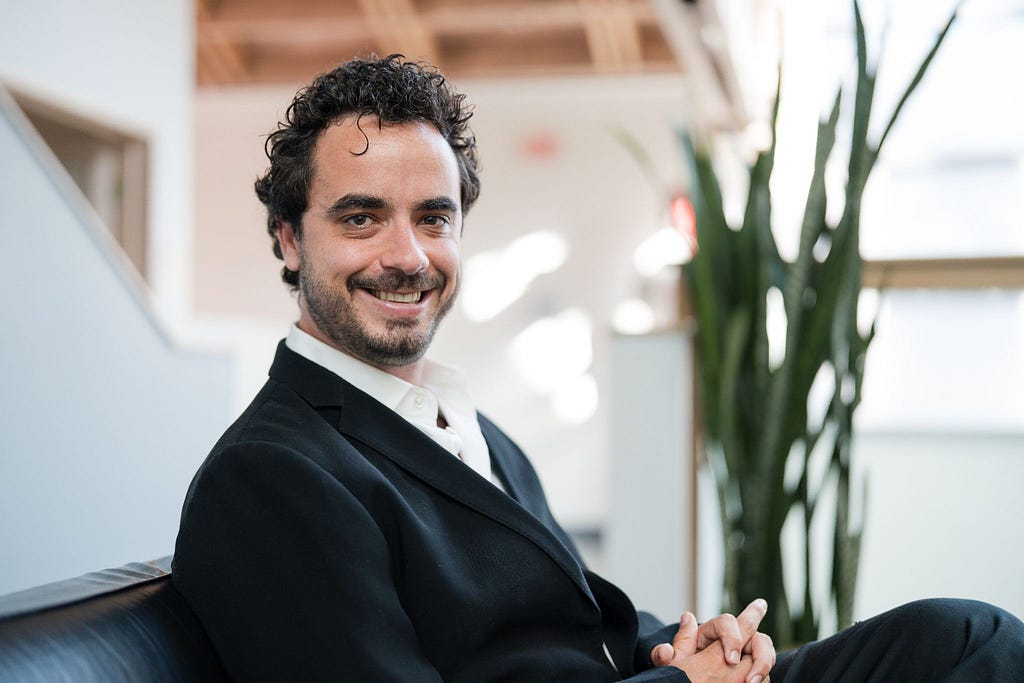
Gabriel Borden on Arrow Fund, SpaceX Secondaries and Why “Integrity Is Everything” in Venture Capital
“I always grew up with a philosophy in my family which was whatever you’re going to do, make sure it’s done beautifully and that beautiful work impacts the world in a positive way. That was a super important thing for me growing up. I live by it today. I try to only do things that are beautiful and impact the world, and I think venture capital done right moves forward a lot of the industries that I really care about.”
I had the pleasure of talking with Gabriel Borden. If you want to understand how a kid who grew up wandering around the sets of Hollywood blockbusters became a quiet powerhouse in the venture capital world, you have to look at the intersection of art and hustle. Borden, the managing partner of the Los Angeles-based investment firm Arrow Fund, didn’t follow the traditional, starched-collar Wall Street playbook. Instead, his path to managing an estimated $150 million in assets is a uniquely Californian story, steeped in creativity, cryptocurrency, and a relentless drive to connect the right people.
Born and raised in Santa Monica, Borden was marinated in a culture of high-stakes creativity. His father, Bill Borden, is the prolific film producer behind hits like Desperado and the High School Musical franchise, while his mother, Melinda Gray, is a highly successful modern architect. “I grew up with two parents that were very happily married, both who were artists that turned their art into entrepreneurial ventures,” he recalls. Despite spending his childhood on movie sets in Utah and China — even making a brief cameo as a backup dancer — Borden was inherently camera-shy. The glitz of the camera lens didn’t appeal to him, but the mechanics of building an empire did. “I always grew up with a philosophy in my family which was whatever you’re going to do, make sure it’s done beautifully and that beautiful work impacts the world in a positive way,” he says. That ethos, combined with a household grounded in Transcendental Meditation, gave him a calm center in chaotic environments.
That inner calm paired well with a restless entrepreneurial itch. Long before he was negotiating secondary market stakes in Elon Musk’s companies, Borden was the kid hawking crystals and running lemonade stands on the side of the road. By the time he hit the business school at Loyola Marymount University, he was already playing in the big leagues. At just nineteen, he launched Maya Tech, a fintech startup designed to bring banking and cryptocurrency services to low-income communities via ATM-like devices. The venture was a success, eventually getting majority-acquired and giving Borden his first real taste of the burgeoning crypto landscape. It was a wild frontier, and he was there for the early gold rush, buying Bitcoin when it was sitting below the hundred-dollar mark.
Today, Borden channels that same frontier energy into Arrow Fund, an opportunistic firm he built to target late-stage, pre-IPO tech giants and unique special-purpose vehicles. The firm doesn’t just throw money at a wall to see what sticks; they act as financial snipers. “Being an investor is all about having a target and hitting that target,” Borden explains. “Arrow Fund is a great name for an investment company because our mission is to really be the arrow that hits the right targets.” Those targets have recently included highly coveted secondary shares in heavyweights like SpaceX, Neuralink, and Valar Atomics.
His approach to vetting these massive deals is surprisingly human. In an industry obsessed with algorithms and cutthroat contracts, Borden relies heavily on a handshake ethos. “I believe most investments are made in the people rather than the company,” he notes. “Things don’t always go right in business; they go wrong, and if you invest in a good person, they are able to navigate through the problems.” It is a philosophy he applies to his own team as well, insisting on working only with highly ethical partners. “If we say something, we do it. We are not going to cheat people, and you are always going to get what you see. “
Borden’s world is a blend of high finance and curated Los Angeles cool. When he isn’t pacing in circles taking phone calls, he is hitting the boxing gym, sauna or hosting deeply curated networking events that feel more like exclusive parties than stuffy corporate mixers. Picture afternoon gatherings with a vinyl DJ spinning tracks, a live saxophonist, and fresh sushi. “We want people to connect naturally, fostering more of a natural connection rather than a business setting,” he says.
Even his personal life feels written for the screen. He met his wife, Sydney, at a sprawling, thousand-person Hollywood party hosted by a crypto-entrepreneur friend during the pandemic. When the police arrived to shut the gathering down, the two hid in a secret podcast recording studio, hopped on the mics, and instantly clicked. They played that accidental podcast audio recording at their wedding in Ibiza a few years later.
Despite his success, from managing the family office of crypto billionaire Brock Pierce to taking a controlling interest in a $200 million beverage bottling company, Borden remains focused on the horizon. He is betting big on prediction markets like Polymarket and the revolutionary potential of artificial intelligence, embracing the chaos of innovation rather than fearing it. Above all, he is pushing for a business culture rooted in pure honesty. “If you really act in full transparency with everybody around you,” Borden reflects, “I think that’s the way to live.” In a financial ecosystem built on smoke and mirrors, Gabriel Borden is proving that sometimes, the most disruptive thing you can be is entirely yourself.
Yitzi: Gabriel Borden, it is so good to talk to you again. Before we dive in deep and talk about your amazing work with Arrow Fund, our readers would love to learn about Gabriel Borden’s personal origin story. Can you share the story of your childhood, how you grew up, and the seeds and the genesis for the amazing work that has come since then?
Gabriel: Great to talk to you too, Yitzi. It’s always a pleasure. I grew up in Santa Monica, California. I grew up with two parents that were very happily married, both who were artists that turned their art into entrepreneurial ventures. My mom was a graphic designer turned into an architect. She has a company, Gray Matter Architecture, and does all sorts of highly beautiful modern architecture. She designs a lot of houses, schools, and things like that, mostly in Los Angeles, but she has a lot of them in Venice and Pacific Palisades. Then my dad was a painter. He was a painter turned filmmaker. He grew up painting and then ended up moving that art to filmmaking and created a successful business doing it. I always grew up with a philosophy in my family which was whatever you’re going to do, make sure it’s done beautifully and that beautiful work impacts the world in a positive way. That was a super important thing for me growing up. I live by it today. I try to only do things that are beautiful and impact the world, and I think venture capital done right moves forward a lot of the industries that I really care about. I grew up mostly in LA, but also around the world on movie sets. I spent time in China for the filming of Kung Fu Hustle, and I spent time in Utah for the filming of the High School Musical series, as well as on different movie and TV sets. One other thing that I think shaped my childhood is that my parents are both meditators. They have been doing transcendental meditation, or TM for over 40 years. I think meditation made my parents grounded and happy. That translated over to me and I had a very blessed childhood.
Yitzi: Tell us the story behind how you got into the finance industry.
Gabriel: I got into finance because I was entrepreneurial as a kid. I was always the kid that had lemonade stands and was selling random things on the side of the road. I sold crystals as a kid; I sold whatever I could get my hands on. I was always an entrepreneur growing up.
My first company I started in College was a promotion company for Uber and Lyft At the time when Uber and Lyft were launching, they put out promo codes, and we hired tons of brand ambassadors to pass out promo codes all throughout our college campuses and kind of scaled the business doing that. Then a little bit later in college, I started Maya Tech, which ended up getting majority acquired by Daniel Cho. Maya is a fintech company trying to bring banking services to low-income communities. It is a hardware device that users can put cash into to pay bills, transfer money, buy crypto and pay for other different financial services. That is when I got introduced to cryptocurrency for the first time in college. That was the start of my entrepreneurial career.
Yitzi: Amazing. Tell us the story behind how Arrow Fund was created.
Gabriel: I had been working with Chris since I met him in college at LMU. We started working together after college in a private equity company. A little over a year and a half ago, I came on to be the managing director of a family office and I brought Chris on to be the co-managing director. We managed a family office together for a year, so we were working really closely with each other. Although we had known each other and worked together for 10 years, a year and a half ago we really started working together again. I left that family office about seven months ago to start Arrow Fund, and Chris also left the family office to join me for Arrow Fund.
Yitzi: Is there a story or deeper meaning behind the name Arrow Fund?
Gabriel: Yes, there is. Being an investor is all about having a target and hitting that target. I think Arrow Fund is a great name for an investment company because our mission is to really be the arrow that hits the right targets.
Yitzi: Let’s talk about what makes Arrow Fund unique. Let’s phrase it this way: What do you think you do that other people in your industry don’t do as well?
Gabriel: There’s the relationship piece, which I think is my specialty. I have really strong relationships with different family offices, VCs, tech companies, and, on the other side, founders. I have access to a lot of the founders, the top 50 companies, and their employees from socializing. The other thing is something that Chris and I share, which is the most important part: we both work with high integrity. Our word is our bond. If we say something, we do it. We are not going to cheat people, and you are always going to get what you see. In the finance industry, it is hard to find people like that. We naturally gravitate to others like that, so our network is not only successful, but equally as important, full of integrity. People who do what they say and keep their word are the most important thing to us.
Yitzi: I read that you focus on secondaries and SPVs, or special purpose vehicles. Can you describe to our readers what exactly a secondary and an SPV are?
Gabriel: Yes. There are two ways to invest in a company for the most part: primary and secondary. Primary is when you’re investing directly into the company’s offering, and secondaries are when you’re buying an existing shareholder’s stock. We specialize in secondaries, meaning we will actually buy out other existing shareholders’ positions. We do this from funds and individuals. We buy out LP stakes and GP stakes; we like buying out secondary positions like that. An SPV just means a special purpose vehicle which are often unique to one investment. For example, if we are going to invest in a company like Polymarket, we create an SPV, raise money and deploy it into that target company.
Yitzi: In your opinion, why do you think SPVs can outperform traditional funds?
Gabriel: I think there are a few reasons. For one, with a fund, there’s a lot of time spent on compliance. At one point you’re focused mostly on fundraising, and then at another point, you’re focused on deploying. With SPVs, you’re simultaneously focused on getting the allocation and deploying it in a rapid manner, and you can keep doing it. Funds have some advantages too, such as always having capital ready to go so you don’t have to go back to your LPs. However, in this world, SPVs are allowing us to deploy larger amounts of capital into opportunities and earn more money. Investors get only what they are looking for and GPs are compensated well.
Yitzi: Based on your experience, can you share some of the strategies you use to source opportunities that others miss? What is your trick for deal flow?
Gabriel: I’ve been working in the investment world for over a decade with founders and investors, so a lot of deal flow comes from pre-existing relationships. This includes people I’ve worked with before, people I’ve had good experiences with, and people I’ve grown up with in general. A lot of it also comes through networking events. We host parties and events; we’re hosting several events right now for the Milken conference. Between hosting events, organic relationships, and having some success, it becomes a ripple effect. Everyone now wants to talk to us for all the deals, so it’s a mix of all those things.
Yitzi: Can you talk a little bit more about some of the exciting secondaries you’ve been able to invest in?
Gabriel: Yes, we’ve been able to invest in Polymarket , SpaceX, Valor Atomics, and Neuralink. These are some of the hottest names in the sector. We’ve been on a good roll and have been able to continuously close deals since we started. In this game, consistency and closing are really important, and we keep closing.
Yitzi: Just to clarify for our readers, all those companies are not on the open market. You are able to get access to those deals by individuals selling their shares? Is that how it works?
Gabriel: Yes. Individuals, funds, companies, and family offices — all of those groups.
Yitzi: That’s unbelievable. For example, let’s say SpaceX will go public soon. People are able to get into a pre-IPO investment before it goes public, and then they can make a big return?
Gabriel: Correct.
Yitzi: Could someone give you another large investment and say they want to invest more in SpaceX?
Gabriel: Yes, we’re always working on a lot of the popular names and are usually able to continue deploying money into those companies.
Yitzi: It sounds like the advantage of a secondary is that you have more liquidity but also more profit. Am I saying that correctly?
Gabriel: Yes, with very late stage pre IPO companies, investors usually have access to liquidity on the secondary market.
Yitzi: But in regular VC investments, when a person buys equity in a company, you don’t really have too much liquidity.
Gabriel: It depends on the stage. The earlier the stage, the less access to liquidity you have. The later the stage, the more access to liquidity you have through the secondary markets, because you can sell the stock to the secondary markets.
Yitzi: How can an investor get in touch with you? Can anyone who has capital say they want to work with you, or do they have to have certain accreditations and meet a certain standard?
Gabriel: We only work with accredited investors, so they are required to be accredited. However, I am relatively easy to get in touch with. We have a website and a LinkedIn presence. I am on LinkedIn, so people can get in touch with me if they reach out.
Yitzi: Can becoming accredited simply mean having enough assets? Does it have to be as complicated as needing to pass tests or having that as your career?
Gabriel: The SEC has a few rules they set under Regulation D. You need to meet the following: if you’re an individual, you have to earn more than $200,000 a year, or over $300,000 if you’re married. Alternatively, you could have a net worth over a million dollars, and your primary residence does not count towards this million. You can also qualify if you have certain securities licenses. I believe that covers all of the things that make you an accredited investor.
Yitzi: Do you leverage AI in your business? And how?
Gabriel: Absolutely. All day, every day. We use Claude, ChatGPT, and Grok. For investment companies, AI has completely changed the game. It helps with the analyst work, financial reporting, memos, and even the first drafts of legal work to outline things so your attorneys can be more efficient. We use AI for graphic design as well; we use it across pretty much every component of our business. It helps with typical financial analysis and just about everything.
Yitzi: With the newer generation of financial companies, is it typical to use AI? I imagine companies like Prudential are probably a little more cautious of it. Gabe, are we losing you? I think you’re muted, Gabe.
Gabriel: I think anybody who is smart should use AI. It makes life easier, especially for people in the VC business.
Yitzi: This is our signature question: Can you share five things you need to see before making a VC or private equity investment?
Gabriel: In general, before investing, there are a few things we like to see. One, we always start with the people. I believe most investments are made in the people rather than the company. This is less so in late-stage companies, but it is still absolutely a factor. We always like to start with the people and invest in good people first and foremost. We look for people that we believe are going to win because things don’t always go right in business; they go wrong, and if you invest in a good person, they are able to navigate through the problems. So, first and foremost, the people. Second, solid company financials. We look for not only strong income but strong profit margins and strong growth. If there is not strong income, we also invest in companies that have very strong growth. Some other things we like to look for are something that is going to fundamentally change the world for the better. We like Neuralink, for example. We really believe Neuralink is going to change humanity by providing humans access to technology inside their bodies that could maybe repair their vision or give a leg back to someone who didn’t have one. We see that as a very fundamental technology. At the same time, we see something like Polymarket changing the world by creating real-time prediction markets that can actually give a real idea of the success of something. News is just the companies reporting, but when people are essentially reporting with their own money, we believe that is a much better prediction of what is going to happen in the world. It has almost created a new form of media, or news. I guess those three things are the most important, and I will leave it to three for now.
Yitzi: Do you invest in cryptocurrency?
Gabriel: Yes, we do. Absolutely. We are very bullish on the future of cryptocurrency. We even have a focus on our deals where we like them to be cryptocurrency-related in some regard. For example, with Polymarket, a lot of people think they are planning to launch a Polymarket token, so we see that as a potential upside to our investment. We are also looking at deals like Tether, which is a cryptocurrency-focused deal. Given my background — both starting a company in the cryptocurrency industry, getting into cryptocurrency early when I was younger, and managing a family office for a cryptocurrency entrepreneur — I am super invested in crypto and bullish on the industry.
Yitzi: I know somebody that lost a ton of money, maybe like a million dollars, investing in Bitcoin. A lot of people have made money, and a lot of people have lost money. Can you give some general advice about successfully investing in cryptocurrency?
Gabriel: Most investors who have ever invested in the major cryptocurrencies and held have made money. I think it is really about holding. Investments aren’t typically over a one-year span. Most of the people who have lost are people who invest and sell a few months later. Everybody I know who has held for years has made a tremendous amount of money.
Yitzi: I think you’re right. I think during the big crash he sold it, and if he had held on for another two years, he would have made it back.
Gabriel: Yes, you probably can’t find many people who have invested, held on for two years, and lost.
Yitzi: Looking at the future, can you share some of the exciting trends you see in this new generation of financial tools?
Gabriel:I think some of the companies we invest in are great examples of entirely new trends emerging. Prediction markets barely existed a few years ago, and now companies like Polymarket and Kalshi are worth tens of billions and becoming widely adopted. They’re even changing how people consume news and think about betting markets.
You see the same thing with SpaceX and Starlink, which are completely redefining global connectivity and space technology. We like investing in businesses that create new markets and genuinely change the way the world operates.
That’s also why we invested in Valor Atomics. Nuclear energy was held back for decades because of safety concerns, but the technology today is dramatically more advanced and safer than it used to be. We believe it’s one of the cleanest and most efficient energy sources available, and an area that will become increasingly important in the future.
Yitzi: Could you talk more about the events that you’re hosting? What are their goals, and how do you see them developing more business?
Gabriel: We are doing several events mostly focused on what we call GP, LP, and founder meetups. This involves getting investors and founders together to talk and meet in a more casual setting. We have them mostly at houses, so they don’t feel as much like a conference. They have a good vibe, and we have good food. For example, one of the events we are doing is a sushi and champagne daytime event where we are having a vinyl DJ, a sax player, and serving healthy sushi to everybody. It is during the day from 1:00 to 5:00 PM, so it’s going to be beautiful out. We want people to connect naturally, fostering more of a natural connection rather than a business setting. Those are the environments we like to curate. We try to bring people from different industries together, and the good thing about investors is they touch all sorts of different industries. Since I grew up in a family of artists, how everything looks is really important to me, and the energy of the people together is really important. We try to bring really good people together in a beautiful environment. We care about how things look and feel, and how people treat each other. It is more casual, but enjoyable.
Yitzi: Based on your experience, do you have some advice about how to best network? Let’s say if I go to an event, how can I best use that as an opportunity to meet people that I want to meet? How do you best network during an event?
Gabriel: There are a few things. The main one is probably hustle. You have to go out, really put yourself out there, and do the hard work. Be brave, talk to people, learn from people, and get vulnerable so you can actually connect with them. Tell them about yourself, not just your business, because people do business with people. I think that is the most important thing. If you really connect with someone, you will want to be talking to them regularly, and you will have a much better chance of getting something amazing done together if you have a real relationship rather than just a business-focused one.
Yitzi: On a personal level, can you share the self-care routines that you do to help your body, mind, and heart thrive?
Gabriel: Yes, I exercise regularly. I box several times a week and do sauna and cold plunge almost every day since I have both at home. I also play a lot of sports — mostly tennis, usually with my dad, and racquet sports like pickleball. Outside of that, I lift weights and walk a lot. I spend a big part of my day on phone calls, so I’m usually pacing around while I talk.
Yitzi: Okay, this is our final aspirational question. Gabriel, because of your amazing work, you are a person of enormous influence. If you could spread an idea or inspire a movement that would bring the most amount of good to the most amount of people, what would that be? You never know what your idea can spread.
Gabriel: I think it would be a movement around transparency and honesty. I really believe that when people operate with full transparency — in business, relationships, and everyday life — it creates stronger trust, better collaboration, and better outcomes for everyone involved. A lot of problems in the world come from misaligned incentives, lack of communication, or people not being upfront with each other. If more people approached life and business with openness and integrity, I think it would create a much healthier and more trustworthy world.
Yitzi: Gabriel, how can our readers continue to follow your work? How can they get involved with your company if they want to consider investing? How can our readers support your work in any possible way?
Gabriel: We are always looking for opportunities to invest in strong companies. We are looking to buy out positions from founders, employees, funds, other individuals, and companies. We are always looking for investors that are interested in accessing this type of deal flow. If your readers fit into any of those categories, I’d love for them to reach out, and I am happy to talk to them.
Yitzi: Are there certain types of companies you have in mind, like pre-IPO ones, that you would love?
Gabriel: Yes. Pre-IPO companies, primarily the top 100 or 200 companies, are our main focus. But we also do earlier stages too. We do all stages, so we are opportunistic, but our focus is really on those late-stage pre-IPO companies.
Yitzi: Amazing. Well, Gabriel, thank you so much for your time. It has truly been an honor to do this with you. I wish you continued success and good health, and I am excited to share the article with our readers.
Gabriel: Alright, Yitzi. Thank you so much. I appreciate it. Have a wonderful rest of your day.
Gabriel Borden on Arrow Fund, SpaceX Secondaries and Why “Integrity Is Everything” in Venture… was originally published in Authority Magazine on Medium, where people are continuing the conversation by highlighting and responding to this story.