
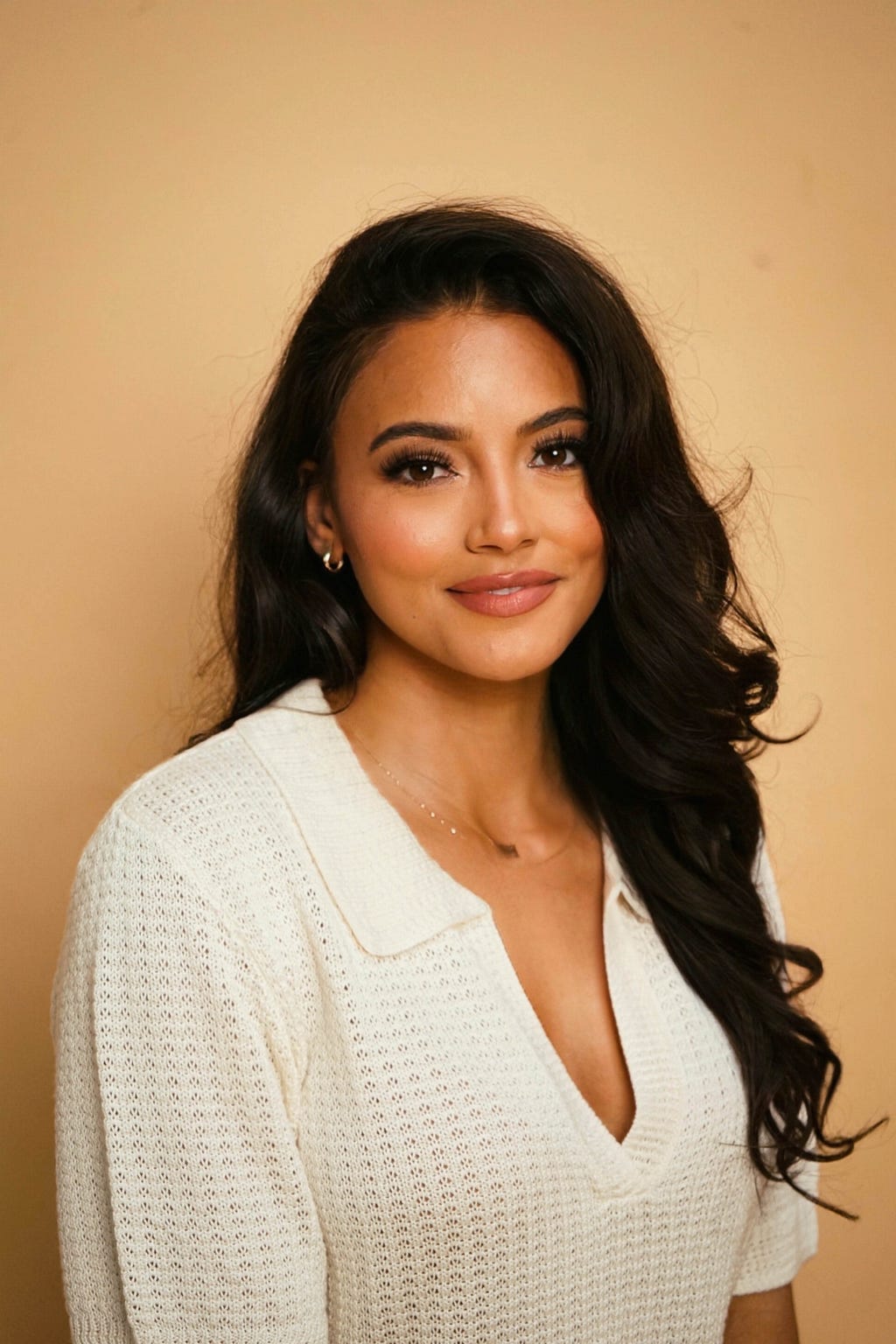
“When I think of my why, I think of the little girl who felt alone in her room, who felt misunderstood… I do it for her. I do it for that little girl who believed she was meant for more in this life… And I do it for my daughter. Because when you have that, your focus shifts. It becomes less about being special or performing. It becomes about purpose.”
I had the pleasure of talking with Gabrielle Walsh. Gabrielle is an American actor whose work spans television, film, and animation, with performances marked by emotional depth and versatility. She is currently a lead cast member on NBC’s missing-persons drama Found, a network hit that has drawn praise for its focus on underrepresented stories and its emotionally complex characters. In the series, Walsh portrays Lacey Quinn, a law student and survivor whose harrowing past with a kidnapper now fuels her role within a recovery team that seeks justice for others who have gone missing.
Born and raised in Countryside, a small town outside Chicago, Walsh grew up between her father’s home in the suburbs and her mother’s on the South Side of the city. Her early exposure to classic Hollywood cinema through Turner Classic Movies instilled in her a deep appreciation for storytelling. Encouraged by both parents, she began acting in community center productions and school plays, eventually deciding to pursue the craft professionally. She studied acting at Northern Illinois University and later trained abroad at the Moscow Art Theatre School, an experience that added classical rigor to her performance technique.
Her early years in Los Angeles were marked by the typical uncertainties of a working actor. Walsh recalls navigating rapid-fire auditions and tight turnarounds that contrasted sharply with the extended rehearsal periods she had known in academic settings. One pivotal moment in her early career came when she auditioned for what would later become Paranormal Activity: The Marked Ones. Initially unaware that the project was part of the popular horror franchise, she leaned into improvisation to secure the role of Marisol, delivering a performance that placed her on the radar of major studios.
In addition to her work in Found, Walsh has appeared in a range of other notable television series, including Shameless, The Vampire Diaries, 9–1–1, and The Brave. Her work also extends to animation, having voiced the lead character Emily in HBO Max’s adult animated series Close Enough, which ran for two seasons. She cites her ongoing participation in acting classes as key to sustaining her artistic growth and keeping her craft grounded in a demanding industry.
Found has proven to be a defining role for Walsh. The show, created by Greg Berlanti and Nkechi Okoro Carroll, focuses on the disproportionate number of missing persons who are people of color, a reality often underrepresented in mainstream media. As Lacey Quinn, Walsh plays a character who survived abduction as both a child and an adult, and who now channels her trauma into advocacy. The role has required not only emotional stamina but also the logistical endurance of long filming days across a 22-episode season. Walsh has described the challenge of sustaining a character across such an intense workload as both demanding and rewarding.
Outside of acting, Walsh is a mother and advocates for issues surrounding single parents and family health. Having had her daughter at age 15, she speaks candidly about balancing motherhood with a performing arts career, often drawing from her personal experiences to inform her on-screen roles. Her daughter, now an adult, remains a central anchor in her life and career decisions.
Walsh is also exploring work behind the camera. She is currently developing and producing new projects. In another pivot, she has begun training for a forthcoming mixed martial arts film, a departure from her past roles and one that she hopes will expand her range as both a physical and dramatic performer.
Walsh’s entry into fashion was a recent and unexpected development. After attending New York Fashion Week as a front-row guest, she was invited the following day to walk the runway for Alvin Valley, a rare and notable turn in the fashion world given the high-profile nature of the event and the spontaneity of her inclusion.
Walsh often returns to a guiding principle instilled early in her journey: the importance of intention. Whether in acting, advocacy, or personal growth, she views purpose as the through-line that connects her choices. A key piece of advice she shares, received from a mentor early in her career, is to “let them catch up to you,” a reminder to trust one’s preparation and move forward without clinging to external validation.
Walsh remains active in pursuing creative opportunities that allow her to stretch beyond genre constraints. Whether portraying emotionally layered characters or helping shape stories from behind the scenes, she continues to build a career rooted in authenticity, resilience, and a clear sense of purpose.
Yitzi: Gabrielle Walsh, it’s so nice to meet you. Before we dive in deep, our readers would love to learn about your personal origin story. Can you share the story of your childhood and how you grew up?
Gabrielle: I grew up in a little town outside of Chicago, Illinois, called La Grange, but an even smaller town within that called Countryside. I was raised by my father, and I spent half my time with my mother on the South Side of Chicago.
I got into acting at a very young age, though not professionally. My mom loved taking us to the community center where they put on plays. My dad always had me involved in performances. The school had shows too, and I loved watching old classic movies — Turner Classic Movies — like Clark Gable, Greta Garbo, and Bette Davis, with my father. Watching how those stories affected him made a big impression on me. I saw how storytelling could move people, how we could see ourselves in these characters. It transcended gender and race. You felt like you belonged in some way.
I loved it. From there, I pursued a career in acting. I studied at Northern Illinois University. I also have a daughter — she’s 20 now, but I had her when I was 15. So I went to college right outside of Chicago in DeKalb County and studied acting there. I even got to study abroad in Russia for a semester. After graduating, I moved out to Los Angeles. And the journey continues.
Yitzi: Amazing. Can you share one or two stories that most stand out in your mind from your professional life so far? You probably have some amazing stories.
Gabrielle: Yeah. Some stories that stand out… I think the first one that comes to mind is when I first got out to Los Angeles. I was running around like a chicken with my head cut off, going to all these different auditions, trying to figure out where I stood and how to implement the work in a meaningful way. The transition from college, where you get weeks of rehearsal time with a character, to just a few short days, was a big adjustment.
There was an audition that came up — it was an improv audition — and I loved that because it gave me space to create as an actor. They just gave you a character description. I thought it was going to be the next Freedom Writers, so I was writing all these notes in my journal. The audition itself felt incredible. I felt alive in it. It was for a project called OT Beach.
Afterward, I called my manager a million times, like, “Did I get it yet?” And she kept saying, “They’re still looking. You did a great job. We’ll let you know.” Then I didn’t hear anything for months. Maybe six months later, I got a call while I was visiting a friend in New York. They wanted to see me again, and it turned out OT Beach was going to be the next Paranormal Activity. I was shocked. I remember thinking, “What? They didn’t say anything about paranormal stuff or ghosts!”
I went back through all my notebooks — thank God I took so many notes because I had no idea what I’d done — and went into Paramount Studios. It was my first time ever auditioning at a studio. I auditioned for Christopher Landon. In improv auditions, especially, a lot of actors are just trying to grab attention. I was in there with two guys, and they were completely taking over. I was trying to figure out how to be seen in that space.
They ran right over me the first time, but I got another shot with two different guys. My character’s name was Marisol, and she was supposed to be delivering information she’d researched online. So I scribbled down my own fake research. In the middle of everything — while the guys were vibing and being loud — I yelled, “Hey guys, I found this!” I grabbed everyone’s attention in that moment. Even the president of Paramount came out to see what was going on.
I just remember thinking, “Yes, this is what it’s about.” Not just grabbing attention, but being involved, being creative, having your own input. At that time, I was hungry and maybe a little ignorant, but I really wanted to book a job. I had moved my whole life, my family, my daughter, out to Los Angeles to follow this dream.
When you get caught up in that hustle, you can forget that you’re also an artist. Yes, you’re collaborating and complementing each other, but being able to bring your own voice, take risks, and stand out is so important. That moment was pivotal for me — and it happened on my birthday. The synergy of it all, the lesson, the timing, where I was in my journey — it all felt very intentional and aligned.
There were still more rounds of auditions after that for this project, but that moment was magical. Even afterward, some of us actors were in the parking lot talking about our journeys. We went out to eat, and even rehearsed together. That’s the kind of actor I am — I like to rehearse, I like to study. I’m a forever student. Even now, I’m still in classes, still cultivating my craft.
Yitzi: It’s been said that sometimes our mistakes can be our greatest teachers. Do you have a story about a funny mistake that you made when you were first starting acting and the lesson that you learned from it?
Gabrielle: Okay, I have a few. I mean, there’s more than a few, but one that comes to mind worked out in my favor, even though it was kind of a mistake. I was auditioning for the agency I’m still with today. I was visiting Los Angeles just to check it out, to see if it was the place I wanted to be.
Before we graduated, we met with different theaters in Chicago, and they gave us advice like, “When you do your auditions, do not stare the casting director directly in the eyes during a monologue. Don’t do it to them directly. They can’t focus because now they’re part of the scene, and it weirds them out.” But I totally forgot that.
I went into this audition with the agency. I did one scene, and then for the next round, I brought in a monologue. It was a really intense piece from A Long Kiss Goodnight — the Geena Davis film. If you know it, she plays this house mom who has amnesia and then finds out she’s actually an international assassin. The monologue was a cut scene where she’s talking about her brother’s death and how it made her lose her religion. So, she’s deep in assassin mode, and I just picked one of the agents, Ethan Salter, and locked eyes with him the whole time. I stared him down in this super intense way because I needed an anchor to focus.
They ended up taking me on. It worked in my favor, but afterward, I thought, “Okay, maybe that was a bit much.” But we’re still good to this day.
One more. I’m a say-yes kind of girl. So, I had received an offer from a sketch comedy group called Six Guys One Car. They were doing stuff for the online Comedy Central platform and were looking for actors to join a sketch. I read the script, and it was hilarious.
The premise was that these guys are on tour, part of a sketch group. One of them goes off for a booty call, and another, who’s very faithful to his girlfriend, ends up being stuck in an apartment with this girl who’s trying to seduce him. I was originally supposed to play the other girl — the one the friend was going to see — but they asked if I wanted to play the one doing the seducing. And I thought, “Oh my gosh, this is hilarious.”
The character is obsessed with this guy, and he’s a huge fan of Gatorade. So she keeps offering him different kinds of Gatorade. He finally takes one, and then she ends up roofing him. And — should I even be telling this story? — she ends up, like, dry humping him. I thought it was funny at the time. But then when it came time to actually do the scene, I was like, “Oh my God, now I have to do this!”
To their credit, the guys were really respectful and professional, and the scene ended up being funny. But it definitely taught me something: “Okay, Gabby, you’ve got to think a little more before you just say yes.”
And there was another time. I did a short horror film because I thought it was hilarious that the character gets possessed and goes into labor with spider babies. I was like, “What? That’s funny!” But later I thought, “Wait, what am I doing?” I still had a great time, but again, the lesson was: think before saying yes.
Yitzi: Those are great stories and you’re a great storyteller, Gabrielle. We love hearing stories where somebody who’s a bit further ahead opens up a door or creates an opportunity that changes somebody’s career trajectory. Do you have a story where someone did that for you or you did that for someone else?
Gabrielle: Yeah. In the beginning, I had a guest star spot, and I used to show up on set just wanting to stay in character because I was so afraid of losing it — the momentum, the creativity. Instead of trusting that I had done the work and it was there, I was gripping too tightly.
Then I got this guest star role on “Agent X”, I believe it was on TNT, with Sharon Stone as the lead. I decided to shift my mindset. I said, “You know what? I’m going to have fun. I’m going to lead with love.” I got into the trailer and, oh my God, Sharon Stone was getting her makeup done right next to me. I was like, “What is happening?”
She was just so generous. I think part of that came from me having a more open energy. I was playing a child revolutionary soldier who didn’t trust this woman — didn’t trust this white lady at all. I was like, “Nope. You’re not my father. I don’t trust you.” But Sharon really took it upon herself to mentor me during that time.
She gave me a great note: “Take your character and wrap it around your core.” That really helped me, especially during some pivotal scenes where my character had just lost her father and needed to break down. Because of the love and support I felt coming from her, it made it so much easier to free up that part of myself and bring it through.
She also gave me another note — one I don’t always follow, clearly, considering the Gatorade sketch story — but she said, “Always make the sexy choice.” And I mean, come on, this is Sharon Stone. She knows how to make those choices.
Yitzi: Amazing. So Gabrielle, you have so much impressive work. Can you share with our readers the exciting projects you’re working on now and what you hope to be working on in the near future?
Gabrielle: Yes. I have a project in development right now where I’m both the lead and a producer. Developing projects isn’t easy, but the story is really beautiful and a little kooky.
I’m also working on an MMA film. I can’t say too much yet because we’re still finalizing contracts, but I’ve already started fight training, and I’m looking forward to kicking some butt.
Yitzi: That’s awesome. That’s amazing. So, you’re one of the stars of Found. Found has a cult following. What do you think it is that makes it such a beloved show and helped capture people’s hearts and minds?
Gabrielle: I think it’s the people. It’s the characters. These characters are very multidimensional. They’re heroes, they’re vigilantes, but they’re also very flawed. And I think those deep flaws make them relatable. People see themselves in these characters. They make choices that aren’t always within the law, but they do it with purpose. You see them grappling with their trauma and channeling it into power and action.
And I mean, they’ve got a crazy guy in the basement lurking around every corner — Mark-Paul Gosselaar — who’s incredible. And he’s also Zach Morris, so people are curious to see him in a role that’s so different from what they remember.
Then there are the cases themselves — the forgotten ones. People from all kinds of diverse backgrounds. The show brings their stories to light, stories that don’t often get told. We get to see pieces of humanity, pieces of ourselves. Found shines a light on those people and shows why they matter, why they’re loved, and why we should love them too.
Yitzi: That’s good. From what you know of real life PR professionals, how are they similar and how are they different from Gabby Mosley, from Found?
Gabrielle: [laughs] I mean, listen, I’m new to the PR world. My publicist is amazing. This is my first time teaming up with her, and she’s been so great — very loving and friendly.
Gabby Mosley, though — she uses publicity to twist and manipulate things to compel others to do the right thing, ultimately. But she definitely plays fast and loose with the truth a lot of the time. I don’t know if that’s a regular thing in PR… I mean, maybe in politics, sure.
But one thing that’s definitely different: Gabby has so many costume changes, she gets no sleep, and she’s always ready to speak to the public. I don’t know anyone who lives like that in real life. That definitely has to be a written character, because no one could pull all that off and still look flawless.
Yitzi: How about your character, Lacey Quinn? How is Gabrielle Walsh similar and different from Lacey Quinn?
Gabrielle: I love Lacey. From the moment I read the sides and the character breakdown, I connected with her. She’s a motivator. She’s about using power, pain, and purpose to do the right thing — to bring out the best in the people she loves, to help guide them, and to help them see the light in a situation.
I see a lot of that in myself, too. With my friends and family, I try to be a guiding light. Not that I’m perfect — I definitely don’t know everything, and I make mistakes all the time — but I really believe that life is meant to be lived in the light, in joy, and in love. That’s not always easy. Life can be really tumultuous. But if we can still find the light through the darkness, we’re better off. We’re more alive.
So, I see that in Lacey, and I try to bring that energy into my own life and into the lives of those around me.
Yitzi: That’s great. What are the lessons you think society can take from the themes of Found?
Gabrielle: Judge less, love more, care more. These people — the cases — are real people. They deserve to be seen. Diversity and identity are so important, but it’s about diversity through unity — through community.
We’re all different. We’re unique in so many ways — through culture, gender, sexual orientation. But at the end of the day, what unifies us is that we’re all human beings who deserve to live in safety and to pursue our desires, as long as it doesn’t hurt anyone else.
Everyone deserves to be found. Everyone deserves to be seen. Everyone deserves to be loved. And healing isn’t linear. Things aren’t black and white.
I could say so much more, but I’ll leave it at that.
Yitzi: You were also in Locked, which I just saw and really enjoyed.
Gabrielle: That was a crazy film, right? It was wild. I was so surprised. I thought Dave Yarvoesky did an incredible job using just that one space — in a car — and making it feel so intense, chaotic, and dynamic. I never thought I’d experience that much suspense within the four doors of an SUV. It was crazy. And Bill Skarsgård — Anthony Hopkins — I mean, say less.
Yitzi: What can we learn from the themes of that film?
Gabrielle: [laughs] Keep your hands to yourself.
But seriously, I think the bigger question is, what’s worth the risk? Because in life, you can’t avoid risk. It’s part of the deal. But risk that puts your life — or the lives of others — in danger? That’s probably not the kind of calculated risk you want to take.
Life can be hard. It can feel unfair. You can get dealt a bad hand. But how do you keep moving forward in a way that doesn’t destroy you or the people around you? In Locked, that character could have ended up dead — or in jail. And then what? He’s not helping his daughter. He’s not helping anyone.
There’s always a fast way, an easy way, but fast money never pays in the end. It just doesn’t.
Yitzi: You’ve been in so many different projects, so many diverse genres. What has been the most challenging role or most challenging project that you’ve taken on and why?
Gabrielle: Challenging projects, challenging projects. Huh. Life projects. Project life. Project Gabrielle. Figuring it out step by step — all of it.
I think there have been different challenges throughout so many of the things I’ve taken on in this career path. Even just the hustle of auditions, getting so many no’s, and still saying yes to yourself, to this path, to continuing on and moving forward.
I think Found was very difficult in a different way because it was my first series regular. For season two to have 22 episodes, and to be taking on a procedural — which involves a lot of expositional work, a lot of information, all the time — it’s mind-boggling. If I’m saying a different address every episode, it’s a lot.
To be consistently working 14-hour days, five days a week, it’s very consuming. And then there’s the work you do after that. I think there’s a misconception, at least one that I had, that once you get the thing — once you get the job — it gets easier. But all the work you do before is really in preparation for having the stamina to hold it, and then some, and then raise the bar.
So Found was challenging in many ways because of the emotional depth, which I loved so much. That’s what I was crying out for as an actor, as an artist in my career. But also just the amount of hours, the effort it takes to balance life and career. It’s definitely a master juggling act.
So that was very challenging — and at the same time, very rewarding.
Yitzi: Very beautiful. This is our signature question. So Gabrielle, you’ve been blessed with a lot of success now. Looking back to when you first started, can you share five things that you’ve learned now that you wish you knew when you first started?
Gabrielle:
- Trust yourself. Lead with your truth. You can play to conventions or to an idea of what you think someone else wants, but at the end of the day, what people are really looking for is what you bring — and that can only come through your own truth and authenticity.
- Don’t be afraid to take risks. Everything is a risk either way. The worst that can happen is someone says no, and you’re going to get a lot of no’s. That’s okay. Your yes is out there for you, and you just have to keep putting one foot in front of the other and let go.
- And I think that’s another one — let go. Move on. One of the best pieces of advice I ever got was from my acting mentor, Joe Palese. He’s passed now, but he was like a father to me when I was in Los Angeles. He told me, “Let them catch up to you.” You did your job. You go in, and that’s it. Once you close the door, leave it behind you. If you feel like you could’ve done something better, give yourself five minutes to vent, then let it go. Let them catch up to you. Move on and move forward. That helped a lot. Letting go is one of the hardest things to do in life in general, but for me, it was definitely a saving grace.
- Another thing: believe in yourself. I think because of the path of so many no’s, it’s easy to lose that belief. But there’s always going to be a yes if you keep moving forward, growing, adapting. You have to believe that you can actually achieve it. I didn’t even realize I wasn’t doing that. All those no’s had built up. I’d booked a guest star here and there, supporting roles, but not the kind of role Found was. It wasn’t until I did this program that had a visualization component — about releasing limiting beliefs — that something clicked. It was about identity. That you are already what you seek. That really planted the belief that I could hold this thing. There’s a quote that says, “We’re not afraid of failure. We’re afraid of success.” And I think that’s very true. We fail many times, but when success comes, it’s like — do you believe you can actually hold it? And I realized I didn’t, not until I did that work. Once I believed I could, that’s when Found came. That’s when I landed the biggest job I’ve had so far. And I’m still growing, still working on that belief.
- Lastly, it’s not a straight path. Even in that belief in yourself — I’ve lost myself to find myself, only to lose myself again and find myself again. You just keep digging in. Reinvest in the tools that helped you succeed before, and find new ones. It’s not like I always believe in myself. I still deal with doubt, with imposter syndrome — even after achieving a lot, even after working so hard. I still have to go back and dig in. I have to reinvest in the “I am,” in the vision, in the belief that I can achieve and hold this big dream — and that it’s worth holding.
One last bonus idea: What will help you succeed, what will help you run through walls, is having the anchor of your why. Why are you going after this dream? Why are you doing it? Why is it important to you? Keep asking yourself that until you get to the root. For me, when I think of my why, I think of the little girl who felt alone in her room, who felt misunderstood, who was crying and trying to figure out why she felt so lost. I do it for her. I do it for that little girl who believed she was meant for more in this life than what she was experiencing at the time. And I do it for my daughter. I go back to my why. Because when you have that, your focus shifts. It becomes less about being special or performing. It becomes about purpose. And purpose — that’s what helps you move through any fear.
Yitzi: Beautiful. This is our final aspirational question. Gabrielle, because of your amazing work and the platform that you’ve built, you’re a person of enormous influence. If you could put out an idea or inspire a movement that would bring the most amount of good to the most amount of people, what would that be?
Gabrielle: Hmm. I want to say self-love. Because honestly, if you love yourself, if you accept yourself, everything else kind of falls into place.
If we all did that, if we all dug into that, there would be a lot less judgment of other people. If we saw others the way we see ourselves — in love — as a mirror, recognizing that we’re all reflections of each other, we could learn and grow from one another. There would be a lot less hate, a lot less judgment, and a lot more understanding and love. The challenges and the obstacles would still be there, but they’d become purposeful. Adversity would become growth. Love is the strongest thing we have. And it’s not always soft or simple — it’s complex, it has many shades. But if we can dig into accepting ourselves, it becomes much easier to accept, love, and understand other people and the world around us.
Yitzi: Gabrielle, it’s been such a delight to meet you. We wish you continued success and good health. And I hope we can do this again next year.
Gabrielle: Yes, same to you. Same to you, Yitzi. Thank you so much. These are beautiful questions.
Gabrielle Walsh on ‘Found,’ Channeling Trauma Into Power, and Why Purpose Is Her North Star was originally published in Authority Magazine on Medium, where people are continuing the conversation by highlighting and responding to this story.