
Laurie Pasler on Unearthing a Father’s Hidden Past and Turning Nuremberg Into a Multimedia Wake-Up Call

“Nazi ideology was the cause of the war, and we prove it. It’s our thesis. The Holocaust was an integral part of the war, and if kids understand that, then when they learn about the Holocaust, they’ll grasp why it happened and how it was possible… This is where we are radically different from traditional tolerance education. It’s more like Mothers Against Drunk Driving — hitting them with a hammer. That’s what we want them to remember.”
I had the pleasure of talking with Laurie Pasler. Laurie never intended to become an educator, historian, or nonprofit founder. She spent most of her career working as an art and creative director/producer in the corporate world, shaping campaigns and large-scale events for Fortune 500 clients. But a crumpled bag of hidden artifacts changed the course of her life.
Raised in Boca Raton, Florida, Pasler grew up fishing, boating, and swimming. Her early years were shaped by both Catholic schooling and a home environment filled with music and art. After a brief stint at Florida State University, she moved to Chicago to attend Columbia College, where she studied television production and journalism. This move north marked the beginning of her creative career, where she thrived at the intersection of design and production — able to both imagine and execute.
Then, in 2015, Pasler’s father died, and with his passing came a revelation. She was handed a shopping bag containing his long-hidden World War II memorabilia. Until that moment, she had no idea he had worked for the Nuremberg prison commandant, stationed with some of the most notorious Nazi war criminals.
Her father, who spoke fluent French and conversational German, had served in a U.S. anti-aircraft battalion assigned to guard a secret Allied interrogation center in Luxembourg at the war’s end. It was there, months before the world saw them in court, that Nazi leaders were privately shown an atrocity film documenting mass killings and concentration camps. Among her father’s papers was a report showing Nazi leaders deflecting blame — claiming the skeletal prisoners on film were victims of Allied air raids, not their own crimes.
Pasler’s father was later transferred to Nuremberg, where he worked in prison administration during the International Military Tribunal, or first trial of Nazi leaders. His silence about this chapter of his life jolted Pasler into action. Those documents and photographs weren’t just family heirlooms. They were fragments of a buried history that pulled her down a rabbit hole of inquiry.
Over the next ten years, Pasler immersed herself in archives, tracked down historians, and traveled in search of context. Along the way, she uncovered a lack of public understanding about Nuremberg’s lessons and legacy. Though widely viewed as a turning point in international law, the trials remain under-taught — especially in showing how they revealed the Holocaust was central to Hitler’s war aims.
That realization sparked her vision for Courtroom 600, named for the room in the Nuremberg Palace of Justice where the trials were held after WWII. She first imagined an interactive, story-based project where learners could go behind the scenes — the kind of resource she wished had existed when she was piecing together her father’s hidden past. To bring that idea to life, Pasler founded Descendants Media Group, a 501(c)(3) educational nonprofit.
Then Charlottesville and the Tree of Life murders brought new urgency. With swastikas appearing more openly and hate crimes on the rise, Pasler realized youth education needed to be at the center of her work. Around that time, she met a retiring history teacher, a U.S. Holocaust Memorial Museum Fellow who had spent his career teaching Nazi Germany and Nuremberg. He had long seen the gaps in classroom resources and believed trial evidence could close them in ways that were efficient for teachers and transformative for students.
Together they’re developing curriculum for today’s classrooms. Modeled on the four Nuremberg indictments — Conspiracy, Crimes Against Peace, War Crimes, and Crimes Against Humanity — Courtroom 600 combines Pasler’s communications background with her partner’s decades of teaching experience. Narrative podcasts and immersive photo galleries bring students right into Nazi Germany, not as distant observers but as young people facing the choices of their time. They then analyze primary source trial documents that build on what they’ve heard and seen. Nuremberg’s evidence shows how education and media normalized antisemitism, taught a nation to hate, and led Europe into war. Students see that Nazi ideology was the true cause of the conflict. From there, they begin questioning the propaganda flooding their own world today — building critical thinking skills to recognize and resist conspiracy theories.
“We connect history with media literacy and ethics,” Pasler says. “Students see visceral photos of cities in rubble and injured or dead Nazi soldiers — the lethal consequences of following evil. They’re asked to reflect on their own choices and values, knowing that when people choose evil, it ultimately comes back on them. This is what Hitler actually did for Germany.”
As she explains, “Holocaust education remains vital, but we also need new approaches for students who don’t connect with empathy-based lessons — the very students vulnerable to online extremism. Courtroom 600 is standards-aligned WWII education that places the Holocaust at the center, just as the Nuremberg prosecutors proved in court.”
Now in classrooms across 10+ states, the curriculum is reaching students in suburban, urban, and racially diverse schools. Teachers have praised its accessible resources and approach, expressing demand for more lessons. One student remarked, “The way antisemitism and racial superiority were beaten into everyone’s minds.”
Early support has come from institutions like the Jewish Federations of Omaha and Chicago and the Jewish Council for Public Affairs, which see Courtroom 600 as a way to strengthen Holocaust and civic education in diverse communities.
“The stakes could not be higher,” Pasler warns. A recent report details the growth of neo-Nazi youth groups in dozens of states, modeled loosely on the Hitler Youth. They offer Scout-like activities such as hiking and camping but also include white supremacist “racial education.”
Pasler has won awards for her video and design skills, and she’s drawn on that expertise to shape the curriculum for both visual and audio learners. The first module’s podcast — narrating daily life in 1930s Germany through the eyes of young people — won a Communicator Award of Excellence. “The lessons of Nuremberg can reach students if they’re presented in ways that connect to where teenagers are in their lives,” she says.
With the 80th anniversary of the trials beginning in November 2025, Pasler sees the work not only as filling a historical gap but as addressing a civic emergency. That urgency is also shaping the project’s future.
Beyond classrooms, Courtroom 600 is evolving into a broader learning platform — adapting Nuremberg’s lessons for law and military academies, higher education, and global partnerships focused on Holocaust education and the prevention of hate-fueled violence. Plans include consumer podcasts, documentary films, and traveling exhibits designed to bring the trials’ legacy to new generations worldwide — an ambitious expansion that will depend on philanthropic investment and partnerships to bring it fully to life.
“I didn’t go looking for this,” Pasler says. “It found me.”
What began with a gut punch from her father’s hidden documents has become a mission to show that Nuremberg wasn’t just a reckoning with the past — it was a warning to the future. And that future is now.
Yitzi: Laurie, it’s a delight to meet you. Before we dive in deep, our readers would love to learn about Laurie Pasler’s personal origin story. Can you share with us the story of your childhood and how you grew up, and then the seeds for all that came afterwards?
Laurie: Sure. I grew up in Boca Raton, Florida, fishing, boating, and doing all kinds of things outdoors. I went to Catholic grade school and then begged my parents to let me go to public school in seventh grade. My parents did a lot of traveling and exposed me to music and art, and those things have shaped both my professional and personal world in a big way.
When it came time to go to college, I followed my friends to a state university in Tallahassee — Florida State — but realized it wasn’t the right fit. I wanted to get out of Florida. I wanted to be in a metropolitan area where I could be exposed to more diversity — not just in people and ideas, but also in food and cultural experiences. I moved to Chicago to attend Columbia College and majored in television production and journalism.
After school, I interned at a production company doing video and communications work. But I realized that art was calling me. I’ve always had a two-track career — on one side, art direction and creative design, and on the other, project management as a producer, helping shape things and bring teams together.
That’s what I do in my world. I’ve done a lot of work for corporations, including Fortune 500 and 1000 companies, helping produce launch meetings, large-scale corporate events, and marketing initiatives. I thrive in environments where all my skill sets — my little Swiss Army knife — can come into play.
About ten years ago, I lost my father. This marked a turning point where the transferable skills I had developed in my creative and professional life began to move in a new direction, toward a purpose that found me.
My dad had worked for the Nuremberg trials and never told us about it. When he was sedated in hospice, I flew down to be with him and was handed a crumpled shopping bag of his World War II memorabilia — things no one in the family had ever seen. It was given to me by his partner, since my parents had split years earlier. As I pulled everything out, history hit me in the gut.
Inside were badge credentials, photos, postcards, letters — an entire secret story that I had to get to the bottom of. My father worked for the prison commandant at Nuremberg, in prison administration. I think he started as a guard and then got promoted. He was stationed in the major war criminals’ wing with some of the worst figures of all time — Hermann Göring and others. In fact, he was with them before the war even ended, during the summer before Nuremberg was selected as the trial location.
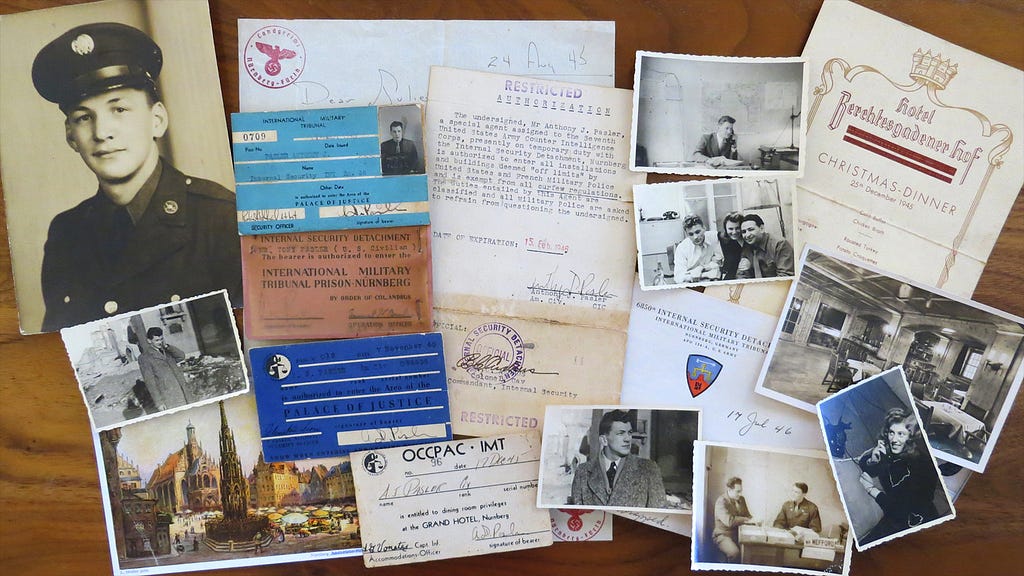
His anti-aircraft battalion had been called to guard a secret interrogation center in Luxembourg. The Allies used it to keep the highest-value Nazi targets away from the media and general public. Because my father spoke fluent French — which he learned in the Army — and German, which he picked up from his parents who were from what is now Slovenia, military historians told me that’s how he ended up in the Commandant’s office.
Over the past ten years, I’ve gone down a deep research rabbit hole and discovered another tool in my Swiss Army knife — I’m a research junkie. I love archives, digging through raw materials, and piecing stories together.
As I traveled around the country looking for pieces of my father’s story — which I found in several places — I also learned about the Nuremberg trials and the war, which I had previously known very little about. Along the way, a vision started to form. One evening, I realized that Nuremberg is such a complicated, fascinating, and largely unexposed chapter of history. I decided to turn it into a project and start a nonprofit to bring it to life.
Back then, I wasn’t even sure what it would become. I thought maybe a virtual museum. I wanted to share the human stories. There’s plenty of facts and figures online, but that’s boring — it’s like memorizing battles and treaties. What really intrigued me was the human experience. And I’m a visual learner, so I started collecting photos from archives that most people haven’t seen and built the story visually.
Then I met a retiring history teacher in Chicago who had been a US Holocaust Memorial Museum Teacher Fellow. He’d taught about Nazi Germany and the Nuremberg trials for 35 years in private schools. I showed him what I had, and this was right after Charlottesville happened. That really shook me. It felt like the tide was turning and the Nazis were coming out of the closet. I had no idea how many there were until then — and after that, more kept coming out, not just here but around the world.
What started as a personal project turned into an urgent call to action. When I met this teacher, I knew we needed to create new youth education to combat this. From his perspective as an educator, there were serious gaps in the classroom. From my perspective as a multimedia producer and designer, I wanted to develop materials that would engage young people — and adults too.
So we partnered and developed a curriculum that uses Nuremberg primary sources in a way that hasn’t been done before. We show students the actual evidence — the irrefutable documentation — to help them understand that the Holocaust was central to the war. In fact, it was the cause of the war. That’s not how it’s taught now. In most textbooks, World War II and the Holocaust are siloed into separate units. And that’s only in the 29 states where Holocaust and genocide education is even mandated, meaning 21 states don’t require it at all.
As we saw more opportunities, we decided to frame the curriculum to be plug-and-play, so it could easily fit into a variety of social studies classrooms while staying aligned to standards. Teachers have limited time and need to check certain boxes. Our mission now is to get this curriculum into classrooms everywhere, turn the tide on hate, and help students recognize conspiracy theories and disinformation online by placing them into the historical context of 1930s Nazi Germany. Not as distant observers, but as young people faced with moral dilemmas and choices.
That’s our approach. We’ve piloted the program in a few classrooms and conducted professional development training in three states. The response to our first module has been overwhelmingly positive. Teachers are excited about the new approach. Students are engaged.
We tested it in two very different schools — Deerfield High in Illinois, a mostly white suburban school with some Asian students, and a Chicago Public Schools classroom that was predominantly Black and brown students. In both places, the results were the same. Learning objectives were met. Students understood the consequences of following evil.
What we’re doing complements, but doesn’t replace, Holocaust education. It deepens the understanding by connecting it to the broader context of the war. And most importantly, it helps young people think critically about the information they’re seeing today and the choices they’re making.
Yitzi: So inspiring. It’s amazing what one person can accomplish. I have so many questions. First of all, there are other groups in the country that promote Holocaust education, like Facing History and Ourselves. Have you been in touch with them? How do you see your work? Is it aligned with theirs? Is it different?
Laurie: Great question. It’s one that prospective funders are asking too — how are you different? Aren’t there already enough great resources out there?
My education partner has worked with Facing History materials, and he says they’re excellent. But they don’t reach a certain percentage of students in the classroom — those who, for whatever reason, aren’t able to engage with empathy-based learning.
We don’t center our content on the victims’ or survivors’ stories. Instead, we focus on the consequences of what the perpetrators did. That’s a very different approach. Facing History’s Holocaust and Human Behavior is a dense textbook. It’s also a 16-week elective unit that not every school can fit into the curriculum. And in those 21 states without Holocaust education mandates, students aren’t getting that material at all.
Our resources are designed to be plug-and-play. Each module is one to three class periods — short, easy for teachers to integrate, and accessible. It’s multimodal learning too. We include things like short narrative podcasts, which Facing History doesn’t offer. And again, we’re not a 16-week unit. We’ve built this so teachers can pick it up and use it immediately.
Teachers are artists, really. They pull from different resources based on their students’ needs — their reading levels, lived experiences, where they are developmentally — and they have to make it relatable. Because in today’s classrooms, students are thinking, “That happened 80 years ago. Why does it matter to me?” They’re spending seven hours a day on their phones, scrolling through content that’s often dangerous or misinformed.
There are a lot of great Holocaust education resources out there — more being developed all the time — and Facing History is a tremendous tool for teaching tolerance and the Holocaust. But we’re focusing on the students whose needs aren’t being met. The ones laughing in the back of the class, thinking about what they’re doing Friday night.
There’s a lot of funding going into Holocaust education in an effort to combat rising antisemitism and racial hatred. But is it working?
The way I see it, there’s this giant dike behind us with water leaking from a dozen different holes. There are people trying to plug those holes, and some of them are doing great work. We’re simply another tool in the toolbox — plugging holes that haven’t been addressed and can’t be plugged by the existing resources.
Yitzi: Amazing. So, a devil’s advocate might ask — why is the solution to antisemitism and racism talking about a terrible tragedy of the past? Maybe it’s more important to focus on the present, focus on why people are wrong today. Why is it important to take a tragedy from the past and use that to prevent hatred now?
Laurie: We approach it in a very roundabout way. We actually have a partnership with the Jewish Federation of Chicago — we’re just getting started, and they’re behind us on this.
By focusing on the distant past, it removes the heat from the current political moment. It also allows us to center everything around fact-based, evidence-driven history. It’s irrefutable. We’re teaching about the past, and we’re hoping that students can connect it to their own lived experiences in the present.
For example, I’m not a teacher, but I was in the room when we ran our pilot in Chicago Public Schools. That was the first time I witnessed the transformation in students. Afterward, I told my education partner, “Now I understand why teaching is so gratifying, but I could never do it — I’d want to smack that one kid who was on his phone the whole time.”
Still, I watched the students start to map the marginalization of people deemed “inferior” onto their own experiences. They asked thoughtful questions about the images and about eugenics. They were reading a primary source affidavit and were surprised by what they were learning.
For instance, they didn’t know what the so-called Aryan ideal looked like. When they saw a photo of a blonde-haired, blue-eyed person described as the “master race,” a group of Black girls asked me, “Is that supposed to be it?” And I said, “Yes.” They didn’t know that. Without even knowing their personal histories, it was clear that seeing how it unfolded then helped them process and understand how similar dynamics might play out today.
We want students to recognize the progression of hate — the propaganda, the repetition, the desensitization. One of the most insightful comments came from a non-binary student, who said, “The way antisemitism and racial superiority were beaten into everyone’s minds.” That student had the most sophisticated response in the class.
They’re connecting the past to the present. By understanding what happened then, they can better recognize the warning signs and patterns we’re seeing now.
Yitzi: I love how you’re connecting the idea of conspiracy theories to antisemitism, because it’s been my experience that once people go down the rabbit hole of conspiracy theories — JFK, 9/11, or anything else that on the surface seems unrelated to Jews — it almost always ends up being a wormhole to antisemitism. Almost always.
Laurie: Yes, it is. And that’s probably been the most frightening thing I’ve learned on this journey. When you consider that the Jewish population worldwide is something like 0.18 or 0.2 percent, the amount of hate directed at Jews is just staggering. It breaks my heart. It truly does.
But I believe we can make an impact. That’s what drives me. This is an urgent call to action, and it was a purpose that found me. It’s mind-boggling that all of this started with a crumpled shopping bag of my dad’s hidden World War II memorabilia. That single moment sent me down this path.
Yitzi: Tell us, how can individuals, communities, and governments get involved to support the work that you’re doing?
Laurie: Now that we’ve seen proven impact, we’re ready to expand. We surveyed 79 teachers across three states, and we already have adoption in over ten states. It’s time to take this data to the fundraising and philanthropic community.
We’ve gotten early support from the Jewish Federation and the JCPA nationally, and now we’re fundraising based on both our results and the demand from educators. Right now, we’ve only completed one of four planned curriculum modules. Each module aligns with one of the four indictments at Nuremberg, which provides a really powerful and coherent framework.
The first is Conspiracy, which Nuremberg proved was rooted in Nazi ideology and was the actual cause of the war. Then Crimes Against Peace, followed by War Crimes, and finally Crimes Against Humanity. That last charge was created at Nuremberg to address the Holocaust, because those atrocities didn’t fit into any of the existing legal categories at the time.
Any kind of media exposure — press coverage, articles, anything — would be incredibly helpful right now. We’re approaching the 80th anniversary of the Nuremberg Trials this November, and it’s the perfect moment to spotlight how relevant and urgent these lessons are today.
This history has been buried in archives and overlooked in classrooms for decades. Our approach is new and different, and it’s designed to reach students who have been left out of traditional Holocaust education models. Attracting philanthropic support is critical so we can complete the full curriculum and keep moving forward.

Yitzi: What if a school says, “We don’t want any woke textbooks”? How do you answer that?
Laurie: That’s exactly why we’re staying right down the middle of the history lane, focused on social studies classrooms with a standards-aligned curriculum. Every world history class is required to cover the causes and consequences of World War II. Each state defines that a little differently, but it’s a universal requirement.
We’re not showing images of Nazi brownshirts arresting Hitler’s opponents in 1933 and saying, “That’s like ICE today.” Absolutely not. As I mentioned before, teaching the distant past helps take the heat out of the present.
Earlier this year, we had our workshop proposals accepted at two major social studies conferences — in New York and Illinois. Both were held in rural districts, which is exactly our target. These are often red districts, and we wanted to see how the teachers there would respond to the materials. The response was overwhelmingly positive. They rated it incredibly highly.
Those rural areas are often where students don’t have access to counter-narratives. And we’re very intentional about avoiding the “woke” debate entirely. What we’re offering is innovative World War II curriculum that also qualifies as Holocaust education.
We can get into the classroom with these materials and at least teach students about propaganda, conspiracy theories, and what actually happened — using standards-aligned lessons that don’t bring in present-day political analogies. It’s history, and it’s grounded in facts.
Yitzi: How do you answer the challenge of, “Enough about the Holocaust. We don’t want to hear about it anymore. It’s too much. You’re shoving it down our throats. There’s a whole Holocaust industry. Too many Holocaust movies.”
Laurie: We’re teaching the causes and effects of World War II by using trial evidence of what actually happened — their own signed documents. Is it the story of the Holocaust? Yes, but it’s also the story of the war, the war of aggression, the violation of treaties, and all these things that have to be taught in classrooms and social studies. International relations classes will benefit from this.
Module two is “Hitler’s Deceitful Diplomacy.” Think about how relevant that is. Studying the distant past and thinking about how the lessons from back then apply to the world today. War crimes, crimes against humanity — those are terms being thrown around in newsfeeds and social media by people who don’t understand what they actually mean. We’re going to correct that too.
Yitzi: The word genocide — people don’t even know what it really means.
Laurie: Correct. Everybody wants to go straight to the most extreme label. It’s sad. But to address your point about Holocaust education and these stories, I think there will always be a market for them because they’re human stories — stories of survival or persecution that tug at the heartstrings. The market is primarily Jewish, and others who care because it’s personal. When it’s your family, it’s personal to you.
I’ve talked to so many people who say the same thing: “If my father had told me this story a long time ago, I would’ve been like, ‘Yeah, yeah, whatever.’ But since I had to learn it myself, it’s more meaningful. I’ve learned so much more context to put it together.” World War II is the most studied period, and Nazi Germany is the most studied regime in all of history — for a reason. It’s absolutely mind-boggling what those people did and got away with.
And to see the rising hate now — it’s an alarm bell. There’s an organization called the Global… what is it… GPAHE. I can never remember exactly what it stands for, but they’re basically a research institute. They published a study in June showing that neo-Nazis are organizing as youth groups and taking it offline.
It’s like Fight Club — remember that film? They’re doing MMA-style martial arts and basically organizing a modern-day Hitler Youth. There are 19 chapters in 42 states, and it’s growing like wildfire. These are 15 to 18-year-old kids. So yes, we have a Nazi problem that needs to be addressed.
Nazi ideology was the cause of the war, and we prove it. It’s our thesis. The Holocaust was an integral part of the war, and if kids understand that, then when they learn about the Holocaust, they’ll grasp why it happened and how it was possible.
Our podcast — which I’m proud to say won a Communicator Award of Excellence for the first season — takes the point of view of a young boy or girl growing up in Germany in the 1920s and 30s. What would your life be like? They look at photos of real life from that time. Girls were told their only role in society was to have as many racially pure babies as possible. Boys were taught they would die for Hitler as soldiers, and they were learning to use guns before the age of 10. We’ve got all the pictures to show it.
This is where we are radically different from traditional tolerance education. It’s more like Mothers Against Drunk Driving — hitting them with a hammer. That’s what we want them to remember. We even got feedback from students saying things like, “I learned that when you do evil, evil comes back at you.”
Yitzi: Amazing. Laurie, you’re doing such special work. I hope you have an infinite amount of energy, resources, and connections to bring your vision to fruition. I thank you personally — as a grandson of Holocaust survivors. My grandparents were in Auschwitz, and my great-uncle and great-aunts were killed there. Thank you on their behalf. You’re doing amazing work, and I wish you continued success. How can our readers get involved?
Laurie: courtroom600.org. They can learn more there. Teachers can download the resources — they’re free, which is another big bonus. As long as we can get sustainable support, we can continue to make these resources free of charge to teachers. Courtroom600 also has a donate page where you can donate securely. We’re a 501(c)(3) nonprofit, so all contributions are tax deductible to the full extent of the law.
Yitzi: Laurie, thank you for all that you do. You’re a humanitarian. It’s an honor to meet you. Really an honor.
Laurie: You as well. Thank you. Bye-bye.
Laurie Pasler on Unearthing a Father’s Hidden Past and Turning Nuremberg Into a Multimedia Wake-Up… was originally published in Authority Magazine on Medium, where people are continuing the conversation by highlighting and responding to this story.