…Obviously, everyone has a different experience and a different response to trauma, combat, and all the things that serving in our military involves. But there are many men and women who come home and really struggle. You can’t solve a problem if you don’t know about it. You can’t solve a problem if it’s not on your mind, and you can’t solve a problem if you’re not trying to engage with the people who are going through it. If we can motivate people to think about it and to act upon it in a concrete way — and of course, everything’s local, right? It’s all about reaching out to the people around you. In terms of six degrees of separation, we all have probably one or two degrees of separation when it comes to the military. So, that’s the message of this film…
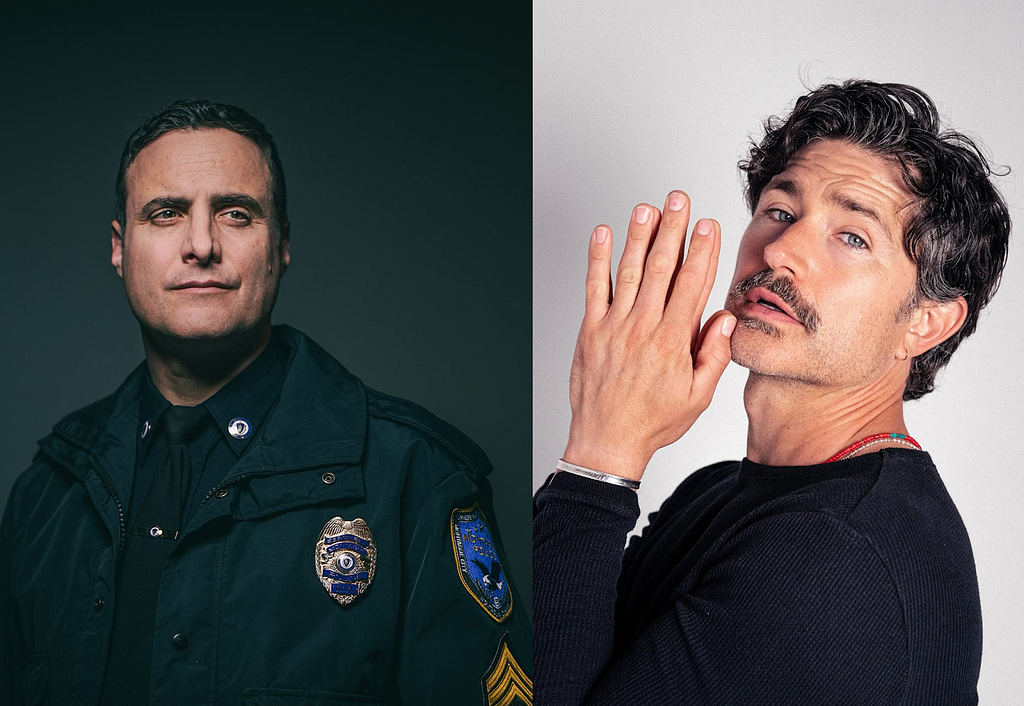
I had the pleasure of talking with Dominic Fumusa and Matt Dallas, two actors whose careers have taken radically different trajectories to arrive at the same gritty destination. On the surface, they make for an unlikely pair. Fumusa is the quintessential character actor — a theater-hardened Wisconsinite best known for playing the exasperated husband on Nurse Jackie and a distinct lineup of military operators. Dallas, conversely, rose to fame as the face of mid-2000s teen sci-fi, the wide-eyed, belly-button-less protagonist of Kyle XY. Yet, in their new film Sheepdog, these two distinct energies collide to tell a story not just about war, but about the brutal, silent battle of coming home.
To understand how they got here, you have to look at where they started. For Fumusa, the path to Hollywood wasn’t a straight shot; it was a panic-induced pivot. Born and raised in Madison, Wisconsin, he spent his college years at Lawrence University prepping for a life in courtrooms, not casting rooms. “I studied political science and government, and I thought I was going to be a lawyer,” Fumusa recalls. But as his peers began the grueling prep for the LSATs during his junior year, reality hit him hard. “I had a panic attack,” he says. “I came to the conclusion that I really didn’t want to be a lawyer; I wanted to play a lawyer on television.”
That realization sent him from political science to an MFA program at the University of Illinois, followed by the grind of the Chicago and New York theater scenes. He spent years cutting his teeth on Broadway and Off-Broadway stages before the television world finally caught on. His breakout role on Showtime’s Nurse Jackie changed everything, but his heart remained tethered to stories of service. “I really love getting to tell stories about the military,” Fumusa says, noting that Sheepdog is a natural continuation of a career often defined by uniform-clad roles.
Matt Dallas, on the other hand, was never going to be a linebacker. Growing up in Phoenix, Arizona, he found himself at odds with the typical boyhood expectations. “I was the kid out in right field chasing butterflies and picking daisies,” Dallas admits with a laugh. Recognizing he hadn’t found his tribe, his grandmother took him to his first audition at age 12. Theater became his sanctuary until he packed his bags for Los Angeles at 18. “I thought, ‘Hey, I’ll give it a shot in Hollywood,’” he says. It was a gamble that paid off when he booked Kyle XY, a role that turned him into a cult icon for a generation of TV watchers.
But Sheepdog isn’t a project that was simply sent over by an agent; it’s a labor of love that has been marinating for over a decade. The seeds were sown in 2011, when Dallas was shooting a Western with director Steven Grayhm at the now-destroyed Paramount Ranch. Grayhm had a chance encounter with a combat veteran working as a tow truck driver, a man struggling with demons that were slowly eroding his family life. Grayhm couldn’t shake the story. He told Dallas, “I want to uncover the truth about this… I want you to come along with me.”
What followed was a method approach to filmmaking rarely seen in the industry. The duo embarked on a series of cross-country road trips, spending ten years “digging into every nook and cranny of this country, talking to anybody that would sit with us.” The goal wasn’t just to make a movie, but to document a reality. As Dallas puts it, the film attempts to shift the conversation from post-traumatic stress to “post-traumatic growth” — the idea of “holding your trauma, doing the work, coming out the other side, and becoming stronger because of it.”
In the film, Fumusa plays Clarence, a character that hits close to home. Clarence starts as a hockey coach, allowing Fumusa to tap into his own history as a self-described “jock” who played college football. “I relate to wanting to reach out, make sure somebody’s okay, and help them any way I can,” Fumusa says. His character eventually joins the police force, a transition that resonates with Fumusa’s deep admiration for first responders. “I aspire to their ability to sacrifice and work for the common good,” he says. “I wish I were more like them.”
Dallas plays Daryl, a character he says mirrors his own desire to “put some love and joy into the world.” While Dallas admits the military world “never really existed in my realm,” the project forced an immersion that radically altered his perspective. “It does take a village,” Dallas says, emphasizing that the film is a call to action for civilians to step up.
Ultimately, both actors view Sheepdog as more than entertainment. For Fumusa, it’s about visibility. “You can’t solve a problem if you don’t know about it,” he says bluntly. He hopes the film motivates people to bridge the gap between the civilian and military worlds. For Dallas, the message is even more direct. He wants every veteran watching to know one thing: “You matter.” It’s a simple sentiment, but coming from two men who have spent a decade trying to get this story right, it lands with the weight of truth. “If we can help save one life with this movie,” Fumusa says, “that’s the only thing that matters.”
Yitzi: Matt and Dominic, how are you? Dominic, could you share your personal origin story and the seeds for the amazing work that has come since then, particularly in this film?
Dominic: Okay. Well, I was born and raised in Madison, Wisconsin. When I was in college, I went to a liberal arts college called Lawrence University, which is in Appleton, Wisconsin, near Green Bay. I studied political science and government, and I thought I was going to be a lawyer. I always tell this story: I was a junior in college, and all my friends were getting ready to prepare for the LSAT, and I had a panic attack because I had been doing theater my whole life, and I was doing theater in college as well. I came to the conclusion that I really didn’t want to be a lawyer; I wanted to play a lawyer on television. I was a big fan of a show called L.A. Law at the time.
Anyway, I went to graduate school at the University of Illinois. I got an MFA in acting. I started in Chicago, moved to New York, and did theater, theater, theater — Broadway, Off-Broadway, regional theater. Then, in my late 20s, I started getting television work. The job that really changed my life was being a series regular for seven seasons on a show called Nurse Jackie opposite Edie Falco, which was on Showtime from about 2009 to 2015. Since then, it’s been mostly television and film.
I still love the theater, but I love getting to do film and TV, and I really love getting to tell stories about the military. I’ve done several movies and television shows about the military, and this is just a continuation of that. It’s so thrilling to be a part of Sheepdog. It tells such an important story about what happens when we come home. There are so many great stories about combat, being overseas, and deployments, but we don’t see too many films deal with the reality of returning to society after having had that experience. That is such a powerful message. We need to support our military in that way — our soldiers, our men and women who come home. That’s what Steven’s movie does. It’s a great movie, and hopefully, a lot of people will get to see it.
Yitzi: How about you, Matt?
Matt: Okay, origin story. I grew up in Phoenix, Arizona. I’m sure, as in many cities, the boys play sports. I played some sports growing up, but it was never really my thing. I was the kid out in right field chasing butterflies and picking daisies. My grandmother recognized that I hadn’t really found my passion yet, so she took me to audition for my first play when I was 12. Then I just did theater; theater became my life until I turned 18. I was deciding — I almost went to New York City — but Los Angeles is a lot closer to Phoenix than New York is. So, I thought, “Hey, I’ll give it a shot in Hollywood.” I always thought I was going to do theater; that was going to be my thing. But after a few years of living in L.A., I booked my first TV show, which was a leading series regular on a show called Kyle XY.
From there, I started working mostly in film and television. But this project came to me in 2011. Steven and I were shooting a Western together up at Paramount Ranch — which is unfortunately no longer there; it burned down in 2018. He shared with me this experience he had with a tow truck driver who was a combat veteran. He sort of opened up about the demons he was facing and the toll it had taken on him, his wife, and his kids. Steven couldn’t get the story out of his head. He shared it with me and said, “I think I want to uncover the truth about this and see are there more men and women out there that are going through this same experience. I want you to come along with me, and if this ever becomes a movie, you should play my best friend in it. But first, we got to go out and get the story.”
So, we did. We set out on our first of a few cross-country road trips, digging into every nook and cranny of this country, talking to anybody that would sit with us. Over 10 years, we researched and developed the screenplay. Our objective was just to get it right, allow their stories to start the conversation, uncover the truth, and share it with the rest of the country. As the years went by, it further developed. As Dominic was saying, one of the unique things about this story is that it really does focus on the war at home. Even beyond that, most everybody knows about post-traumatic stress, but to really make the focus on post-traumatic growth I thought was something special. To change the narrative to be able to talk about holding your trauma, doing the work, coming out the other side, and becoming stronger because of it.
Yitzi: So Dominic, can you compare and contrast your personal character Dominic with Clarence, the character you play in the film? How are you similar and how are you different?
Dominic: That’s a good question. I think I’m similar in that he started out as a hockey coach. He coached Calvin, and they bonded over sports and that world, which I know very well. I played pretty much everything, including some college football. I definitely considered myself a jock as a younger person, and I still to this day love sports. I do more watching than playing, but there’s that connection. Also, just the sense of wanting to help a guy who feels like a little brother to me. I don’t have a little brother; I have two older brothers. But I relate to wanting to reach out, make sure somebody’s okay, and help them any way I can, which is something that Coach O says directly in the film. He says, “If I can be there, I’m there.”
Coach O then becomes a cop. I relate less to wanting to be a cop, but I do admire it. I admire our first responders and the sacrifice that they make, and of course, the sacrifice that all our soldiers make. I’ve got to know so many great people in the military and first responders over my career, whether I’ve literally played some of them in films or just gotten to know them through research and eventually friendship. So, I admire them. I aspire to their ability to sacrifice and work for the common good. I wish I were more like them in that way. I try sometimes, but maybe I could try harder. I’m always in awe of the things that people do for our communities, for our country, for our world. So, I’d like to be more like Coach O, I think.
Yitzi: Matt, how about you? How would you compare and contrast your character with Daryl, the character you play? How are you similar and how are you different?
Matt: I think Daryl and I are similar in that we wake up every morning with an intention to put some love and joy into the world and try to provide the people around us with some joy and lead with love. Contrastingly, sort of like what Dominic was saying about being a cop, I don’t know that I ever considered joining the military. That was never something that really existed in my realm or my world. But through this project, I have grown an immense amount of respect and gratitude for them. This immersion into their world has really opened my eyes to so much, and I am forever grateful.
Yitzi: Amazing. What’s the message, what’s the takeaway you hope viewers take away from the film and practically, how do you think they’ll change the way they relate to veterans moving forward?
Matt: I would say to the veteran community, or anybody that’s experiencing trauma or trying to make their way through it, that they are not alone and that they matter. But I think also to the civilian population, it does take a village and a community. I don’t come from a military family, so to me, this was a very eye-opening experience. I hope that we were able to do that for others so that they can step up and show some support to the veteran community.
Yitzi: What would you say, Dominic?
Dominic: I would just add, and it’s really what Matt is saying, with regard to the vets who will see this: there’s an expression in the film that, “You matter.” I hope that they’re hearing that from all kinds of places, but I certainly hope they hear that when they watch this film because that’s really the most powerful message we can share. It always sounds a bit simple or a bit Pollyanna, but if we can help save one life with this movie, that’s the only thing that matters.
To the general public, just a stronger awareness of what our soldiers are going through upon their return. Obviously, everyone has a different experience and a different response to trauma, combat, and all the things that serving in our military involves. But there are many men and women who come home and really struggle. You can’t solve a problem if you don’t know about it. You can’t solve a problem if it’s not on your mind, and you can’t solve a problem if you’re not trying to engage with the people who are going through it. If we can motivate people to think about it and to act upon it in a concrete way — and of course, everything’s local, right? It’s all about reaching out to the people around you. In terms of six degrees of separation, we all have probably one or two degrees of separation when it comes to the military. So, that’s the message of this film.
Yitzi: Matt and Dominic, I want to thank you both so much for your incredible work. I wish you continuous success and good health and I hope we can do this again soon.
Dominic: Thank you. Very good to talk to you. Thank you.
Yitzi: Thank you, have a great day everybody.
Matt Dallas on ‘Sheepdog’, 10-Year Cross-Country Research & the Power of “Post-Traumatic Growth” was originally published in Authority Magazine on Medium, where people are continuing the conversation by highlighting and responding to this story.