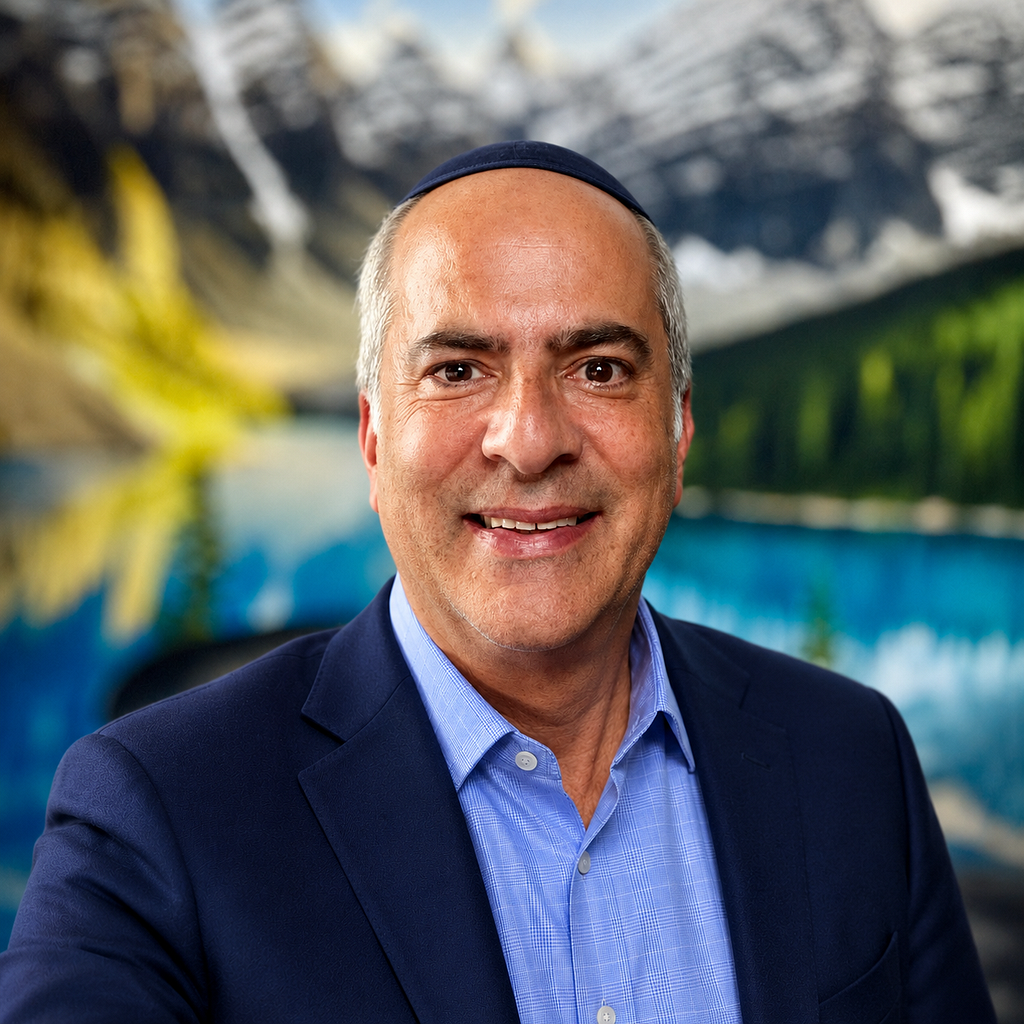
Inside R’ Shlomo Horwitz’s Radical Theatrical Approach to Torah Education
Over the years, I’ve learned to behave like you are always on display, because you are
I had the pleasure of talking with Rabbi Shlomo Horwitz. Years ago, at a campfire program for high school boys with special needs, R’ Horwitz closed his guitar case and announced that he was becoming somebody else. “My name is Tuvia,” he said. For the next 20 minutes, he told the story of a secular Jew who lost a leg in a farming accident, moved to Israel, and helped reunite two brothers separated by the Holocaust.
When R’ Horwitz reopened the case, he became Shlomo again. At least that was the plan. Walking back to the cars, one boy stared at his legs and marveled at how naturally he moved with a prosthesis. R’ Horwitz explained that he had been acting. The boy had forgotten.
R’ Horwitz went home and told his wife, “This acting thing really works.” The moment helped define the educational method he has developed ever since: traditional Jewish learning delivered through decidedly unconventional forms. He has portrayed Rabbi Akiva, an Israeli fighter pilot, a soldier at the Western Wall in 1967, Maimonides, an Israeli underworld figure, and other carefully researched characters. He has used music, dramatic monologues, writing, podcasts, and ordinary classroom teaching to make religious ideas feel immediate.
R’ Horwitz grew up in Queens in a Modern Orthodox home shaped by Torah, attachment to Israel, and communal responsibility. His father, an anesthesiologist, had studied as a teenager with Rabbi Yaakov Kamenetsky in Toronto. The relationship outlasted the classroom. Rabbi Kamenetsky helped arrange his and perform his parents’ marriage, traveled by subway to meet R’ Horwitz’s mother and her family, and gave the couple a set of Shulchan Aruch that she still treasures.
Years later, at Ner Yisroel in Baltimore, R’ Horwitz pushed his way into a room where the elderly Rabbi Kamenetsky was resting after a speech. When the rabbi learned that the young man was Nachum Horwitz’s son, “Rav Yaakov lit up, looked at me, grabbed my hand, and gave me a kiss,” R’ Horwitz recalled. What stayed with him was not simply proximity to a revered scholar. It was the idea that “a talmid (student) is a talmid for life,” that education creates an obligation extending far beyond a course or institution.
That principle became personal during R’ Horwitz’s own period of doubt. As a high school student, he privately questioned whether God existed and whether the Torah was true. He did not feel comfortable raising those questions with his parents or teachers. At Yeshivat Sha’alvim in Israel, Rabbi Moshe Tzuriel recognized his uncertainty and met with him for hours at a time. “He was so comfortable talking about anything,” R’ Horwitz said. “He treated me with immense respect.”
Once his questions no longer felt forbidden, R’ Horwitz devoted himself to learning. At Ner Yisroel, he encountered Rabbi Yaakov Weinberg and decided, after barely a month at the school, that he wanted private study time with him. He approached Rav Weinberg in the Beit Midrash, violating an unspoken protocol obvious to everyone except, perhaps, the determined newcomer.
Rabbi Weinberg kindly said he was too busy. R’ Horwitz remained standing there and blurted out, “Rebbi, you don’t have 15 minutes a week?”
The answer was yes. Those 15 minutes grew into a 17-year relationship, continuing for 12 years after Horwitz entered the working world as a CPA. Rabbi Weinberg advised R’ Horwitz and his wife on family and educational decisions, and encouraged the theatrical approach that would become central to R’ Horwitz’s teaching. When R’ Horwitz proposed using historical characters and period performance to teach Jewish history, Rabbi Weinberg’s response was simple: “Great idea, go do it.”
R’ Horwitz did, though not by abandoning the practical life he had built. He maintained a business career while teaching adults and teenagers, playing music at nearly 1,000 weddings and bar mitzvahs, writing for Jewish publications, and developing Jewish Crossroads around the questions that once troubled him. The combination is not as tidy as a conventional biography might suggest. Music could become so consuming that he heard it while trying to study. Acting risked overshadowing the material it was meant to serve. His work has therefore involved learning when to release a talent and when to restrain it.
His wife has been central to that balance. R’ Horwitz describes her as a partner in his projects and “one of my true heroes,” particularly because of the way she handled a serious illness from which she has improved. He declines to tell the stories she would prefer to keep private. The restraint is revealing in a man who makes much of his living through stories.
Today, R’ Horwitz teaches a daily Talmud class, writes, performs, hosts and co-hosts podcasts, and continues searching for ways to make Torah intellectually credible, emotionally accessible, and enjoyable. He still approaches education like the student who ignored the silence behind him in the Beit Midrash and asked for 15 minutes anyway. The conversation that follows explores what he learned from the teachers who welcomed difficult questions, why he believes talent carries responsibility, and what happens when a guitar case closes and a lesson becomes a life.
Yitzi: Rabbi Shlomo Horwitz, it’s such an honor to have you with us. Before we dive in and talk about your amazing work, our readers would love to learn about Rabbi Shlomo Horwitz’s personal origin story. Can you share with us the story of your childhood, how you grew up, and particularly the seeds and genesis of all the amazing creativity that has come since then?
Rabbi Shlomo Horwitz: Certainly. I’m from Queens, New York, and I grew up in a Modern Orthodox home that was permeated by Torah, love for Israel, and community responsibility.
My father, of blessed memory, was a doctor from Toronto, Canada. He was an early student of the famous Rabbi Yaakov Kamenetsky, zatzal, before Rabbi Yaakov came to Torah Vodaas and became a world-famous Rosh Yeshiva. Rabbi Yaakov came from Europe, and after living in a couple of cities, he landed in Toronto where he ran a Talmud Torah for boys who were between 14 and 17 years old. These were high school-aged Jewish boys who went to public school because that was all there was. There were no day schools back in the early 1940s. My father was one of those boys, and he was good friends with the Kamenetsky sons, who all became famous Rosh Yeshivas themselves. He was literally in their class.
Rav Yaakov was a tremendous influence on my father, and Rav Yaakov would later perform the wedding ceremonies for my two sisters. My father, who became a talented anesthesiologist, was like a family doctor for the Kamenetsky family. He actually helped save the life of one of Rav Yaakov’s granddaughters who swallowed a necklace. My father was very active in helping the family, and Rav Yaakov loved my father deeply, and it was mutual. That was a big influence on me, just seeing how my father loved a gadol b’Yisroel (a Torah giant).
Rav Yaakov was the first gadol that I ever met. I met him a number of times, and one particularly incredible time that had a lasting impact on me was when I later came to yeshiva at Ner Yisroel in Baltimore, as you did. I was there for the 50th anniversary of the yeshiva in 1983, and Rav Yaakov came and spoke. He was one of the highlights of a three- or four-day celebration the yeshiva hosted. He was also a first cousin of the Rosh Yeshiva, Rabbi Ruderman, of blessed memory.
Rav Yaakov spoke in Yiddish. Honestly, I didn’t understand it at the time. Now I know more Yiddish, but back then I didn’t understand it. Still, you could see the love he had for his cousin, the Rosh Yeshiva. The fact that he came at a very advanced age — I think he was already in his 90s, just a few years before he passed away — and spoke was remarkable.
Afterward, he was guided to a side room to recover from the effort, and they closed it off to people. You could not get into that room, but I just kept forcing my way through. Finally, I made it into the room, and they asked me what I was doing there.
I said I wanted to meet the Rosh Yeshiva, Rav Yaakov, because my father was Nachum Horwitz (his English name was Norman). Some people didn’t recognize the name, but one of Rav Yaakov’s sons said, “Nachum Horwitz is your father? Come right in.” They let me in, and he told his father, “Rav Yaakov, this is the son of Nachum Horwitz.”
Rav Yaakov lit up, looked at me, grabbed my hand, and gave me a kiss. He loved my father so much. I won’t say it was a life-changing moment, but it is a moment seared into my memory. The love he had for my father, and that my father had for him, is a huge part of my chinuch (upbringing).
I grew up in Queens, and my mother was a refugee from Germany. She caught one of the last boats out of Germany. After a brief stay in Palestine that didn’t work out, she came with her family to New York and grew up in the Breuers community. Rav Yaakov was my parents’ shadchan (matchmaker) and mesader kedushin (wedding officiant).
Many years later, I discovered that he actually went to check out my mother before the match. Someone asked Rav Yaakov about my father as a suitable match for her. He got on a subway in Williamsburg, all alone, and traveled to Washington Heights to see my mother and meet her parents. My mother served him tea and offered him some cake, and he spoke for a short while with my grandfather. Evidently he approved, since days later my father called her for a date. If you think about the hours and effort he spent, you can see how much he loved my father. My father was already a doctor and wasn’t in yeshiva anymore, but a talmid (student) is a talmid for life. I learned this from Rav Yaakov and my father. It wasn’t a matter of, “While you’re in my yeshiva, I care about you, and then it’s over.” No, he guided my father throughout life. Needless to say, Rav Yaakov officiated at the wedding.
I also found out that he gave my father a set of Shulchan Aruch as a wedding gift. My father passed away about 27 years ago, but my mother still treasures that set, which features an inscription from Rav Yaakov.
I grew up in Queens. I went to Yeshiva Tiferes Moshe. We had a legendary principal, Rabbi Avraham Levin, tzatzal. He himself was a talmid of Rav David Leibowitz from Chofetz Chaim. We didn’t realize it at the time, but Rabbi Levin was a pioneering mechanech (educator). He had tons of creative ideas on how to teach Torah and get kids excited. We just thought everybody did it that way.
For instance, you would get a bankbook for the Torah Sheb’al Peh Club. When you learned Mishnayos on Shabbos, you got an entry in the bank book like a deposit. Then you got prizes based on your bankbook. We just thought every kid did that. We didn’t realize he was the only one doing it. His mind was brilliant with educational ideas well ahead of his time, and he had a very big impact on me.
Years later, when I started dabbling in education myself and realized we had studied under a master, I called him up. I said, “Rabbi Levin, I don’t know if you remember me, my name is Shlomo Horwitz.” He immediately replied, “Parshas Vayelech was your bar mitzvah parsha. I walked to Forest Hills from Kew Gardens Hills to hear you lein.” I was blown away. He remembered me out of thousands of talmidim. He zeroed in right away on who I was and my bar mitzvah parsha. I had the chance to tell him, “Rabbi Levin, now that I teach, I realize you were a giant in education, and I want to thank you for the impact you had on thousands of students.” He was too choked up to speak, but I was grateful to thank him for what he did for us.
My mother, may she be well, lives in Har Nof, Jerusalem and is a tremendous armchair psychologist, advisor and mentor to many; foremost to her children. She still gives me advice well into her 90s, kein ayin hara. In fact, an hour ago she just gave me a piece of advice. I told her I started exercising, so she said, “I want you to exercise at a set time every week, because otherwise you’re going to fall off of it.” I told her, “Mom, my job doesn’t always allow me to pick and choose my timing.” She remains a major influence on me, as was my late dear father in law, Mr. Isaac Kinek, and y’bdl, my mother in law Mrs. Shirley Kinek. .
I’m the youngest of four children. The rest of my siblings live in Jerusalem. I went to Tiferes Moshe, then to Chofetz Chaim for high school, and then to Sha’alvim for two years, which were life-changing years for me.
When I was in Chofetz Chaim, I developed many doubts about our faith. Is the Torah true? How do I know God really exists? I didn’t feel comfortable asking my parents or even my teachers. I felt like I shouldn’t be having those thoughts and that something was wrong with me, so I kept them to myself. I went to Israel with all these tremendous doubts, and there I merited to meet a teacher who changed my life: Rabbi Moshe Tzuriel, tzatzal, who passed away in August of 2023, right before October 7th.
He was the mashgiach of the entire yeshiva of Sha’alvim, overseeing about 200 guys, but he saw that I had these doubts. I had been afraid I wouldn’t stay religious because I didn’t think anyone could answer my questions. But when I got to Israel, I asked him, and he was so comfortable talking about anything. He sat with me for three hours a day until I felt completely secure. He treated me with immense respect and made sense out of our entire faith, handling every question I threw at him with a smile.
After that, I spent two years working hard at my Gemara and Torah skills. Now that I truly believed it and understood it was true — not just something I was raised to do — I needed to learn how to learn. I also learned to speak Hebrew fluently during my time there. Before that, I only knew biblical Hebrew, but having Israeli roommates, teachers and roommates provided an immersion experience. I had to learn how to say everyday things like, “You dropped your toothpaste on the floor, pick it up.” Becoming fluent serves me well today when reading Torah books or conversing and teaching in Hebrew.
Afterward, I decided to study at Ner Israel Rabbinical College. Even though it was philosophically a bit more to the right of where I grew up and spent time in Israel, I chose Ner Yisroel because their learning schedule was longer than the alternative institutions I considered. Ner Israel offered four more hours of learning a day, which I wanted and needed. I had a bit of a debate with my parents who had preferred that I stay local to NY, but I convinced them it would be good for me, and they agreed.
Very quickly, I was able to see the greatness of Rabbi Yaakov Weinberg, tzatzal. Listening to him was somewhere between breathtaking and awe-inspiring. My friend Henry Rosenberg had curated a small group of guys to learn Rambam with Rabbi Weinberg every Thursday. You had to know Henry to get in, and when I heard about it, I asked him and he let me join. The first time I heard Rabbi Weinberg in that setting, I was awestruck. I knew I had to find a way to learn from this man one-on-one.
This was in September, during Elul, and I was plotting how to ask him for private learning time. People told me nobody does that unless they’ve been at the yeshiva for 10 or 15 years as high-level scholars, and I had only been there a month. But by November, I decided to just ask anyway because I didn’t know any better.
I walked up to the front of the Beit Midrash where Rabbi Weinberg was learning by himself, completely breaking protocol. As I stood there waiting for him to look up, the entire room behind me grew quiet. I could literally hear the volume drop as people wondered what on earth this new guy, Horwitz, was doing. But I was already committed, Yitzi.
I waited until he looked up from his large volume of the Talmud and asked, “Yes, can I help you?” I said, “Rebbi, my name is Horwitz. I’m in your Thursday Maimonides group.” He acknowledged me, but I was just one of twenty guys. Then I asked, “Can I have a Seder with you? Can I have private learning time with you?” It was unheard of. He said, “I’m sorry, I’m very busy. I don’t have any time.” He smiled and nodded, which was his way of ending the conversation, and looked back down at the Talmud.
I stood there turning red, wanting this so badly. I just blurted out, “Rebbi, you don’t have 15 minutes a week?” He looked up at me as if to say, “What part of ‘no’ are you not getting?” I quickly said, “I’m sorry, I’m sorry.” But he loved it. He smiled, mimicked my cadence, and said, “I think I have 15 minutes a week. Come to my office; Friday mornings at 9:30.” With that, he looked back down at his Talmud.
Those 15 minutes ended up turning into 17 years, merely because I asked for it against all odds. He was another life-transforming rebbe. The choice I made to pick Ner Israel based merely on extra hours turned into a wonderful decision for my philosophy, learning, and growth.
Yitzi: Just to clarify, you learned with him for 17 years? Even after you left the yeshiva and got married, you still went back to learn with him privately?
Rabbi Shlomo Horwitz: Yes, it’s unbelievable. Even after I left the yeshiva, we continued. There is actually a story behind that. I had learned at the yeshiva for about six years and was getting ready to leave for the outside world. I told him how much I loved it there and how amazing it was to learn in the yeshiva. I asked him, “What do I need to do just to stay strong in my Judaism?” He told me something that I really think other people could really grow from. He said, “Shlomo, it’s so obvious. The rabbis told us what to do and nobody does it. So few people do it.” I asked, “Tell me, what’s the secret?” He said, “The way you stay loyal to your faith is to cling to the dust of the feet of the rabbis.” Meaning, create a relationship with a rabbi and study from them; that is the key to your success in the secular world. He said the rabbis told us this key. I smiled at him and said, “Rabbi, if that’s the case, you’re my rabbi. Can we continue learning after I leave? I want to cling to your Torah.” He smiled and said, “Of course, what a question.” And we continued. Out of those 17 years, I was already out of yeshiva and in the working world for 11 of them.
We involved him in many of our decisions about where to send our kids to school, as well as educational challenges that some of my children had and how to handle them. He was very critical in many life decisions. He didn’t make the decisions for me, but he gave tremendous guidance to me and to my wife as well.
The story really comes full circle because Rav Tzuriel, who had guided me in Israel, remained my rebbe throughout, and we visited him every year. For about five years, I had a chavrusa (learning partnership) with him on the phone. He was in Israel, in Bnei Brak, and I was here, and we would learn Navi over the phone. One day I asked him, “Rebbe, you were in Eretz Yisrael, tell me what that was like.” I discovered many years later that he too was a talmid, a student of Rabbi Weinberg, and Rabbi Weinberg had changed his life too. So the first rebbe who changed my life was a student of the second rebbe who changed my life, and I didn’t even know it.
More recently, I have benefited greatly from other master teachers at Ner Israel, including Rabbi Weisbord, Rabbi Berkowitz, and Rabbi Shraga Neuberger.
To fast forward, I’m a CPA and had a career in the business world, generally in non-Jewish, secular environments, and I was able to navigate that because of my connection to Torah. But I never forgot my struggle with belief as a teen, and remembered too well that I had been a confused kid who had questions about Judaism. And that it wasn’t easy to get answers. I made a personal commitment that I was going to do what I could to pay it forward, give back to the system, and teach in some fashion.
During the First Lebanon War, I spent a summer working with street kids in Tel Aviv, helping them spend a meaningful summer and learning some Torah. Later, I actually did some classroom teaching. I taught sixth grade at Beth Tefiloh Community School here in Baltimore. I finished out a teacher’s term after she had a baby and wasn’t going to come back, so I was asked to fill out the rest of the year from about February to June. I loved it, but I made a decision that I wasn’t going to pursue classroom teaching at that stage in my life. I was already a CPA and wanted to work in that field. In the end, I always did my educational work informally on the side as a lecturer for adults and teens, and as a teacher in my synagogue.
I guess that gets us to Jewish Crossroads, which is my biggest link to Jewish education. Jewish Crossroads is a program I started for kids covering the areas I struggled with myself. I have a website, jewishcrossroads.com, if anybody wants to read about it. I wanted to address questions like: How does free will work? How do I know God exists? Even if He exists, how do I know He gave us the Torah and it wasn’t a human invention? Those were some of the biggest questions I had, and I wanted to give those answers back to kids, and later to adults who wanted to know more.
I started a group at my synagogue, Shomrei Emunah of Baltimore, for teens, because I felt that teens needed it the most. I had been a confused teen, and there are a lot of others out there. I started a group for boys with Rabbi Weinberg’s direction on everything, and another group for girls. Both groups were pretty successful; I would get between 15 and 30 boys and 15 and 30 girls. I ran them separately because I didn’t want anybody to skip it because it was co-ed. I wanted to reach as many kids as I could, and keeping them separate had its advantages. Probably a couple hundred kids came to my programs over the years, and I’m actually still in touch with some of them. I hope I made a difference.
Another passion of mine is music. I was a professional musician for many years on the side, playing weddings and bar mitzvahs. I was on a few albums back in the day with bands like Kesher, Shlock Rock, and Zemer. I also played for the Diaspora Band and Avraham Rosenblum. I played a few different instruments — guitar, bass, drums, and some keyboard. That was a sideline, but I was always interested in music and tried to use it as a tool to teach Torah, not just for relaxation.
One day my approach to teaching changed drastically. I was once invited to tell a story at a program for high school boys with special needs. I brought my guitar to perform a kumzits (musical gathering) for these boys, and I had a great story that was originally told by Rabbi Pesach Krohn. The story is about a guy named Tuvia, a secular Jew growing up in the United States who was in a terrible farming accident and lost his leg. He got a prosthesis, moved to Israel, and drove a cab. Through him, two long-lost brothers who thought each other had died in the Holocaust were reunited. It’s an incredible story and one of my favorites.
Normally, I would just tell the story like everyone else does: “Once there was a fella named Tuvia…” But something happened around that time that made me want to change my approach. My wife and I went to Williamsburg, Virginia, where they have people dressed in period costumes showing what life was like in colonial, pre-revolutionary Williamsburg in the 1760s when it was the capital of the English colony. They beautifully reconstructed the whole city based on the original plans, with costumed actors pretending it’s 1760 and they are visiting from England.
I was very skeptical. I saw a guy talking to a bunch of tourists with a slight British accent, talking about the local Native Americans and what was going on with England. Being a bit of a wise guy, I wanted to see if I could throw him off a little. He asked me, “Where do you come from, sir?” I said, “I just came from Baltimore, and traffic was murder on the Beltway.” Obviously, that’s not something you would say in 1760. But he absolutely ate me for breakfast. He was so engaging and knowledgeable about the era that I completely suspended my disbelief for a minute and felt like I really was talking to someone in 1760. He had me hooked. After about 25 minutes, my wife said, “We have to go, we just got here!” But I insisted on staying because he was so good. I loved the way he transformed a piece of history and made me feel part of it.
When I came back to learn with Rabbi Weinberg, I said, “Rebbi, why don’t we do that? We have such a rich history. Why can’t we use period costumes and act like we’re living in the time of the Rashba, the Rambam, or the Crusades?” He said, “Great idea, go do it.” I joked that I needed a few million dollars to build a theme park like Spielberg, but Rabbi Weinberg was incredibly encouraging, so I decided to try acting to relive parts of history.
My first experiment was at that campfire with those boys. I was going to tell the story about Tuvia, but I decided to tell it as Tuvia. I played a song on the guitar and told them, “When I close my guitar case, I am going to become somebody else.” I stood up and said, “My name is Tuvia.” I thought I made it clear that I was playing a character, since they introduced me as Shlomo and I had just sung with them as Shlomo. For the next 30 minutes, I told the story in the first person. I talked about the farming accident, the prosthesis, moving to Israel, and everything else.
When I finished the story, which has an amazing ending from Rabbi Krohn, I opened the guitar case and said, “I’m Shlomo again. Let’s play Acheinu.” We sang, watched the fire, and then the activity ended. As we walked back to the cars, a boy came over and said, “I really enjoyed the story.” I thanked him, and then he just stared at my legs. It was autumn and chilly, so I was wearing a coat. He kept staring, so I asked, “Is everything okay?” He said, “No, it’s just that you walk so well. I can’t even tell you have a prosthesis; your walking is perfect.”
That’s when I realized he had been completely transformed into believing I was actually that character. I explained, “I’m sorry for the confusion. Remember when I said I was going to become someone else? That was just a character. I’m fine, my leg is normal, thank God. I was just acting.” He said, “Oh, I forgot.”
I went home and told my wife, “This acting thing really works. It makes a tangible difference.” I’m not a trained, professional actor, but I’m decent. I told her I thought this was the way to go for Jewish education. From there, I embarked on developing different characters. I now have about 20 or 25 characters that I portray.
With Rabbi Weinberg’s permission, I can portray almost any rabbi, like the Ramban or the Ramchal. The only exception he made was that I cannot portray anyone from the Chumash, whether good or bad. I cannot be Abraham, Isaac, Jacob, Sarah, or any of the Matriarchs, nor can I play Pharaoh or Avimelech. I asked about Joshua, and he said, “Joshua you can become,” because he is also post-Chumash. Everyone I tell this to asks why he drew that specific line, and honestly, I don’t know. I just took the permission and ran with it without questioning him.
Since then, I’ve portrayed Rabbi Akiva, an Israeli fighter pilot walking the audience through a mission, and a 1967 Israeli soldier who captured the Kotel. I even play a Palestinian Hamas supporter living in Detroit. All of these characters are thoroughly researched and designed to drive home a specific point. Because of my love for Israel and the Jewish people, I often portray Israeli characters. One of my popular ones is an Israeli mafia boss. I’ll even throw in real conversational Hebrew, which I picked up during my immersion years in Israel.
Sometimes I speak before Israeli audiences in America. I’ll tell them, “My name is Shlomo Horwitz, and I’m going to go into character.” I use a movie clapboard, slap it, and instantly become Gadi Lavon or someone else, changing my accent and throwing in Hebrew to talk about being the first paratrooper at the Kotel in 1967. Afterward, I’ll slap the clapboard again and say, “This is Shlomo again, thank you for listening.” A few times, Israelis have come up to me asking, “B’eizo yechidah hayita?” (What unit were you in?) I have to tell them, “No, I’m not Israeli and I never served in the army, I’m just acting.”
It proves to me that this is an incredibly effective medium to teach Torah to any age. It works beautifully for everyone from fifth and sixth graders up to elderly Holocaust survivors. I don’t try to trick anyone; I give full disclosure that I’m Shlomo but will be stepping into different roles. It just helps people connect and remember the lessons much better.
More recently, I’ve been doing some traditional teaching as well. I teach a daily Talmud class to about 30 men at my synagogue, including a few people who dial in from Israel, which is a great joy. I am also on two podcasts. One is with you, Rabbi Yitzchak Wiener, whom I consider a true pioneer in Jewish education and outreach. I’m honored to share a podcast with someone so creative, interesting, and deeply dedicated to the Jewish people. We share that core passion, and the listeners really pick up on it.
Lately, I also started my own podcast called You Wouldn’t Believe Jewish, where I interview influencers in Jewish education and outreach. It’s brand new. In it, I might share biographical insights; for instance, I’m deeply fascinated by the life of the Chatam Sofer. He was supposed to leave his community of Mattersdorf, Austria in 1802 for a higher-paying job, but most of the Jewish Quarter in his current town burned down the week he was supposed to leave. He decided he couldn’t abandon them in their hour of need, so he stayed for five years to help rebuild, losing the opportunity that would have paid much more. Five years later, Heaven opened up an opportunity for him in Pressburg, which became a life-changing milestone. I love reading about great people, their commitment, and their love for the community.
Yitzi: Tell us a bit about how your amazing wife supports and encourages the work that you do.
Rabbi Shlomo Horwitz: Thank you. You know, I feel like I didn’t say anything about my wife or my family, and I’m married to an incredible woman who supports all of these projects I’m trying to do. My wife is not just an incredible partner in the work I do, but she is also deeply inspirational; I draw a lot of my strength from her. The way she navigates through life is something from which I draw inspiration every single day. I consider her to be one of my true heroes. There are stories I would love to tell about her that she would never actually let me share, so you’ll just have to take that as the story itself.
Yitzi: You’re such an amazing storyteller. You’re so talented. Let’s talk a bit about the podcast that we do together. There are so many podcasts out there — maybe a million or more. Why do you think our readers should listen to this new podcast we do?
Rabbi Shlomo Horwitz: I think the new podcast we have together offers something truly unique. I didn’t realize there were a million podcasts out there! But what we came up with stands out. Rabbi Wiener, you are an expert on the responsa of Rabbi Zilberstein. I don’t know anyone else in the world who knows those questions and answers like you do, and I deeply admire that. In fact, some of the characters in my educational acting are directly based on the real-life rulings and stories of Rabbi Zilberstein. Those are often the most popular ones because they are real, live events that happened in Israel. Rabbi Zilberstein’s work appeals to me greatly. Why? First of all, I just love him. I’d love to meet him. He’s such a wonderful speaker. Have you heard him in Hebrew? He’s unbelievable, just delightful. I would love to meet him; it’s really on my bucket list to meet him one day. He is somebody who loves the Jewish people. His Hebrew is perfect Israeli Hebrew, and he genuinely cares. You can see how much he cares.
The questions he gets, which you artfully compose, are a real slice of life of the Jewish people — secular Israelis, Arabs, soldiers, Holocaust survivors. It’s like a living cast of characters waltzing through his pages. Rabbi Wiener does a great job of finding these gems, and I think our listeners really love this slice of life. You also see a lot of Ahavat Yisrael (love for fellow Jews) exhibited either by the rabbi himself or by the people in the stories, as well as their deep commitment. It’s a tremendous opportunity we have to share these questions, which you have done so well in your writing for Tabletalk. Now we’re bringing it out for the first time; I don’t think there’s another podcast yet that brings these questions to the public the way you and I are doing. On that side of it, I’m really the passive listener, and Rabbi Wiener does the heavy lifting. He gathered the stories and put them together beautifully.
The other half of the podcast happened organically: I share a story that is unknown to almost anyone. Either it’s unknown because it happened to me personally — so who else is going to know it? — or it might be a story I read in the Israeli press or found in a sefer (holy book) that isn’t widely available. I’ll share that story, and then I ask Rabbi Wiener to react.
What people have told me they like about the podcast is that it’s not scripted. You can tell we are just reacting to each other. You’ve never heard my story, and I’ve never heard your dilemma. If I ever have, I’ll tell you and we won’t use that one! But so far, in nine episodes, I have yet to hear one that I already knew. People are excited that we’re bringing this slice of life from Israel. My mother-in-law just told me she loves the camaraderie between you and me, and that is also appealing to people. They like the way we get along, which is unscripted, genuine, and real. People are really enjoying that aspect of the podcast.
Yitzi This brings us to our signature question. Rabbi Horwitz, you’ve been blessed with a lot of success as a very creative educator, using acting, music, writing, and podcasting to spread Torah and teach. Looking back all the way to the beginning when you first started, can you share five things you’ve learned over the years about being an educator? Five things you’ve learned through the school of hard knocks — sometimes the hard way — that you think someone starting out today could really benefit from?
Rabbi Shlomo Horwitz: Great question. Number one: Don’t be afraid to try something new that has never been tried before. Just because other people haven’t thought of it yet doesn’t mean it’s not a great idea. My idea to ask Rabbi Weinberg to learn with me was insane. Now that I’ve been in the yeshiva world for a longer period of time, I realize nobody did things like that. But because I had the guts and was willing to accept potential failure, it turned into a life-changing 17-year experience with him that I still draw from today. Very few people were using acting to teach Torah back then, and few do even now. I just took the leap, and I believe it has been deeply beneficial. Not everybody can act, but I still think that is an underdeveloped area in Jewish education. If I had a dream, it would be to teach that method, and I think some of it is teachable. So, lesson number one is don’t be afraid to try something new.
Another lesson is something I learned from one of my rabbeim many years ago, which is Kabed et Hashem mehoncha. In Mishlei (Proverbs), it says to honor Hashem with your wealth, but Chazal (the Sages) offered another reading: honor Him with what He has favored or granted you. If you have a talent and are good at something, Hashem wants you to use it.
Honestly, I struggled with where to fit in music. I was so into music that I would hear it playing in my head when I was trying to learn, and it would interfere with my studies. As a musician, I was pretty obsessed with music — I think I still am. I had to control it because it threatened to take over. After a while, though, I realized I could use music to help reach Hashem’s children through kumzitses. I’ve played nearly 1,000 weddings and bar mitzvahs, which I hope has brought joy to the participants. I think everybody needs to dig in and see what they are good at. It may not be music or acting; it might be organizational skills, AI, media, teaching, learning, or writing. A major lesson I’ve learned over the years is to figure out what that spark is. Everybody has something they can do. I don’t buy it when someone says, ‘I can’t do anything.’ I don’t believe it. Find that talent and use it for the Jewish people, because we need you.
The third thing I learned relates to my book, Snapshots of the Divine, published by Adir Press, where I put a lot of these stories. I am also a contributing writer for Mishpacha magazine, Ami magazine, and Hamodia’s magazine, Inyan, Aish.com and Chabad.org.
One experience I’ve written about involves a secular Jew who was a food critic for the Baltimore Sun. He had written an article about a kosher restaurant where he described the food but also included a very negative comment about Orthodox Jews, saying something to the effect of, “Even though Orthodox Jews don’t like mixing with secular Jews, we sat together around the tables at this restaurant and everybody seemed to enjoy the food.” He took a clear shot at Orthodox Jews, and it was published in the Baltimore Sun. Somebody asked if I had seen the article, and when I looked it up online, it only described the food; I didn’t see anything wrong with it. At the bottom, however, it noted that the article had been abridged for editorial reasons. When I read the online comments, people were taking issue with something I couldn’t see. Finally, someone gave me the original printed newspaper article, which had gone through before the edit, and that is where he took his shots.
I posted a comment saying, “It’s a shame the author thinks Orthodox Jews look down on secular Jews. It’s really not true, and I’m sorry you’ve had that experience. It pains me that you felt that way.” The author actually reached out to me and said, “You sound like a nice guy. I would like to meet you.” I responded that I wanted to buy him breakfast. We met, and it became clear that he genuinely feels looked down upon every time he runs into an Orthodox Jew, whether he’s waiting in line for a bagel at Goldberg’s or at a 7-Mile Market.
With that revealed to me — and this ties into my fourth lesson — I learned that people watch us very carefully, whether they are Gentiles or other Jews. Over the years, I’ve learned to behave like you are always on display, because you are. Ever since that discussion, if I am standing in line for a bagel, I am smiling my head off. I go out of my way to show warmth because I know there is a hypersensitivity out there. I want to show people that I’m smiling at them, not looking down on them, and that I’m no better than anyone else. We are on display, especially when wearing a yarmulke and being obviously observant, so we have a greater responsibility to conduct ourselves in a way that brings honor to Hashem.
Here is my last one: Jews are absolutely great. I love interacting with them, and I even love arguing with them. What we have seen since October 7th is an overwhelming inner power emerging from places we would least expect. We see people embracing their Judaism and embracing Hashem, even hostages in the darkest tunnels of Gaza, or people who have lost loved ones.
I personally interviewed the mother of a young female soldier who was killed in Nachal Oz. I wrote an article about it on Aish.com. This was a fairly secular family, but rather than wallowing in their pain, they shared how their daughter passed away with Tehillim (Psalms) and Shema Yisrael on her lips. I love being part of the Jewish people because we possess a tremendous power and a deep loyalty to Hashem. You might not see it right away, but if you scratch the surface just a little bit, we are amazing. Am Yisrael Chai. We should be delighted, excited, and amazed to be part of this incredible nation, and I think that is what every educator and individual needs to know.
Yitzi: This brings us to our final aspirational question that we ask in all of our interviews. We usually ask this in non-Jewish contexts, but I’d love to hear your answer here. Rabbi Shlomo Horwitz, because of your amazing work and the platform you’ve built, you are a person of enormous influence. If you could spread an idea or inspire a movement that would bring the greatest amount of good to the most people, what would it be? You never know how far an idea can spread.
Rabbi Shlomo Horwitz: God loves us. What He wants for every Jewish person is for us to discover Him through Torah. If you’re not a teacher, then support teachers. If you feel you can’t learn, learn just a little bit and support the institutions that teach Torah. Torah is the path God gave us to connect with Him, and it should be enjoyable. It is enjoyable. If you’re not enjoying it, learn something different, because there is something in it for everybody. Either change your subject, find a different teacher, or use technology to mine the incredible, delightful depths of the Torah. That is how we connect with Hashem, and it is the most important thing in our lives. That is our eternity.
Yitzi: Amazing. Rabbi Horwitz, how can our readers continue to follow your work? How can they purchase your books, listen to your podcasts, and support your work?
Rabbi Shlomo Horwitz: I would encourage people to see what I do www.jewishcrossroads.com. My book, Snapshots of the Divine, is available online at www.feldheim.com and in Jewish bookstores. It features 53 different essays, many of them containing stories that have not been recorded anywhere else. The goal of the book is to find the divine in everyday life; I try to do that myself and teach others how to do it, though it takes continuous effort from everyone, including me.
I’m currently working on another book with more of these stories, alongside short but powerful insights on the Torah portions and holidays. It’s going to be called You Wouldn’t Believe — Jewish!, which is also the title of my new podcast. I also highly encourage people to listen to the podcast I host with Rabbi Wiener, called Moral Dilemmas and Other Jewish Stories, as well as my solo podcast. That is what I have going on right now.
Yitzi: Thank you so much for your time; it has been an absolute joy to do this with you. I wish you continued success, good health, and blessings, and I look forward to us doing this again very soon.
R’ Shlomo Horwitz on Moral Dilemmas, Other Jewish Stories, and Bringing Jewish Storytelling to Life was originally published in Authority Magazine on Medium, where people are continuing the conversation by highlighting and responding to this story.