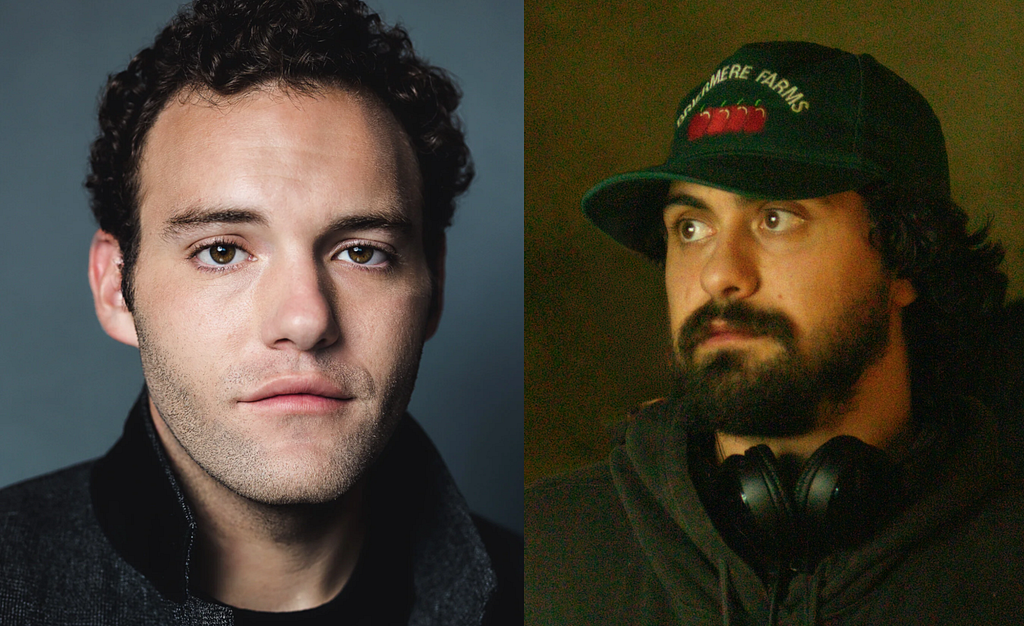
How Nikos Spiridakis and Kyle Primack, The Mimi the Mime Duo Turned Hollywood Strike Desperation Into Dark Comedy Gold
“Not to disparage anyone, but when we were making this movie, we felt like clowns.”
I had the pleasure of talking with Nikos Spiridakis and Kyle Primack. Nikos and Kyle are currently navigating the festival circuit with their new short film, Mimi the Mime, a dark comedy about street performers pushed to their absolute limits. Their journey to this point is a story of grit, shared history, and the relentless drive to create.
Nikos grew up surrounded by the business. “I came from a film-heavy background with both of my parents,” Nikos said. “My mother was an actress for a long time, a B-movie queen, and my dad has been a writer since before I was born”. He made his first video, a global warming public service announcement, when he was just ten years old. He mapped it out on his mother’s whiteboard, catching the filmmaking bug early on. Kyle’s path was completely different. Growing up in Denver, Colorado, he had no family ties to entertainment. “My great-grandf ather was able to survive the pogroms because he was a dancer, and I think it skipped two generations,” Kyle joked. “I am happy that I am not a good dancer, but I am entertaining, which is good”. After acting in a play at the University of Missouri, Kyle fell in love with theater and moved to New York to study at the Stella Adler Acting Studio and Lee Strasberg.
Their paths officially crossed at the Manhattan Film Institute. It was an intense two-week summer program in Long Island where participants scrambled to make twenty-five short films. Kyle attended as an actor, and Nikos as a director. They were constantly crewing on each other’s projects. “When I came as a director, he was on staff and helped me edit my very first film I ever directed,” Kyle recalled. Nikos eventually moved up to become the post-production supervisor for the entire program. That shared experience built a strong foundation of trust that would carry them through the difficult years ahead.
Nikos found early success in post-production. He worked as an intern at 424 Post and eventually landed a job as a sound editor at Sony Pictures Entertainment. “Sony is one of the biggest of all time, so it was pretty amazing to see how all of that got done,” he noted. However, the momentum stalled. Nikos got severely sick, missing out on working on the major studio film Gran Turismo. Then the Hollywood strikes hit. Finding work became nearly impossible. Faced with a stalled career, Nikos decided to pivot back to directing. Kyle, meanwhile, was cutting his teeth in off-Broadway shows and guerrilla filmmaking. He recalled a pivotal shoot in Berlin with a tiny budget where he somehow ended up driving on the Autobahn. “It was the realization that this is what filmmaking is,” Kyle explained. “This is what we sign up for, and what you hope to be a part of before you evolve and get into bigger projects”.
This shared desire to just make something led them to Mimi the Mime. Co-directed by Nikos Spiridakis and Kit Moynihan, and produced by Jason Ziess, the film stars Kyle as Mimi and Brian Wolfe as a struggling clown. The two street performers fight for the attention of a New York City street crowd, only to realize the crowd prefers the actual physical violence over the art. Out of desperation, they turn their routine into an underground fighting ring. Kyle spent five years developing the character of Mimi, diving deep into clowning and Commedia dell’Arte to push himself out of his comfort zone. The shoot was grueling. On the day they filmed the big fight scene, Kyle had a terrible fever. “It was something I had invested time, money, and resources into, and I couldn’t even enjoy it because I was so ill,” Kyle said. Nikos praised his dedication, noting that they had to do what was necessary to pull it off.
The film reflects the dark realities of trying to survive as an artist today. “We felt the same way,” Nikos admitted. “Not to disparage anyone, but when we were making this movie, we felt like clowns”. The project required a massive amount of planning, makeup, and fight choreography, leaving them asking the same questions as their characters about the true cost of success. Nikos has learned the harsh truths of the business. “The biggest one is that there is no easy way to do this,” he said. “You are going to be working nonstop, especially if you are making your own movies. Nobody is going to do it for you”. Kyle agrees, stressing the importance of being open to failure. “If you are not failing, you are not trying,” Kyle said. “Failure is not as bad as it is in your head”. In an industry built on massive budgets and huge crews, they chose to gather their friends and make their own work. Nikos and Kyle are a testament to the idea that if you want to be a filmmaker, you just have to start filming.
Yitzi: Kyle and Nikos, it’s really a delight to meet you. Before we dive in deep and talk about your amazing work, readers would love to learn about your personal origin stories. I guess we’ll start with Nikos. Nikos, could you please share with us the story of your childhood, how you grew up, and particularly the seeds and genesis for all the amazing creativity that has come since then?
Nikos: Nice to meet you as well. Thanks so much. Thanks. I came from a film-heavy background with both of my parents. My mother was an actress for a long time, a B-movie queen, and my dad has been a writer since before I was born. I have always known I wanted to do movies for as long as I can remember.
The first thing I did was when I was ten; I came up with a concept for a global warming PSA, which I try to forget about sometimes. It turned out pretty good. It was very visual, and I have always been a very visual guy. I remember I did the storyboard on a whiteboard that my mom had, and we shot it, and it turned out well. Ever since then, I have had the bug. I have been making movies ever since.
Yitzi: Amazing. How about you, Kyle?
Kyle: For me, my parents are not in the entertainment industry. My great-grandfather was able to survive the pogroms because he was a dancer, and I think it skipped two generations. I am happy that I am not a good dancer, but I am entertaining, which is good.
I grew up in Denver, Colorado, and then I went to college at the University of Missouri. I did a community theater play there, fell in love with theater, and decided to move to New York to pursue it fully. I went to the Stella Adler Acting Studio and Lee Strasberg, and I did a bunch of Off-Broadway shows.
Part of my upbringing in this industry was actually with Nikos. I met him at a place called the Manhattan Film Institute, and that is where we first started working on films together. That is definitely part of my upbringing too.
Nikos: Same here. The Manhattan Film Institute is definitely a big part.
Half the crew is from the Manhattan Film Institute. We made a lot of great friends and team players. Basically, the program was two weeks over the summer in Long Island. Not Manhattan, which is a little weird. But you had to take a bus from Manhattan.
The program was a group of fifty to sometimes even more filmmakers of all walks of life. You come together and you have to make twenty-five films in two weeks. We all would crew on each other’s projects. Kyle came as an actor, and I came as a director. We were all hands on deck the entire time.
Kyle: When I came as a director, he was on staff and helped me edit my very first film I ever directed.
Nikos: Eventually I moved up to post-production supervisor of the program. It was a really great experience, we met a lot of great people, and that is how we connected.
Yitzi: I am sure each of you has amazing stories from your career so far, and this is probably difficult to single out, but Nikos, can you share a story that stands out in your mind from your professional life?
Nikos: A story that stands out? That is a great question. Most of my work has been in post-production. I worked at Sony as a sound editor for about a year, which was a really amazing experience to see how that works. Sony is one of the biggest of all time, so it was pretty amazing to see how all of that got done. I am very into sound design, and I did most of it on this film as well.
It is interesting because it is not what I originally had planned for myself. When I went to college, I was mainly looking to become a picture editor. However, I had to take sound classes on the side to get my degree. I found that I had a really good ear for sound, I was very good at it, and I enjoyed it a lot. I worked with them at 424 Post originally as an intern, and then they contacted me about a year later asking if I wanted to work at Sony. I said yes, and I had a great experience there.
It ended a little tragically. I got very sick and had to miss work. I was supposed to be a sound editor on the Gran Turismo film, and I love doing car sounds, so I was really bummed that I missed that. Then the strikes happened, and it was incredibly hard to get work after that. Basically, it was like getting in line. That was my first legitimate gig in the industry in a union, so it was really difficult to keep working in LA.
I figured I would just move from New York and start directing again. It was the first time in a while that I started writing and doing that kind of work, and it has been really rewarding. That is where this movie came from.
Yitzi: Amazing. How about you, Kyle?
Kyle: I have been lucky enough to be in a couple of really great Off-Broadway shows and perform Shakespeare. But I would say the one story or moment that will always stick out to me — and it comes as no surprise that Nikos and our other director, Kit, were involved — is when we all did a film in Berlin.
It was on a shoestring of a shoestring budget. It was the quintessential guerrilla filmmaking experience in a different country. No one had driver’s licenses except for me. I found myself on the Autobahn at one point, and I have no idea how.
When I look back at all my experiences, that one really sticks out as a pivotal, important moment. It was the realization that this is what filmmaking is. This is what we sign up for, and what you hope to be a part of before you evolve and get into bigger projects with bigger budgets.
It is kind of just starting out with your friends.
Nikos: That was a ton of fun. That was the summer during the strikes. We figured we would just start making stuff. That is how I met Kit, my co-director on this film. I worked as his AD on that project, and we realized we worked really well together, so we decided to do the next one together as a team. Kyle stuck around as well. He developed the original concept for the character of the mime, and then we all fleshed it out together. We just had a blast with it.
Yitzi: Let’s talk about the movie. It seems like a brilliant premise. In your own unbiased opinion, Nikos, please tell our readers why they have to watch this.
Nikos: Well, it is a very relatable story. We start following these weird types of Times Square people, the type of people who dress up as Spider-Man and busk on the streets. They are struggling, and they start fighting over the attention of an audience.
When they start fighting, they have a bit of a eureka moment. The crowd is going crazy and is actually more interested in the fight than they were in either of their art forms, crafts, or acts. It leads them down this dark spiral where their desperation and anxiety about when things are going to pay off turn into this crazy, primal, gladiatorial arena combat.
It starts as this slapstick, buddy comedy where it is all about the relationship. When it goes down that dark path, it is even a little bit funny at first because it is so ridiculous: Mime versus Clown. But by the end of it, you realize and ask yourself if it was a worthwhile trade-off and at what cost they earned all this money.
I think anyone can relate to that, whether you are in the arts or have a desk job. Everybody has this weight on their shoulders right now, especially in this economy. We felt the same way. I think that is what is genius about doing it with Mimi and Hunter, which were Kyle’s character creations. Not to disparage anyone, but when we were making this movie, we felt like clowns.
It took so much work. The amount of work that goes into the post-production, pre-production, extras, planning, makeup, and fight choreography is immense. We have been doing this for so long, and sometimes you do feel like a bit of a clown when you are working hard and waiting for it to pay off. It is a really special film, and despite it being a little twisted and somewhat dark, it is still a comedy at the end of the day.
A lot of our audience who have seen it have responded very well to it, and now we are at the Dances with Films festival. Hard work does pay off sometimes.
Yitzi: How about your perspective, Kyle?
Kyle: I obviously want the audience to find it funny. I want them to laugh and enjoy what we are bringing to them. I remember when I first brought it to Nikos, Kit, and Jason, I said it was already going to be funny. You have two people in makeup; you take one look at that, and you naturally get a big laugh.
Nikos, Kit, and I found it very important to figure out where to find the humanity in it because they are not just one-trick ponies. One of the most important things in storytelling is to create a three-dimensional person. I hope the audience can see a little bit of themselves, whether it be with Hunter the clown, Mimi the mime, the other character Spiro, or just the struggle of the whole process of trying to get from one aspect of what you want to do to the next.
There is this constant battle between art and commerce. I am excited to see the audience at Dances with Films because it is such an independent film-centric group of people. It will hit every audience member, but I feel like it will be something special to the people who know the grind.
I mean, you own your own magazine. I am sure you have things that bother you, but it is about finding the love of the process.
Yitzi: Kyle, you act in the film, right? But Nikos, you do not?
Nikos: No, I don’t.
Kyle: I thought he would be perfect for it at one point and tried to get him.
Nikos: There was some talk of that when we were looking, but luckily we found Brian Wolfe. They had great chemistry. So no, I was not in it.
Yitzi: Kyle, how would you compare and contrast your personal character, Kyle Primack, with the character you play in the film? How are you similar, and how are you different?
Kyle: That is a good question. Mimi is a dreamer, and he is also really stubborn in a lot of ways. What makes this day different from all other days in the film is that it is the day where Mimi just lets go of the control, the stubbornness, and the hardheadedness to follow someone else.
We are similar in that I am very dogmatic in my approach to acting and anything I do. It is about loving the process. Through hell and high water, Mimi loves the process, and it doesn’t really matter to him if he has no money or is sleeping on the streets; as long as he is going out and doing it, something will happen. That is where the dreaming aspect comes out.
Where Mimi and I differ is that I think I am more eloquent with my words than he is. We express ourselves a bit differently because mimes naturally express themselves through their physicality. One of the main reasons why I have been working with this character for five years is because I was really interested in getting myself out of that comfort zone and learning miming, clowning, and Commedia dell’Arte.
He is very good at that, and I have gotten better at it. Going from theater to film, in theater you listen to a play, but you watch a film. In the medium that we are in, it is about telling stories through pictures. If you want to be an actor in film, you really have to understand what that means in a physical sense. You cannot just trust what is coming out of your mouth.
Nikos: One thing I want to add to what you said about Mimi wanting to chase his dreams is that he has to get to that point because his conflict is his moment of self-doubt. Once he gets over that hump, he ends up trading it anyway. The film has a nuance and a contradiction to it. That is what adds to the comedy but also the tragedy at the end. He is going after the dream, but at what cost? I think that is something that can be universally related to.
Yitzi: This is our signature question. Each of you has been blessed with a lot of success now, and you must have learned a lot from your experiences. Looking back all the way to the beginning when you first started in the entertainment industry, can you share five things that you have learned over the years the hard way that someone starting out today could really benefit from? We will start with Nikos.
Nikos: I thought there were no hard questions! That is a tough one. I am kidding. That is a great question. The biggest one is that there is no easy way to do this. You are going to be working nonstop, especially if you are making your own movies. Nobody is going to do it for you. It is up to you and your team, and you have to trust your team with your life.
Many people do not understand the amount of work involved. There is a great quote: “Movies are never finished, they’re abandoned.” That is absolutely true. Be prepared that if you do a twenty-three-minute movie, you might be working for a long time if you really care about it.
We wanted to bring theater-level quality to this movie, from the sound and color to the acting and stunts. We wanted to make it an experience that can compete with an actual feature-length film, so we really poured ourselves into it. If you do not do that, you are not going to get that product. If you care about something, you just have to give it one hundred percent. I guess that doesn’t really answer your question entirely, but that is something I have learned.
Kyle: You have four more things.
Nikos: Yeah, I have four more things. Let me think. If you want to alternate, Kyle, you can do the next one.
Kyle: Always be ready to learn. That is not just taking acting classes — although I still take acting classes — but also being in a writing group and learning from your friends. Nikos is a wealth of knowledge, especially regarding sound. Half the things he says go over my head because it is so technical and hard, and I do not have the same ear as him. However, I will say I now know the difference between good sound and bad sound. Understand what it takes in every process. You have to constantly be learning in every aspect.
Nikos: If you take something like sound, which the audience often never thinks about if we have done the job well, it is not as glamorous as some of the other components of filmmaking. But if one of those pillars is faulty, the entire thing is going to fall apart. Learning every part of the process, from the makeup to everything else, equally creates a believable world for the audience to live in. That is really important.
Kyle: If you find yourself lucky enough to be on a set, you need to understand the environment. When I find myself on a big set soon and I do not have Nikos next to me, I at least have my bearings. Knowing what a grip does, what a gaffer does, and what all the ACs do is crucial. If you want to be a professional, you have to learn and soak up as much knowledge as you can.
I have another one. Always be ready to fail. Failure is a good thing. If you are not failing, you are not trying. Failure is not as bad as it is in your head.
Nikos: You cannot have a fear of failure, or else your movie is not going to do very well. You cannot be scared of the consequences of your time and effort if you care about the story you are trying to tell. That fear does not help. I completely agree with that.
Kyle: I would also add that it is important to find some balance in your life. It is really easy to get swept away in a project. If you are just focused on that and not focused on your health, family, or friends, you lose your baseline. You have to find time for that.
On set, I was so sick. I had a horrible fever right off the bat with the worst flu. It was something I had invested time, money, and resources into, and I couldn’t even enjoy it because I was so ill.
Nikos: You were a champ for that. That was the day we shot the fight scene, and he was completely sick. I think all the choreography and stunts looked amazing. It is beautifully shot. I forgot about that; you really killed it.
Kyle: Do I ever want to do that again? No. So learn this lesson now: take care of yourself because that will help you in the long run.
Nikos: You have to do what you have to do, and we pulled it off.
Yitzi: This is our final aspirational question. Nikos and Kyle, because of your amazing work and the platforms you have built, it is not an exaggeration to say you have enormous influence. If you could spread an idea or inspire a movement that would bring the most amount of good to the most amount of people, what would that be? You never know how far your idea can spread.
Nikos: That is a great question. I think the best thing for filmmakers is to just start doing it yourself. A lot of people wait and wait, but at a certain point, you just have to do something and make what you want. Hopefully, that leads you down a path where you can figure it out and get some recognition.
It has been incredibly rewarding. I started as a director and went to post-production, which I still love — it is the most important part of the movie for me. But at a certain point, when you are looking for work, you just have to make work for yourself. Get in the chair and start doing it. More people need to start doing that because there are still a lot of stories left to be told. I am excited to see what the other films are like at this festival. I think it is very valuable to have unique, small-scale stories. Just make stuff.
Yitzi: That is great. How about you, Kyle?
Kyle: I agree with Nikos on a lot of what he said. It goes back to how we first met: finding a place where you are able to stretch and learn without it being detrimental. If there is anything I can do for future filmmakers and actors, it would be to give them the space to create whatever they want to create.
With that space, they can not only make the art they want to make but also build the connections they so desperately need. I would not be here today without the people I have worked with in the past. That is also why Dances with Films is so fantastic for us. It is not just about making new connections with producers or agents; it is about creating your own network of creatives. It is all about finding an outlet for people to do what they have dreamed about doing.
Nikos: It is an industrial art form, and it takes an army. Whether it is a crew of five or a crew of three, you need like-minded, creative people to help you bring your vision to light. It is a very valuable part of the process.
Yitzi: How can our readers continue to follow your work? How can they watch this film, and how can they support you in any possible way?
Nikos: Great question. We have an Instagram for the movie right now where you can follow our progress, see what festivals we are going to, and watch the trailers and teaser content. It is @MimiTheMimeFilm on Instagram. You can also see us on June 20th at 2:00 PM at Dances with Films at the Chinese Theatre. We can get you tickets for Block 2, and we hope to see some people there.
Kyle: From the acting side, you can find me on Instagram at @KylePrimack, and Brian Wolfe is there too. My website is KylePrimack.com, and it has literally everything: the film Nikos helped me make, the other film he helped me make, and the film we did together. It is basically my entire career.
Nikos: I wouldn’t trade this guy for the world. He’s the best.
Yitzi: It has been a joy to meet you both. I wish you continued success. You are both rising stars, and I am sure the world will be hearing from you soon. I hope we can do this again next year.
Nikos: Thank you very much, Yitzi. We really appreciate it, and we hope to talk to you next year on the next one.
Yitzi: It is really a pleasure.
How Nikos Spiridakis and Kyle Primack, The Mimi the Mime Duo Turned Hollywood Strike Desperation… was originally published in Authority Magazine on Medium, where people are continuing the conversation by highlighting and responding to this story.