
Veronika Emily Pohl Talks ‘Emerging From the Shadows,’ Holocaust Legacy and the Power of Emotional Storytelling
…I have a dream of humans finding a way to build a society that is based on cooperation. Our society in a lot of ways is built on domination and competition. One thing I would like to inspire is for people to dare to be cooperative instead. To think of how we can help and how we can get the furthest by working together. Not against each other, but together. By helping someone else, you will get the best results for all of humankind. That is something I would like to inspire: to try for us all to find a way away from being highly competitive to being more cooperative with each other…
We had the pleasure of talking with Veronika Emily Pohl. A filmmaker, musician, and storyteller, she Veronika Emily Pohl built a career living between two worlds. Known as Emily, the German-American director spends her life creating bridges between history, classical music, and the screen. “I grew up in Hamburg, Germany, for most of my life,” she explains. “My mom grew up in New Jersey, and my dad is from Germany.” After her mother studied German literature abroad, the family eventually settled in Hamburg. Pohl still travels to New York City regularly, maintaining a deep, lifelong connection to her dual heritage. “I enjoy being between two worlds, so to speak, and cherishing two cultures that enrich my life.”
Before stepping behind a camera or observing the inner workings of a concert hall, Pohl was simply a child with a pen. “I wrote my first children’s book when I was still in grade school,” she recalls. “I think I actually wanted to become a writer. I was a storyteller at heart.” Following high school, she decided to study journalism as a way to capture the real stories happening in the world around her. She is also a musician who performed as a singer-songwriter under the name Emily’s Escape. This foundational love of music naturally shifted her journalistic focus toward the stage. “My motivation, I think, is to try to convey to an audience what it means to be an artist,” she notes. She wants to deeply explore “what the motivation is for artists to create their work, and also what it means to them on a day-to-day basis.”
Her professional path includes multi-camera direction for high-profile concerts featuring artists like Antoine Tamestit and Lisa Batiashvili, but her heart truly lies in intimate observation. For nearly eight years, she documented the resident orchestra of the Elbphilharmonie in Hamburg. “Witnessing the orchestra’s inner life and being able to work with them so closely for eight years has really shaped me because it gave me a very in-depth understanding of their life,” she says. She brought this exact same lens to her first feature documentary, In the Flow of Music, which followed two independent musicians on a seven-day houseboat tour. “They packed up their instruments and toured on a houseboat, stopping at each little village down the river, trying to bring culture into the landscape,” she says. “It became a musical road trip, so to speak, showing what the life of independent musicians entails.”
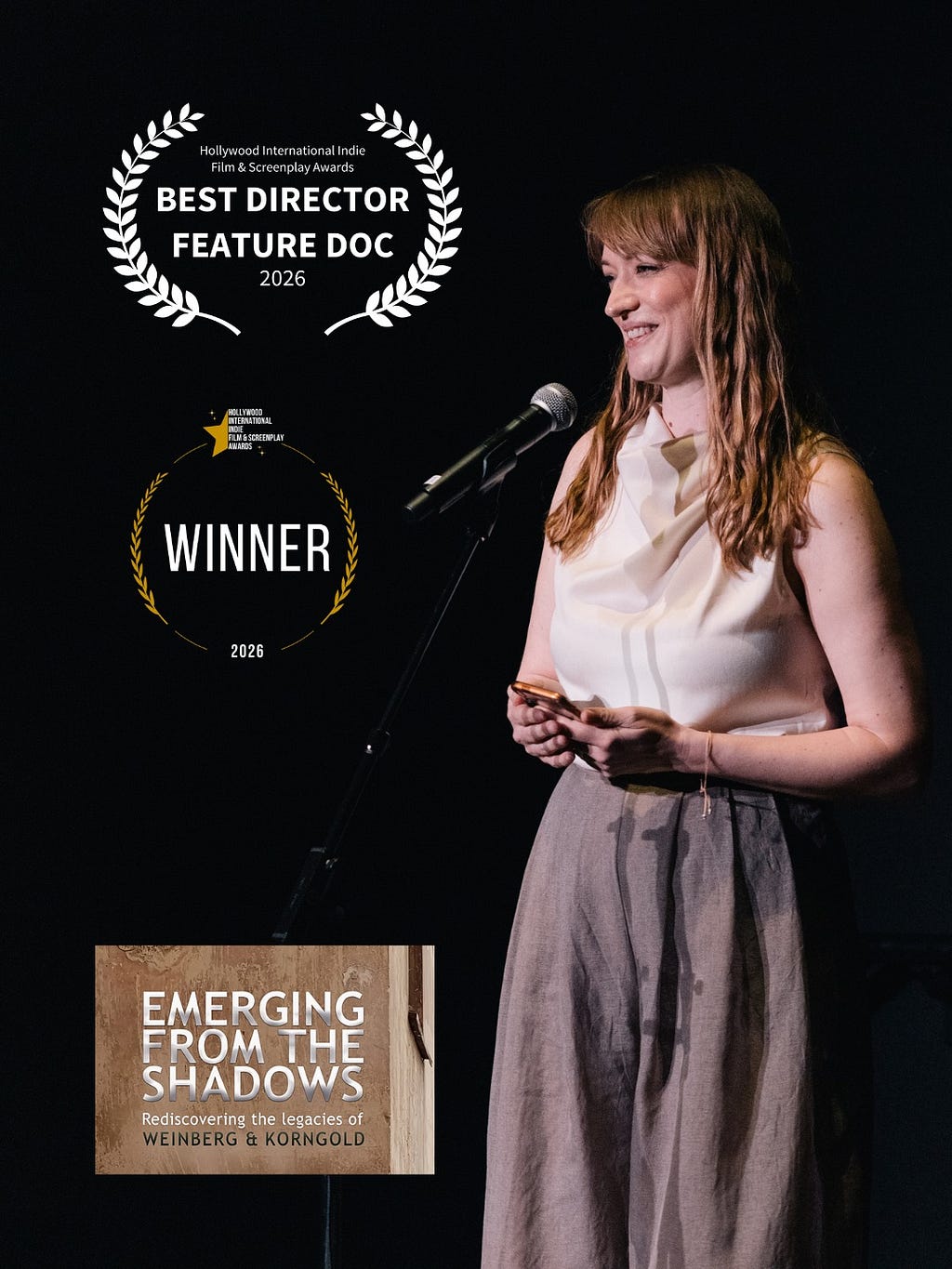
Her most recent documentary, Emerging from the Shadows: Rediscovering the Legacies of Weinberg and Korngold, wades into much heavier historical currents. The film captures cellist Kristina Reiko Cooper and conductor Constantine Orbelian recording works by Mieczysław Weinberg and Erich Wolfgang Korngold, two Jewish composers whose lives were fractured by the Holocaust. Weinberg escaped to the Soviet Union and lost his entire family in the camps, while Korngold fled Vienna for Hollywood, eventually becoming an Oscar-winning film composer. “You have two people in the same horrible situation of having to flee their home countries, losing their home, family members, and culture,” Pohl observes. “They ended up at opposite sides of the political spectrum during the Cold War era… but initiated by the same tragic events.”
For Pohl, engaging directly with this history is a personal duty. Growing up in Germany, the dark legacy of the Second World War was a constant subject. “I have been brought up with the understanding that it’s my responsibility as someone coming from a German family to never forget the brutal lessons we have to learn from what happened,” she states. With her father born in 1943, the connection remains immediate in her family. Yet, she recognizes that as time passes, younger generations experience a very real disconnect. “I understand when we hear about something often, it gets an automatic reaction. People don’t connect emotionally to it as strongly anymore. That’s why it’s important how we talk about it.”
To counter this modern fatigue, Pohl’s filmmaking aims for a visceral response. While filming at the Ninth Fort Museum in Kaunas, Lithuania — where thirty-three thousand people were murdered in a single year — the reality hit her physically. “Just standing on those grounds filming, my stomach turned,” she remembers. “When you stand there in that spot and connect emotionally to what happened, you cannot not feel. You have to feel the horror… I think that is what is missing when people just hear about the topic but are not emotionally connected.”
Through all the history and music she explores on screen, her ultimate vision focuses on our shared humanity. “I would love it if everyone who watches the film takes away the importance of looking at each other from the most human perspective,” she says. She dreams of a larger cultural shift away from modern hyper-competition. “Right now, our society in a lot of ways is built on domination and competition,” she concludes. “One thing I would like to inspire is for people to dare to be cooperative. To think of how we can help and how we can get the furthest by working together.”
Yitzi: Emily, it’s so delightful to meet you. Before we dive deep and talk about your work, our readers would love to learn about your personal origin story. Can you share with us the story of your childhood and how you grew up, and the seeds for all the incredible work that has come since then?
Emily: Sure, I’d love to. I grew up in Hamburg, Germany, for most of my life. My mom grew up in New Jersey, and my dad is from Germany. When my mother came to Germany to study German literature, that’s where they met. She shortly returned to the States to finish her studies at Smith College, and then moved to Germany with my dad. This is where most of my childhood happened. We did live in the States together as a family as well for a couple of years, but most of my life I grew up in Hamburg, Germany, which is quite a lovely, very green town with a big lake and close to the North Sea in the northern part of Germany. I am German-American, so I love being in the States. I have been in New York City regularly ever since 2009. I made a habit to come here almost every year. I enjoy being between two worlds, so to speak, and cherishing two cultures that enrich my life.
Yitzi: Can you tell us the story of how you first entered this amazing career and the film industry?
Emily: I started writing fictional stories when I was a child. I wrote my first children’s book when I was still in grade school. I think I actually wanted to become a writer. I was a storyteller at heart. After I graduated from high school, I decided to study journalism, which is another way of telling stories, obviously. Not the ones that I make up, but the very real stories that I notice around me. Since I’m also a musician at heart, it just naturally evolved that I would tell stories about other musicians’ lives. This is really how I ended up at the stage in my career where I’m at now, having the great pleasure of working with fantastic musicians from all over the world. My motivation, I think, is to try to convey to an audience what it means to be an artist, what the motivation is for artists to create their work, and also what it means to them on a day-to-day basis. What does daily life look like in the life of a musician, a conductor, or people in the arts?
Yitzi: You probably have some amazing stories from different parts of your career. I’m sure this is difficult to single out, but can you share with our readers one or two stories that stand out in your career?
Emily: That is never an easy question to answer. The beautiful thing is that almost all stories have their very unique element. Everyone who is asked to pick a favorite has a hard time saying, ‘I’m picking this over something else.’ However, one thing that really shaped me is that for almost eight years, I worked very closely with the resident orchestra of the Elbphilharmonie in Hamburg, which is a very beautiful new concert hall that opened in 2017. Their chief conductor is also an American, Alan Gilbert. He used to be the chief conductor of the New York Philharmonic before he came to Hamburg. Witnessing the orchestra’s inner life and being able to work with them so closely for eight years has really shaped me because it gave me a very in-depth understanding of their life. That is one very beautiful thing that I’m always going to be grateful for, and that also ended up in real friendships that emerged from this experience. Another very beautiful moment is my very first feature documentary film. It is called ‘In the Flow of Music’. What made that special is that I accompanied two independent musicians on their tour for seven days, and they toured on a houseboat. It was not just any tour; they packed up their instruments — and me — onto the houseboat, stopping at each little village down the river, trying to bring culture into the landscape and into this more suburban area. That was a really intense journey with them. It became a musical road trip, so to speak. They were very intense days and a beautiful experience as well. After its cinema premiere during a film festival a woman came up to me afterwards and said: “I will never look at a musician the same again… I now see all the work behind it.” That made me very happy. It gave me the feeling of having achieved my goal.
Yitzi: Let’s talk about your work. This documentary sounds amazing: discovering the legacies of Weinberg and Korngold. As far as I understand, Weinberg and Korngold had to escape the Nazis. Was there a reason why you chose them? With so many musicians and so many stories you could have focused on, why did you choose this one, and why at this time?
Emily: I have to give the credit for choosing those two composers and combining them in the way that this project has to Kristina Reiko Cooper and Constantine Orbelian. The project originated with them. It was them who saw the grand picture that combining these stories paints for us. They started it and planned an album recording with pieces from these two composers. Because they are so passionate about the project, they decided to ask around if someone could do a behind-the-scenes album documentation for them. It was meant to be a short little thing to document the process of the recording. This is when we were introduced by a mutual friend. As soon as I started talking to Kristina and Constantine, I realized how deep the topic goes when taking these two people’s lives and comparing them. The longer I talked to them, I saw a full-on documentary because there was so much to tell. You have two people in the same horrible situation of having to flee their home countries, losing their home, family members, and culture. But they ended up in completely different spaces. Weinberg, who was born in Warsaw, ended up fleeing to the USSR and living in Moscow, while Korngold, who was born in Vienna, ended up going to Hollywood and becoming one of the most famous Hollywood composers. In the time of the Cold War, after the end of the Second World War, they ended up on completely different sides of the political spectrum, but initiated by the same tragic events. This is what makes it so fascinating. First of all, their personal stories, but also comparing what it does to a creative biography to be shaped by political circumstances that none of us can control, but that we are sometimes just born into and have to deal with. There is so much to tell. It’s incredible. We had our private New York screening at the DGA theater yesterday, and watching the movie back, I still love hearing their stories. I adore their music so much. I’m really grateful that through Kristina and Constantine, I learned more about this history as well.
Yitzi: In your dream, your aspirational goal, what do you hope people take away from both the music and the film?
Emily: I would love it if everyone who watches the film takes away the importance of looking at each other from the most human perspective, as single human beings. Every person we meet, to realize that they are a human being just like ourselves. We might have different backgrounds and different views, and that’s okay, but we’re both humans. This gets lost so much in the political fights going on, in all the hurt, and all the trauma that is unfortunately present in this world. I would love to foster empathy, understanding, and just remind ourselves that we are in this world together as one humankind.
Yitzi: I heard someone once say that people have Holocaust fatigue. That’s why they want to move on, seeing so much content about that five to ten-year period of history. How do you respond to that?
Emily: Because I grew up in Germany, this has been front and center in my life for as long as I can remember. I have been brought up with the understanding that it’s my responsibility as someone coming from a German family to never forget the brutal lessons we have to learn from what happened. In German schools, there is no year that the Second World War is not a topic. But the further we move away from this time in history, young people don’t have the type of connection to it that I have anymore. My grandparents lived through this, and even my dad was born in 1943. I still have an immediate connection. I understand that for someone who doesn’t feel this immediate connection as strongly it might take a little bit more effort for them to feel into it. But I look around us in this day and age, and I think it could not be more important to look back, remind ourselves, and try to truly learn from it. We must not forget the responsibility we still have to try and do better.
Yitzi: Thank you so much. I’m getting emotional. I’m actually holding back tears. Thank you. My grandparents are survivors. My great-grandparents were killed in the camps. My grandfather changed his name after the war from Weinburger to Burger. Also, my father’s side is from Kovno, in Kaunas.
Emily: Wow. There’s so much connection there. It is so hard to put this into words. I understand when we hear about something often, it gets an automatic reaction. We don’t connect emotionally to it as strongly anymore; there’s an emotional disconnect. That’s why I think it’s so important when we talk about this, to create situations where everyone who is not connected to it at the moment is able to actually feel what this means. Not think about it rationally, but to actually connect to their feelings. Because that’s when everything changes. For the documentary that we shot in Kaunas, Lithuania, we visited the memorial site called the Ninth Fort Museum. I think in only one year, 33,000 people were murdered there. Just standing on those grounds filming, my stomach turned. As a student, my school made a point to travel to Auschwitz with us and have us look at these sites. When you stand there in that spot and connect emotionally to what happened, you cannot not feel. You have to feel the horror, and it turns your stomach. I think that is what is missing when people just hear about the topic but are not emotionally connected. We need to create situations that make people emotionally and viscerally understand what this means. And documentaries as well as music are a fantastic way to achieve this.
Yitzi: This is our final aspirational question. Emily, because of your amazing work and the platform you’ve built, it’s not an exaggeration to say that you’re a person of enormous influence. If you could spread an idea or inspire a movement that would bring the most amount of good to the most amount of people, what would that be? Because you never know what your idea can spread.
Emily: I have a dream of humans finding a way to build a society that is based on cooperation. Our society in a lot of ways is built on domination and competition. One thing I would like to inspire is for people to dare to be cooperative instead. To think of how we can help and how we can get the furthest by working together. Not against each other, but together. By helping someone else, you will get the best results for all of humankind. That is something I would like to inspire: to try for us all to find a way away from being highly competitive to being more cooperative with each other.
Yitzi: That’s beautiful. Emily, how can our readers watch the film, and how can they support your work in the future in any possible way?
Emily: Thank you so much for that question. At the moment, we’re super happy that the film is being submitted to and accepted by film festivals. Right now, a possibility to watch it is through different film festivals. It’s been shown in Georgia, the country. In May, it will be shown in Yokohama, Japan, which is very exciting. We will have a hosted screening in Hamburg, where I live. Then it will also be shown in Cannes, France. In the US, there is a festival in September called Zepstone Fest in Utah. We hope we might get into other festivals. This is the first phase of rolling out the film. Another thing we’re always interested in — and I’m saying this as an invitation to connect with us if you have any ideas — is hosting cultural screenings for interested groups. Small gatherings of maybe a hundred people watching the film together and then exchanging ideas afterwards, which is what we’ll do at the Hamburg screening. We will show the film and then have a panel for about an hour talking about it. If any interested groups are open to collaborating on something like that, feel free to reach out to us. Another way to stay connected is through our Instagram and Facebook account for the film called “Emerging From the Shadows Film”. We also hope we can figure out a way to have it play on video on demand on some platform, but that is something to be worked on in the future.
Yitzi: Emily, it’s such an honor to meet you. I’m truly inspired and moved by your work, your values, and your perspectives. I wish you continued success, good health, and blessings. I wish I could be at the Hamburg screening, but I hope we can cross paths again next year. I would love to do another interview.
Emily: Yes, absolutely. Thank you so much for your interest and for helping to spread the word.
Yitzi: It’s my pleasure, Emily. So nice to meet you, and I hope to cross paths soon.
Emily: Yes, thank you. Have a great day. Bye.
Veronika Emily Pohl Talks ‘Emerging From the Shadows,’ Holocaust Legacy and the Power of Emotional… was originally published in Authority Magazine on Medium, where people are continuing the conversation by highlighting and responding to this story.