
Aden Bahadori on Being Hollywood’s “Edit Doctor” and Building Tachi AI to Give Editors Their Mojo Back
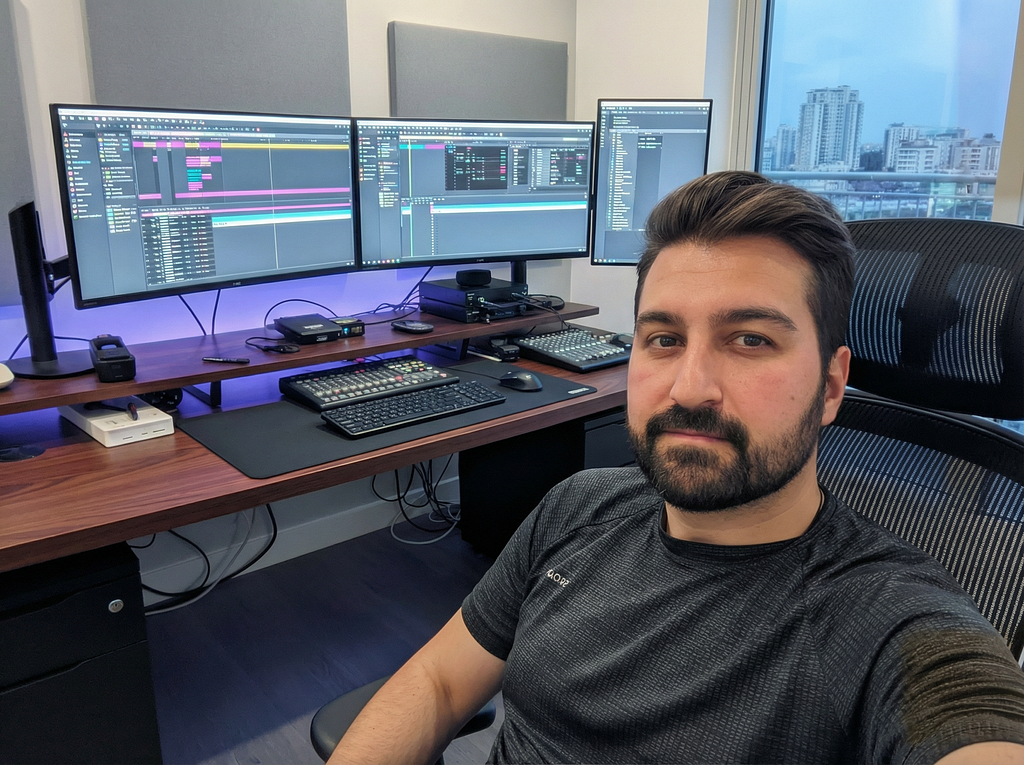
“As humans, we shouldn’t strive to replace ourselves. A computer has never loved; a computer has never put a fresh Hamantash in its mouth and said, ‘Oh my god, the complex flavors.’ It should be an assistant, not a being. That’s my perspective.”
In the high-stakes film editing world, there is a specific kind of person known as an “edit doctor.” When a movie is falling apart, when the story doesn’t click, the budget is bleeding, and the director is losing their mind, they call someone like Aden Bahadori. He’s the guy who steps into a dark room and finds the heartbeat of a film buried under mountains of raw footage.
“I can’t tell you how many lawsuits I’ve fixed or made disappear because I was able to resolve the core issue,” Bahadori says with the calm confidence of someone who has stared down a failing multi-million dollar project and won.
Bahadori’s journey didn’t start in a Hollywood backlot. It began in Tehran, Iran, in the early 1980s. His early childhood was defined by the grim reality of the post-revolution era. “I’ll never forget the sound of the sirens at night because that’s when the bombings would happen,” he recalls. “Seeing explosions in the background, windows breaking, hiding in a shelter, I’m sure a lot of people today can sympathize with that.”
His mother, whom he calls a “superhero,” eventually moved the family to Germany in 1989, just weeks before the Berlin Wall fell. Later, they settled in Canada. It was a trek across cultures that gave Bahadori a unique perspective on the world, one that is half creative and half technical.
Though he was a “shoo-in” for law school thanks to a high-profile mentor, Bahadori’s soul wasn’t in the courtroom. He dropped out of his prerequisites at the University of Toronto and enrolled in film school without telling his parents. It was a gamble on himself that paid off. He started at the bottom, cutting music videos and commercials, eventually spending 23 years mastering the art of the edit.
“Editing is all about the little frames, moving things a little here and there to build the best story,” he explains. “It’s a form of storytelling, really the shaping of it.”
After years of sitting in that dark edit suite, Bahadori had a “Eureka” moment. He was working on a grueling scene at a backlot in Los Angeles, spending three weeks on a single sequence that refused to work. He sat back and wished for a “magic auto-edit button.” That wish eventually became Tachi AI, his new software company that recently emerged from stealth mode.
Unlike the AI tools that generate fake images or deepfakes, Bahadori is building what he calls “utility AI.” Tachi AI is designed to do the heavy lifting, the “grunt work” of sorting through hours of footage to create a rough assembly. The goal isn’t to replace the artist, but to give them their “mojo” back.
“As humans, we shouldn’t strive to replace ourselves,” he insists. “A computer has never loved; a computer has never put a fresh Hamantash in its mouth and said, ‘Oh my god, the complex flavors.’ It should be an assistant, not a being.”
This philosophy of “human-centric AI” is Bahadori’s way of protecting the craft he loves. He’s seen the industry change, and he’s seen how the “hurry up, I need it yesterday” mentality can drain a person. He speaks openly about the mistakes he’s made, like working every weekend for years and neglecting his health. Now, he advocates for the “sacred pause.”
“Take your eyes off the screen,” he advises. “Protect your eyes, as they are the gateway to your soul. Go outside, get some sunshine.”
For Bahadori, the technical success is secondary to the human connections. He tells a story about a “mistake” on a timeline, dropping a clip in the wrong place by accident, only to find it created a better scene than he had planned. “I think the mistake is if you try to be perfect; you’re actually working against yourself. Let God’s plan work out.”
That sense of empathy extends beyond the editing bay. He remembers a time before the pandemic when he stopped to have lunch with a homeless young man who was at his breaking point. That hour and a half of conversation, Bahadori says, saved a life. It’s a reminder that even in an industry built on smoke and mirrors, the most important thing is staying grounded.
As he moves into this next chapter with Tachi AI, Bahadori isn’t looking to conquer the world with machines. He’s just looking to give filmmakers more time to be human. “Don’t put a cap on your imagination,” he says. “Imagination is a beautiful thing. You can get lost in it for eternity.”
Yitzi: Aden, it’s a delight and an honor to meet you. Before we dive in deep, our readers would really love to learn about your personal origin story. Can you share a story from your childhood, how you grew up, and the seeds for all the amazing work that has come since then?
Aden: I was born in Tehran, Iran, around 1981, post-revolution. Obviously, I don’t remember a lot of the early years, but there was a lot of war, conflict, and fear. That shaped me; I was always living in survival mode. I’ll never forget the sound of the sirens at night because that’s when the bombings would happen. Seeing explosions in the background, windows breaking, hiding in a shelter, I’m sure a lot of people today can sympathize with that.
Then we moved to Germany. My mom is a superhero; she gathered us up and moved us to Germany early in October 1989, just about a month before the wall came down. It was a whole new world. It wasn’t what I was used to. It was different, with lots of colors and unveiled people. Europe shaped my mind and my creativity. Then, at the end of ’94, we moved to Canada, where I truly felt peace for the first time. It’s a melting pot, so I got to meet many cultures, talk to a lot of people, and learn. So, that’s where I was born.
Yitzi: Please tell us the next chapter. How did you first get involved in the entertainment industry?
Aden: Through my mentor, Wallace Lammerton, a former superior court judge, I was a shoo-in at law school, but I had to complete some prerequisites at the University of Toronto. To be honest, it just didn’t resonate with me. I don’t know if it was the time, but I just wanted to be creative. So, I dropped out and went to film school without telling my parents. It worked out great. The message here is to follow your intuition. Do what resonates with your soul.
I got into it and started at the bottom like everyone else. However, I accelerated because my mind, perhaps through my upbringing, is half creative and half technical. I blend the two together well. I managed to learn editing quickly because I love puzzles; I love putting things together. It’s a form of storytelling, really the shaping of it. I started off in music videos, then got into commercials, TV shows, and movies, and I haven’t looked back. It’s been just over 23 years now.
Yitzi: Tell us about the exciting new initiatives and angles you’re working on now.
Aden: I tell this story often, my partners are sick of it, but I was at a backlot in LA working on a film. I think it was Paramount or another facility, and I was working on a very challenging, long scene. There was no way to get it to work. I spent probably three weeks trying to work on one scene. I sat back in my chair and said, “I wish there was a magic auto-edit button.” I know a lot of my fellow editors have had similar wishes just to get through a scene.
That planted a seed in my head. In 2012, I thought maybe technology could do something. I started creating a formula of what editing is and bringing that to paper. In 2016, I started my first software company as a proof of concept. I went from the edit chair to the software developer chair. I had some really great partners. In 2019, I met my current partners, and we started another software company to test where AI was at the time. Together with Tim Dashwood and the team at Apple, we developed a product called Fasttrack. It was a video tracking software, a niche product, but a great proof of concept.
In 2023, we sat down and I said, “Look, I want to make AI Edit because I really want to contribute to this field that’s given me so much.” But I didn’t want it to take away from the creative process. I actually want it to increase the time I have to be creative. As of about a month and a half ago, end of November, we came out of stealth mode. We’re now testing with a few production companies in a closed beta system, and I’m loving it. It’s a great tool.
Yitzi: So this tool does the auto-edit? Does it stitch different scenes together in a seamless way?
Aden: Absolutely. It’s called Tachi AI. At its core, Tachi AI is an assembly editor. It’s for scripted feature films or TV shows, not social media videos. It’s a professional-level tool where you upload all your scene footage, your script, and any other artifacts you may have. You select the scene, press a button, there are three generations you can do to get ideas, and it puts together the scene in an assembly, or rough format. In film, we have the assembly, rough cut, final cut, and picture lock. This handles the first step.
What it really does is allow me, as an editor, to retain my mojo by not draining my energy watching raw footage over and over just to get the assembly done. I still have to watch the raw footage, but my intention is different. When you sit down as an editor and see the cut in some form, you’re able to interpret the character’s intentions differently rather than just cataloging the raw shots. The goal is for the editor to sit back and really start molding the cut. Editing is all about the little frames, moving things a little here and there to build the best story and get the most emotion out of the audience and the characters who worked so hard on set. That’s the principle of Tachi.
Yitzi: How is this different than Kling or Veo, where I think they use the first frame and end frame and stitch in between? That sounds purely AI-generated. Yours sounds much more subtle and nuanced.
Aden: We don’t generate any images. We just handle the technical process of editing from footage you’ve already shot. That’s the way it works. No generation. You can put generated shots into the edit, but we are what I’m coining a “utility AI.” It’s a human-centric AI. I might be wrong about this, but I don’t believe true, artisan-level creativity can be replaced by AI because AI doesn’t have intuition or instincts.
Yitzi: That’s fascinating. So you’re an AI that’s trying to be as human as possible?
Aden: I’m hybrid. We all use AI now, I just used it for spell check an hour ago, but it’s a utility. As humans, we shouldn’t strive to replace ourselves. A computer has never loved; a computer has never put a fresh Hamantash in its mouth and said, “Oh my god, the complex flavors.” It should be an assistant, not a being. That’s my perspective as of today.
Yitzi: I think it was Spotify or one of the big creative labels that is trying to put an “AI-free” label on music, sort of like “gluten-free.” I have no doubt that’s where things are going; people want something authentic. I love your vision.
Aden: Thank you.
Yitzi: You probably have some amazing stories from your career. You have so many parts of your career, and maybe this is hard to single out, but can you share one or two stories that stand out most in your mind from your professional life?
Aden: There are so many. I spent a good chunk of my career being a rescue editor, sometimes called an edit doctor. It started at the beginning of 2008 when the financial market was falling apart. I was with my good friend Harvey Glazer helping him on his movie. There were just some things that needed help. I took on this role, I would only start a movie if a friend shot it, but I really had a passion for fixing movies that were complicated. Perhaps something went wrong on set, or the story didn’t come together.
I can’t tell you how many lawsuits I’ve fixed or made disappear because I was able to resolve the core issue. That became a passion. It drove my technical sensibility and skill sets and pushed my creativity to the edge. When you’re in a rescue edit position, the timeline is even shorter than a traditional film schedule. If a movie is supposed to hit the theater in a month and you’re still working on it, that’s not a good place to be. That was a great feat.
Also, with editing, you’re in a dark room all day, but you meet a lot of great people from all sorts of backgrounds. You have really intentional, deep conversations because you’re in this room with the director or producer for six months, five or six days a week for ten-plus hours. The relationships I’ve gathered are the true story for me. That’s probably the best takeaway.
Yitzi: There’s a saying that sometimes our mistakes can be our greatest teachers. Do you have a story about a funny mistake that you made when you were first starting and the lesson that you learned from it?
Aden: I tell this story often. It’s not exactly a mistake, I always bet on myself. But sometimes, and my fellow editors might be upset by this, I accidentally drop a clip on the timeline in the wrong place, and it works out beautifully. It’s a happy accident. That’s a great story to show that editing is a fluid process. You could move it around until the end of time, and it’ll never be perfect because there is no definition of perfect. You could stack the shots differently, wide, medium, close-up, or close-up, medium, wide, and it changes.
In some of the best scenes I’ve ever edited, I assure you there have been three or four “mistake” edits that I didn’t catch, but they just worked out. So, it’s okay not to be perfect. I think the mistake is if you try to be perfect; you’re actually working against yourself. Let God’s plan work out.
Yitzi: There’s another related saying that “no” is not rejection but redirection. Do you have a story where you got a “no”, but it led to an unexpected opportunity, success, discovery, or blessing?
Aden: Absolutely. A lot of filmmakers at all levels can relate to this. As a young, hungry entrepreneur and filmmaker, I always wanted the big movie. I’d say, “Please just give me anything, I’ll cut this,” and keep hearing “no, no, no.” It’s devastating. The rejection was really hard.
But after one specific “no,” I hung my head, walked away, and accidentally bumped into a person who asked, “Hey, are you available to cut this film?” It was a happy accident again. I thought it was the end; I spent a year trying to get a movie, and the final “no” led to the big “yes.” As you said, it was a redirection. It means that this path is not working out, so skew left or right a little bit and try something else, but don’t give up. A “no” is not a stop. It just means “not right now.”
Yitzi: What’s been the most challenging project or role you’ve taken on so far, and why?
Aden: Honestly, every film and TV show has its challenges. But there was a project in 2012, I won’t name it, that really pushed me to my limits. It wasn’t shot well, it was a first-time director, and while the budget was decent, the story didn’t make sense. I like to fall in love with the characters; I like to hate the bad people and love the good people. You have to put a lot of passion onto the screen yourself. That film took me away from being a creative; it was almost all technical. It really bothered me that it didn’t have that emotional element. However, that movie led to what I’ve built today. These little sparks in the universe project you further into your true destiny. So, that was probably the hardest film.
Yitzi: This is our signature question. Aden, you’ve been blessed with a lot of success and must have learned a lot from your experiences. Looking back to when you first started 20 or 30 years ago, can you share five things that you’ve learned that would have been nice to know when you first started?
Aden: Absolutely.
- Patience: Have patience.
- Work on your health: Especially if you have a sedentary job in a dark room. Try to take weekends off and work on yourself, because we get pushed as filmmakers to the limit.
- Don’t be shy about your creativity: Try things, even if it’s a goof. I can’t tell you how many times I’ve tried something and thought, “That was bad,” but I loved that I tried it.
- Be kind: There are a lot of people in this business who aren’t nice, perhaps because of their own stress or demons. Be kind to other people and yourself.
- Don’t put a cap on your imagination: Imagination is a beautiful thing. You can get lost in it for eternity. Be as imaginative as possible. Believe in your heart, instincts, and intuition, that is what creates the story.
Yitzi: We spoke about AI a little bit before. I know this is a big issue now, but what are your thoughts on using AI in creative aspects like music, TV, or film? For example, if a production studio has a small budget, is this a good way for them to produce the best effects?
Aden: I think there has to be a cutoff and there must be transparency. To train AI, the data needs to come from somewhere, so let’s make sure those people get paid and are taken care of. Again, AI is an assisting tool; it should not be a sentient being in the creative world. Maybe there’s space for it depending on what people will accept over time.
If I use a generative tool, it’s to conceptualize an idea, or if I have an idea for a short film, I might make a quick video just for myself or social media. What really scares me about AI is the cyber security level, can AI launch missiles? Can it break into my bank account? I’m more worried about that. But AI is just another hammer in the toolbox; it’s not the whole toolbox. We should have respect for the artists who work so hard to create the legacy we know in entertainment. Let’s not take food off the table of other people. If AI can cure cancer, let’s go. I’m all about that.
Yitzi: Can you share some of the self-care routines that you do to help your body, mind, and heart to thrive?
Aden: I have to be honest, I wasn’t always the healthiest, so this is kind of a new thing. Take your eyes off the screen; protect your eyes, as they are the gateway to your soul. Do other things that excite you. Go outside, get some sunshine. Meditation is huge; even if you don’t believe in it, just sit quietly with yourself and talk to your own mind. Eat better and make time for family. That is one of the best healing tools.
In film, we have this “hurry up, I need it yesterday” mentality. Three or four years can go by before you realize you missed another birthday or holiday because you were told to hurry up. So, take care of yourself. Whatever your passion is, make time for it. Try not to work weekends. I worked every weekend for years, and it drains you. You don’t want to be a drained creative because then you’re not creative.
Yitzi: So wise. I heard the term “take a sacred pause.”
Aden: Absolutely, take a sacred pause. If you’re a person of faith, go to your faith. Connect with something outside of a screen.
Yitzi: That’s where the world is going. Technology forces us to spend our lives in front of screens, and part of the discipline of today is choosing not to be in front of one.
Aden: Yeah, if we could do that.
Yitzi: This is our final aspirational question. Aden, because of your amazing work and the platform that you’ve built, you’re a person of great influence. If you could spread an idea or inspire a movement that would bring the most amount of good to the most amount of people, what would that be?
Aden: I had this conversation not too long ago. I would say: don’t always think about yourself. Sometimes turn to your right or left and make sure the people around you, or even a complete stranger, are good.
I’ll tell you a quick story. A few years ago, before the pandemic, I saw a young homeless person around Christmas time begging for money. I don’t know what connected us, but we started talking and I took him out for lunch at a cafe right around the corner. At the end, he told me, “I thought today was going to be my last day on this planet. If you didn’t connect with me, I think that would have been it.”
That really resonated with me. I didn’t ignore him because of my busy life. I had to go shopping and do my stuff, but I took an hour and a half to have lunch with a stranger in desperate need. It’s important to stop and look around. Take care of your family and yourself, you need both feet on the ground to help anyone, but if you do, look around, help, and be imaginative with it.
Yitzi: Such an incredible story. I actually feel myself about to cry. Wow.
Aden: Thanks, Yitzi, I appreciate that.
Yitzi: How can our readers continue to follow your work, get involved, or engage your services?
Aden: For Tachi AI, it’s tachi-ai.com. I’m not big on social media; I’m quite a private person. But look out, we’re going to make a big splash in the New Year and continue spreading the word about creativity, AI, and filmmaking. If you want to get a hold of me, there’s a “contact us” option on the website. I get all the emails, so I can filter through them.
Yitzi: Aden, it’s been amazing meeting you. I wish you continued success, blessings, and good health. I’m excited to share the article with our readers.
Aden: Thank you so much, Yitzi. Keep doing the good work you’re doing. I appreciate you, brother, and thanks for this opportunity.
Aden Bahadori on Being Hollywood’s “Edit Doctor” and Building Tachi AI to Give Editors Their Mojo… was originally published in Authority Magazine on Medium, where people are continuing the conversation by highlighting and responding to this story.