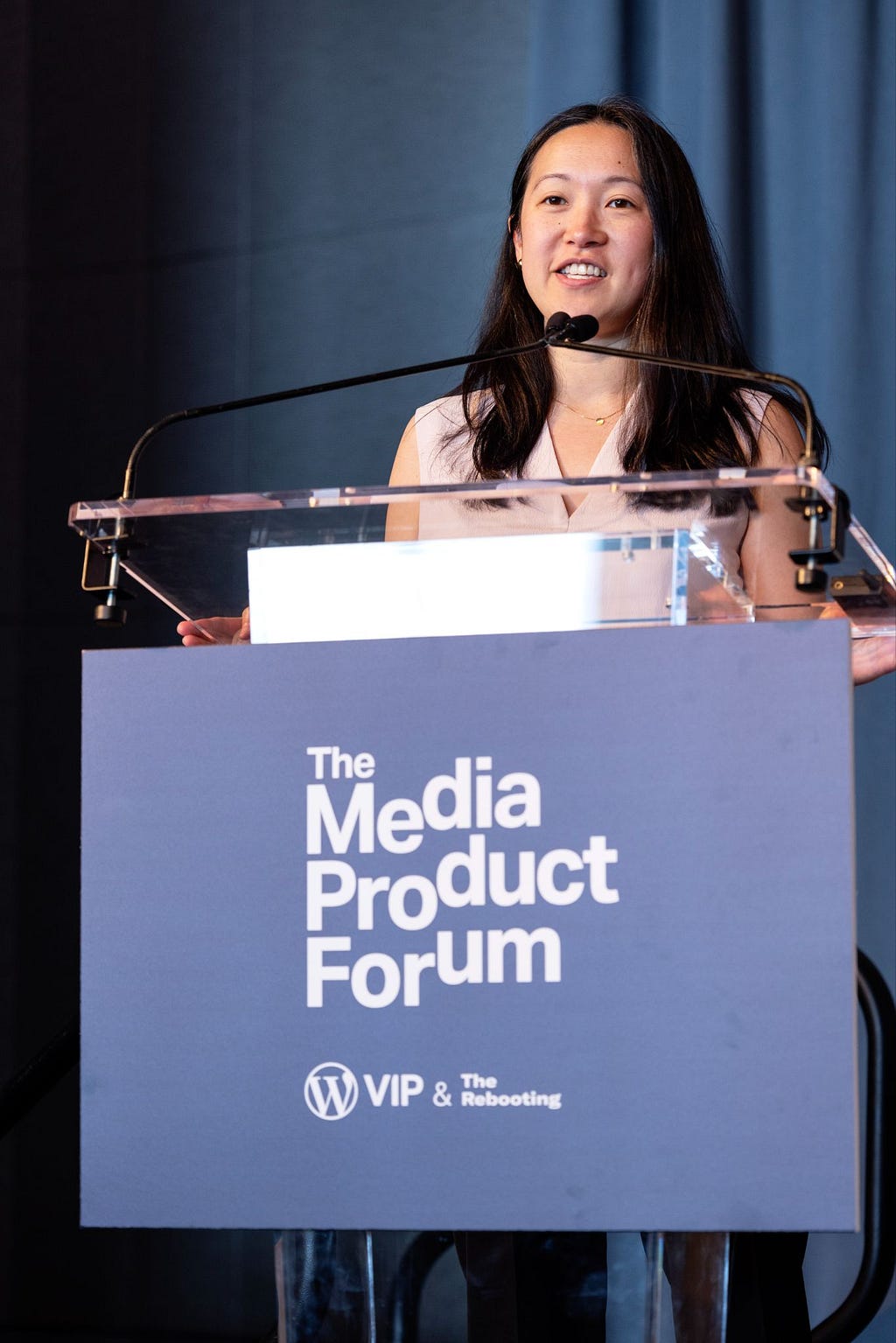
“Working in a newsroom, I saw firsthand what a huge impact WordPress had in terms of freeing folks to be able to create and write.”
I had the pleasure of talking with Steph Yiu, a woman whose career trajectory reads like a long-form feature story. Before she was the CEO of WordPress VIP, she was a self-described journalism nerd. She didn’t start in a boardroom. She started in newsrooms, fueled by a singular, focused drive to see stories make it to the page. “I was the editor of my middle school paper, the editor of my high school paper, and the web editor of my college paper,” she says, reflecting on a path that seemed destined for the printing press. “That just tells you how obsessed with journalism I was, and all I ever wanted to do was work in publishing.”
That obsession eventually landed her at the Chicago Tribune, her first job out of college. She wasn’t just a writer or a designer; she was a hybrid, someone who understood how the words looked on the page and how the code functioned behind the scenes. It was here that she encountered a formative lesson in power and leadership. Assigned to a major project but struggling to gain traction with the veteran staff, she felt invisible. “I was just so new — it was my first job out of college and I was so low on the totem pole — that I don’t think I was able to rally folks to collaborate with me,” Yiu recalls. She asked her boss, the head of digital, what she could do to better grab the attention of the senior leadership she needed buy-in from.”
The response wasn’t a lecture or a dismissal. The next day, her boss called a meeting with the very senior leaders who she needed to work with. When Yiu walked into the room, her boss “got up from his seat, offered it to me, and said, ‘Steph, this is your meeting,’” she says. He spent the rest of the hour in silence at the far end of the table. For Yiu, that moment was a revelation about the mechanics of success. It wasn’t just about personal talent but the environment to make it happen. “It is important to create the conditions of success, and it is important to facilitate and foster the environment that helps that person succeed.”
Yiu eventually moved on to America’s Test Kitchen, where the editorial process is famously grueling. It was there that she witnessed a different kind of discipline: the obsession with the end result. She watched how they developed a simple chocolate chip cookie, starting with a philosophical debate about what the “perfect” cookie should even be before a single bag of flour was opened. But the real lesson came at the end of the process, when the recipe was sent to home testers. The final, deciding question for any recipe was always: “Would you make this recipe again?” If that didn’t hit an 80% approval rating, the cooks went back to the kitchen. “If you think about how much time people invest into making a recipe — the ingredients, the time spent tinkering with different variables and actually baking everything — they want to have these beautifully made, rigorous recipes,” Yiu explains. That “obsession with the end result” became a cornerstone of her own professional philosophy.
Her entry into the world of Automattic, the parent company of WordPress VIP, happened almost by accident. While walking through New York City’s Javits Center during a conference she wasn’t actually attending, she spotted the WordPress logo. She walked up to the booth and asked for a sticker. That simple interaction led to her becoming employee number 15 on the WordPress VIP team. She joined because she saw the platform as a tool for liberation. “Working in a newsroom, I saw firsthand what a huge impact WordPress had in terms of freeing folks to be able to create and write,” she says.
Thirteen years later, in August 2025, she was named the CEO. Her rise within the company was built on a foundation of “growing up” inside the organization, moving from support and documentation into executive leadership. Even as CEO, she maintains the perspective of the practitioner. She remembers being 60 days into the job when a code update broke the media library for major customers. The panic was real, and the technical jargon — terms like “trunk,” “core,” and “RC” — was overwhelming. “It forced me to get really brave and ask the dumb questions,” she says. “One thing I learned from that experience is not to be afraid to ask those dumb or silly questions, because if you don’t understand it, your customers won’t understand it.”
Now leading a platform that powers some of the biggest media and enterprise sites in the world, Yiu is navigating the shift into an AI-native world. While many are predicting the end of the traditional website, she remains a staunch defender of the open web. She views the rush toward closed social media feeds as a trap for creators and businesses alike. “You wouldn’t be content with being trapped in a social media grid or an algorithm feed for how you want to express yourself or your business to your audience,” she argues. For her, the goal remains the same as it was in her middle school newspaper days: helping people own their “corner of the web.”
Yiu’s journey from a young designer at the Chicago Tribune to the head of a global tech entity is marked by a refusal to lose touch with the people actually using the tools. She isn’t interested in the typical tech-savior narrative. Instead, she remains focused on the rigor of the “recipe” and the necessity of the “dumb question.” As she puts it, her leadership is about “the responsibility of being one of the few female CEOs in tech” while never forgetting the thrill of seeing a story finally go live.
Yitzi: Steph, it’s so great to meet you. Before we dive in and talk about your amazing work, I would really love to learn about your personal origin story. Can you share the backstory of your childhood, how you grew up, and the seeds and genesis for all the amazing work that has come since then?
Steph: I actually started my career in journalism. I was the editor of my middle school paper, the editor of my high school paper, and the web editor of my college paper. That just tells you how obsessed with journalism I was, and all I ever wanted to do was work in publishing. I worked with a lot of newsrooms in the early part of my career, and I used a lot of different publishing platforms, and just like you, I also used WordPress. WordPress was always my favorite. That is really where the beginning of my career began. One day in my late 20s, I was in New York City for work, and I was at the Javits Center. I saw the WordPress logo at a conference booth. I wasn’t even attending that conference in an official capacity. I walked up to the team there and I said, “I love what you do, could I please have a sticker?” That is really how I met the Automattic team the first time around. I ended up joining the WordPress VIP team, and I think I was employee number 15. I joined because I wanted to support journalists and content creators. Working in a newsroom, I saw firsthand what a huge impact WordPress had in terms of freeing folks to be able to create and write. Then I just got to work with customers all day, every day at WordPress VIP.
Yitzi: You probably have some amazing stories from different parts of your career. I’m sure it is difficult to single out, but can you share with our readers one or two stories that stand out in your mind from your career?
Steph: At my very first job out of college, I worked at the Chicago Tribune. I joined as a designer back in the day. The head of digital at the Chicago Tribune noticed that I was able to design and write because I went to journalism school, and he also noticed that I knew my way around code and technology. I had also built sites on WordPress. He put me on this big cross-functional project in the newsroom, entrusting me with a big initiative. As I started to get going on the project, I was just so new — it was my first job out of college and I was so low on the totem pole — that I don’t think I was able to rally folks to collaborate with me and participate. I went to the head of digital and I said to him, “People don’t understand the importance of this project. They’re not coming to any of my meetings.” The next day — and I will never forget this — he scheduled a meeting with everyone I needed on this project, including a lot of senior folks. I walked into the conference room, and he was at the head of the table, and all of the leaders and senior folks were lined up on either side. He got up from his seat, offered it to me, and said, “Steph, this is your meeting.” He then went and sat at the far end of the table and did not say a word for the rest of the meeting. He just let me run it. I think in that moment I realized a couple of things. One is that it is really powerful when someone truly believes in you and empowers you to succeed. The other thing I learned is that it is important to create the conditions of success, and it is important to facilitate and foster the environment that helps that person succeed.
The other story is related to the early part of my career when I worked at America’s Test Kitchen. That publication is known for rigorously testing its recipes. It is a key part of their product offering to customers. A chocolate chip cookie recipe is one they were famous for. To start the process, the editorial team would get together to consider the perfect chocolate chip cookie. They would ask, “What is America’s Test Kitchen’s POV?” They would think about things such as what color it should be, how it should taste, how difficult it should be to make, and how long it should take. They would come up with their criteria for what the America’s Test Kitchen chocolate chip cookie recipe should be. Then a test cook would take that and make the recipe. Before shipping it into production, they would actually ship it into beta testers’ homes and let them try it. They asked a series of rigorous questions before it made it to publication, such as, “How long did it take you to make this?”, “How much did the ingredients cost you?”, and “What equipment did you need?” The final question they would always ask is, “Would you make this recipe again?” If that question did not hit a certain criterion, which I think was 80% for them, they would send the test cooks back to completely rework the recipe. I have never forgotten that. I have actually given talks about this internally at our company because of this obsession with the end result. It is not just rigorous testing; it is also about the customer at the end of the day. Would they do this again? Was it good enough? If you think about how much time people invest into making a recipe — the ingredients, the time in the evening, everything — they want to have these beautifully made, rigorous recipes. I think that is what has made them so successful over the years and built a die-hard fan base. That is something I learned early in my career that has stayed with me.
Yitzi: Tell us about the exciting work you are doing at WordPress. Tell us how our readers can get involved and what you are doing.
Steph: At WordPress VIP, we are an open and intelligent content experience platform. One of the things we are really excited about right now is this moment where so many folks are looking at how to adapt, create, share, and publish content in an AI-native world. We deeply believe that choosing an open-source platform gives you the flexibility and adaptability to continue evolving. Right now, no one can predict the future. If I asked you what you think tech or AI will look like in the next 12 months, I think most folks would be making up an answer. One of the amazing things about WordPress VIP is that we have this 20-year heritage of open source, and throughout that time, we have continued to adapt and evolve. In the last few years, we have become increasingly AI-native. You want to build on an open platform. You do not want to choose a closed platform because right now, as you are iterating as fast as you can, you want to be able to work on code that you can touch, understand, and that can be flexible and adapt with you. We are really excited about what we are working on.
Yitzi: How is WordPress VIP different from regular WordPress, where you could go to the CSS, put in AI, and change everything to make it custom? How is WordPress VIP better?
Steph: WordPress VIP is built for the enterprise grade. It takes the ease of use, flexibility, and adaptability that we have all come to know and love in native WordPress. However, when you are working in a large enterprise organization, and you need to have rigorous standards, compliance, security, and performance at a certain level, WordPress VIP provides that. Today, we are also providing an analytics platform alongside that, as well as AI connectivity, which allows us to adapt with these enterprises as they evolve.
Yitzi: Is your target primarily publishers, let’s say news sites or blog sites, or is it beyond that? Is it for any type of enterprise website?
Steph: We work with media organizations quite a lot. It’s what I am really passionate about because it is where I come from. I think what is phenomenal about working with media organizations is that I sort of think of them sometimes as the F1 of content. They are producing in huge amounts, experimenting, and trying new things. We love working with media organizations. We also work with a lot of public sector organizations like NASA, large enterprise organizations like Salesforce, and large publishers like The New York Post.
Yitzi: Steph, How could our readers continue to follow and support your work in any possible way?
Steph: Follow us on the WordPress VIP site, wpvip.com.
Yitzi: Steph, it’s so good to meet you. I wish you continued success, and I hope we can do this again next year.
From Newsroom Obsession to Tech CEO: How Steph Yiu Is Championing the Open Web at WordPress VIP was originally published in Authority Magazine on Medium, where people are continuing the conversation by highlighting and responding to this story.