Marine Veteran Turned Founder Justin Henshaw on Choosing Focus Over Fortune and Redefining the Workforce With GAGE

…One of our lead investors said to me, ‘You can build a restaurant empire or you can build a tech startup, but I promise you, you can’t do both. Even if you are able to do both, I feel sorry for your family, because you’re just not going to have time for anything else.’ That hit hard. I realized I had to stop and really focus on one thing. It was a humbling experience because I ended up having to sell or shut down a lot of what I had built…
I had the pleasure of talking with Justin Henshaw. He’s a tech founder now, but don’t picture a Silicon Valley kid in a hoodie. Henshaw’s story starts a long way from Palo Alto, in a “little dusty town in Southeast Georgia.” It’s a story marked by tragedy before he even hit double digits.
“My mother passed away when I was really young,” he says, his voice steady. “She struggled with alcohol and drug abuse, and she ended up taking her own life when I was eight years old.”
That’s a hell of an origin story. After that, his grandmother, a cashier at the “little local grocery store,” Winn-Dixie, took custody and raised him and his sister on St. Simons Island. “We were still very poor,” he admits. This upbringing, defined by loss and scarcity, shaped everything that came next.
For a while, it looked like he’d escape through a different door. “I was really into the performing arts,” Henshaw recalls. “Loved theater, musical theater, and being a musician myself.” He took that dream to New York, but the world had other plans. “9/11 happened while I was living there,” he says, “and that inspired me to join the Marine Corps.” Just like that, the theater kid was gone, and Henshaw “spent most of my twenties in the military.”
When he got out, the hustle began. Henshaw used his GI Bill for college, but he didn’t wait for a diploma to start building. He launched a DJ company “that focused primarily on weddings and private events.” It wasn’t a small-time gig. “To this day, it’s still one of the biggest things I have going,” he says. “We do 20 to 30 weddings a week.”
But one business was never enough. While still in school, he started a food truck. That led him into the restaurant world, and the empire began. “I opened a frozen yogurt brand… got into franchising myself with Jimmy John’s and Smoothie King… a salad concept called Salata.” All told, over 14 years, he’s “opened and operated about a dozen businesses and restaurants.”
Henshaw was on a tear, building what he calls a “little restaurant empire.” But a “shiny object” had distracted him, a spreadsheet he’d built to manage his own teams. That spreadsheet had a name: GAGE. And it was starting to look like the main event, not a side project.
Henshaw found himself trying to ride two horses at once. The restaurant empire was growing, but the tech startup was “moving up and to the right.” He hit a wall. He remembers a lead investor, Wade, laying it on the line.
“He said to me, ‘You can build a restaurant empire or you can build a tech startup, but I promise you, you can’t do both,’” Henshaw recalls. “Then he added, ‘Even if you are able to do both, I feel sorry for your family, because you’re just not going to have time for anything else.’”
That, Henshaw says, “hit hard.” He had to choose. “I get distracted by shiny objects, that’s what my wife would say,” he admits. The lesson was brutal: focus. “I realized it needs all of me… It took some bumps and bruises to get to the point where I really understood the importance of focusing on this one thing.” He didn’t sell everything, some legacy brands still “provide for me and my family”, but he pivoted hard toward tech.
So what is GAGE? Henshaw describes it as “LinkedIn for the younger generation” or, more accurately, “blue-collar LinkedIn.” He bristles at the idea of traditional networking sites. “I’ve never really liked LinkedIn, it’s too spammy for me.”
His beef is that platforms like LinkedIn have alienated the majority of the workforce. “Nurses, warehouse workers, restaurant staff, the people who fix our roads and serve our meals,” he lists. “They’re the unsung heroes of everyday life.”
GAGE is built for them. It’s a “workforce community” that flips the script on data. In most HR systems, Henshaw explains, “the business always owns the data.” When an employee leaves, “all of that information goes away. It disappears… their performance reviews, evaluations, promotions, it’s all thrown out.”
GAGE’s “unique approach” is simple: “the employee gets to own the data as well and take it with them from job to job.” Suddenly, a good cook or a reliable warehouse worker has a “transferable employment record” to prove their value. The results, he claims, are staggering: “In our prototype, we saw GAGE users experience wage increases of up to 40%.”
It’s a mission that makes sense for a guy who’s been both the worker and the boss. He’s not a “tech guy” by trade; he’s a “restaurant background” guy who had to figure out a new industry. He remains skeptical of the path he never took.
“I would advise… don’t underestimate the value of learning a skill, an actual trade,” he says. “I think colleges and higher education are in their day of reckoning.”
He’s betting on the people who do the physical work, the ones AI can’t easily replace. “There’s not going to be a robot showing up to my door to fix my toilet. It’s just not going to happen anytime soon.”
It all circles back to one idea: purpose. “I used to say all the time that work is the most important word in our human experience,” Henshaw says. “I don’t pretend that anyone will find their lifelong purpose working in a sandwich shop, but that sandwich shop can still be part of the journey.” For Justin Henshaw, the journey from a dusty Georgia town to the helm of a tech company is proof that the work, the grit, and the journey are the whole point.
Yitzi: Justin Henshaw, it’s a delight to meet you. Before we dive in deep, our readers would love to learn about your personal origin story. Can you share the story of your childhood, how you grew up, and the seeds for all the amazing things that have come since then?
Justin: I grew up in a little dusty town in Southeast Georgia. After my mother passed away when I was really young, we grew up in a really troubled household. She struggled with alcohol and drug abuse, and she ended up taking her own life when I was eight years old. After that, my grandmother took custody of me and my sister, and she raised us here on St. Simons Island. That played a huge role in my childhood, both being raised here and being raised by her.
But we were still very poor. She worked as a cashier at Winn-Dixie, a little local grocery store. I went through high school, of course, and spent some time in New York when I was young. I was really into the performing arts, loved theater, musical theater, and being a musician myself. But 9/11 happened while I was living there, and that inspired me to join the Marine Corps. I spent most of my twenties in the military.
So that’s the very beginning, the origin story. After I got out, I used my GI Bill, went to college, and started a business while I was in school. I launched a DJ company that focused primarily on weddings and private events. It was just me at first, but then I hired my best friend and later another friend. Actually, to this day, it’s still one of the biggest things I have going. We do 20 to 30 weddings a week. It’s more of a production AV company now.
When I was in college, I also started a food truck, which led me into the restaurant industry. I opened a frozen yogurt brand and got into franchising myself with Jimmy John’s and Smoothie King. Altogether, over the past 14 years, I’ve opened and operated about a dozen businesses and restaurants.
Yitzi: Amazing. A dozen businesses in different industries?
Justin: Yeah, all over. Mostly restaurants. I did Jimmy John’s, Smoothie King, and a salad concept called Salata. Island Sound, now called I Sound, has grown into a production AV company, and it’s doing really well. I got into real estate a little bit, but those core concepts have been the main focus. And throughout all of that, GAGE was happening in the background. It actually started as a spreadsheet, just a management system my teams and I used, and it’s grown into what it is today.
Yitzi: Tell us more about GAGE. Tell us what it is and how other businesses can benefit.
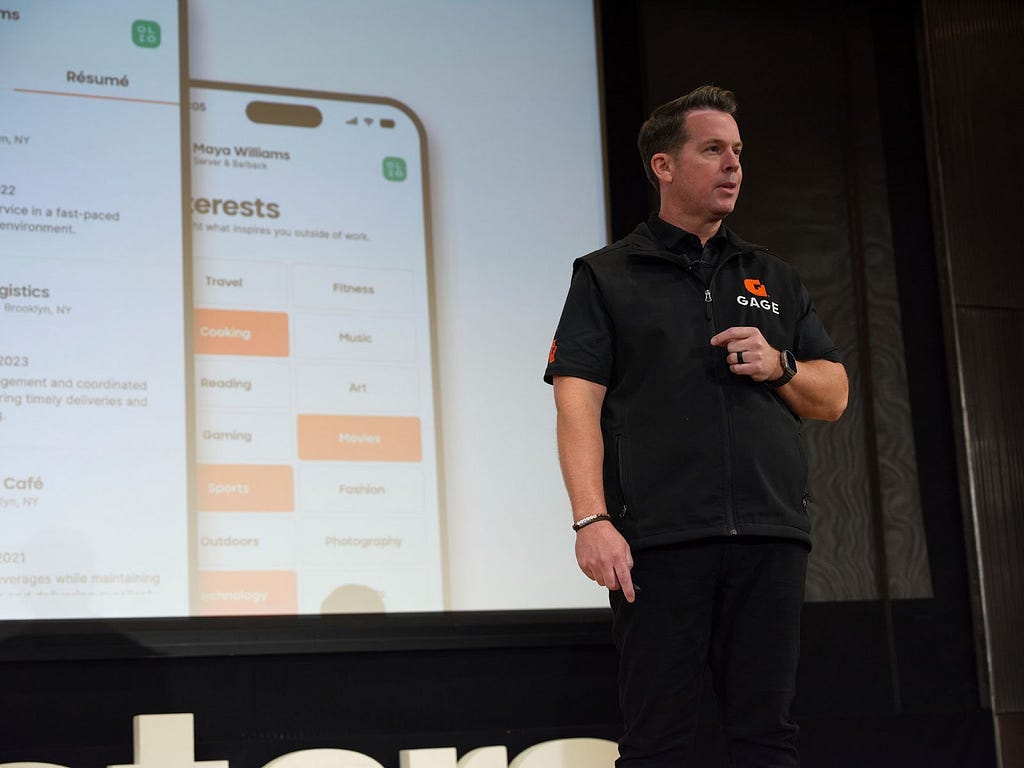
Justin: Sure. GAGE is the first workforce community for the frontline, shift, and hourly workforce. It’s essentially LinkedIn for the younger generation. And that’s essentially what we’ve evolved the product into being. We have gone through quite a journey. We launched a prototype about two or three years ago. We saw some incredible traction that made investors happy, and we raised the money that we needed to build the full vision of GAGE. So essentially what it is, it’s a workforce community where coworkers and workers and managers and business owners can all connect with each other within workspaces. One of the investors said it’s LinkedIn and TikTok had a baby. So, it’s basically a really good, productive use of social media.
Yitzi: What’s the origin of the term GAGE? Is it an acronym?
Justin: I just kept saying it. It came from enGAGEment. At the end of the day, we’re talking about engaging the workforce. It doesn’t matter what role you play, whether you’re the business owner or the employee, everyone has a part in being engaged within that workspace.
Yitzi: You probably have some amazing stories from the different parts of your career, the different places you’ve been. Can you share with our readers one or two stories that most stand out in your mind from your career?
Justin: Oh, goodness. The journey of GAGE has probably been the most difficult. I’m not a tech guy, not from a tech background, I’m from a restaurant background. It’s been challenging.
When I met our lead investor through a pitch competition in Texas, that was a defining moment for us. A major VC saw promise in what we were building, and that really shifted things. To this day, they’re still a significant part of the company and on our cap table. That was a big moment for us.
I’m really looking forward to this release. It’s going to be significant. The system we’ve built is designed to grow organically and virally through our network. We have over 175,000 users on our waitlist, including corporate pilots and partners. We also have partnerships within the educational system, so we’re going to give schools access to GAGE when we launch in the next few weeks.
Yitzi: It’s been said that sometimes our mistakes can be our greatest teachers. Do you have a story about a funny mistake that you made when you were first starting your career and the lesson that you learned from it?
Justin: Oh, I make mistakes all the time. One of the biggest was a series of decisions I made over the last few years. I was growing what was becoming a little restaurant empire, multiple brands. We were building a multi-brand operating company, which is something people can be very successful at, and we were well on our way. We had 12 restaurants across different brands.
At the same time, GAGE was taking off. It was moving up and to the right, and I reached a point where I had to make a decision. But I kept doubling down on the restaurant side. I told myself, “This is our path,” but at the same time, GAGE was clearly showing bigger potential. The upside was much higher, possibly, than with the restaurants.
One of our lead investors, his name’s Wade, the GP of the firm, said to me, “You can build a restaurant empire or you can build a tech startup, but I promise you, you can’t do both.” Then he added, “Even if you are able to do both, I feel sorry for your family, because you’re just not going to have time for anything else.”
That hit hard. I realized I had to stop and really focus on one thing. It was a humbling experience because I ended up having to sell or shut down a lot of what I had built.
Yitzi: So, you’re saying the lesson was that you were trying to do too much? That was it?
Justin: Yeah. I get distracted by shiny objects, that’s what my wife would say, and there’s definitely some truth to that. We were just on another path, you know?
But the power of focus, and being able to go all in on this very real, very powerful idea that GAGE represents… I realized it needs all of me. It needs full focus. So I doubled down on the brands that had been providing for me and my family, even though GAGE is still very much a startup.
Now, I’m able to give 100% of my attention to GAGE. But it took some bumps and bruises to get to the point where I really understood the importance of focusing on this one thing.
Yitzi: So, you didn’t exit from the restaurants?
Justin: Not entirely. It was more of a middle ground. Some of those concepts still provide for me and my family, a couple of them in particular. My legacy brands, the ones I started and built, like the AV company and the frozen yogurt concept, they’re franchising now. Those have always been the main ones that support us while GAGE gets off the ground.
We’re also in the middle of another fundraising round. Once that’s complete, I think I’ll be able to step back even more from the others. But I couldn’t go all in right away. I’m not 22 and living in a loft apartment like most tech startup founders. I had to find some balance.
But trust me, I have a lot less on my plate than I used to.
Yitzi: Does it feel tricky, competing with Silicon Valley? Or do you feel like you’re part of Silicon Valley?
Justin: I don’t think we’re competing against them yet, but I feel like it’s coming. With GAGE, it always feels like something’s brewing just beneath the surface. The amount of feedback, intrigue, signups, and partnerships has been really interesting.
What GAGE represents… I think we’re going to be well known soon, especially once we get this next version out. The way the system works, it’s designed to make every job, no matter what it is, feel meaningful, with purpose and potential. It creates economic and career mobility for everyone.
It builds a transferable employment record that employees can use to show proof of their performance and abilities in the workforce. That alone adds real economic mobility. And while a lot of people are trying to solve this problem, I think we’ve come up with a really unique, outside-the-box way of doing it.
Yitzi: You mentioned a few ways, but tell us some other ways that this is better than LinkedIn?
Justin: Well, LinkedIn is probably the closest comparison, but it’s not really the same. We’re truly a disruptor, we’re creating a new category. LinkedIn is a networking site, and what they did really well was validation. They’ve got a monopoly on it.
You probably didn’t even take this call without checking my LinkedIn profile first. And for a lot of white-collar or executive-level roles, you can’t even apply without one. It’s become the standard for professional validation. But I’ve never really liked LinkedIn, it’s too spammy for me.
What’s missing is a professional network for the other 60% of the workforce, the ones who clock in every day. Nurses, warehouse workers, restaurant staff, the people who fix our roads and serve our meals. They’re the unsung heroes of everyday life, and they’ve been completely alienated by existing professional networks. There’s no platform that lets them validate who they are and what they can do on the job.
If you solve that, you create real economic mobility. In our prototype, we saw GAGE users experience wage increases of up to 40%. Employers were willing to pay more because those workers could prove their performance and reliability on previous jobs.
When you give validation and credentials to people who’ve never had that kind of professional recognition, you unlock real, meaningful potential for upward mobility.
Yitzi: So you’re saying this is a primary benefit for people who are more blue-collar. Is that it?
Justin: Yeah, it’s blue-collar LinkedIn. Another way of looking at it is it’s an HR system, a management system, just like the hundreds, if not thousands, out there. But we’re very unique in the way we handle the data. If you’re part of Paycor, Paycom, Bamboo, or any of those HR systems, the business always owns the data. It’s the business’s platform. That means whenever the employee leaves, all of that information goes away. It disappears. Their performance reviews, evaluations, promotions, it’s all thrown out. And that leaves the employee with no record of what they’ve done.
But if you change that, and the employee gets to own the data as well and take it with them from job to job, that unlocks everything. That’s our unique approach. We’ve built it using a fun, very familiar language, which is social media. Like I said, we have a community feed, like a TikTok feed, that really resonates with this generation. But there are still managerial features inside the app as well.
Yitzi: You probably have some good perspective on the trajectory of jobs in general. I feel like there’s so much uncertainty now. People aren’t sure if their industry will be around in 10 years. If you were a young high school student, or if your friend was, where would you advise that person to stake their future? Which industry do you think will be around for the long term?
Justin: I would advise, including my own children, don’t underestimate the value of learning a skill, an actual trade. I think colleges and higher education are in their day of reckoning right now. People are starting to realize it might not be worth four years of my life and $80,000 just to prove I can accomplish goals. It might be better to go learn a trade or a skill. That’s what I’d recommend to any young person.
I think all of the trades and skilled jobs are going to be just fine. The rise of AI has definitely created some top-down challenges. What’s interesting about this particular technological advancement is that it attacks from the top down. It affects executive-level positions more than someone who’s going to fix my HVAC. So I think trades and skills will be around for a long, long time, and there’s amazing value in that.
Yitzi: So you’re saying focusing on hard skills like electricians, plumbing, woodworking, and construction, those industries will be around for a while, whereas maybe accounting and coding may not be.
Justin: I didn’t say that, but yes, I agree with that. But I think that’s the general gist. It’s very hard to imagine a world anytime in the near future where robotics is catching up to AI, right? There’s not going to be a robot showing up to my door to fix my toilet. It’s just not going to happen anytime soon anyway. But I do believe just the value of having a trade. People want to go to school because they want to be rich or they want to have money. Well, you can be extremely wealthy as a plumber. I mean, there are many millionaire plumbers out there. So I just feel like having a trade and skill… and I keep going back to the electrician, the plumber because that’s just a go-to. But it could really be anything. Just having an absolute skill that has value in this world as opposed to a four-year degree studying something that doesn’t. Sorry, not sorry, but that’s just the way I feel about it.
Yitzi: You’re a serial entrepreneur and you’ve built many businesses. This is our central question. You must have learned a lot from your experiences. Based on your career, can you share five things you need to successfully build and scale a business?
Justin: Oh, goodness. Putting me on the spot. Five, huh? All right. I got this. Well, you need resources, right? You need some sort of capital, but there are a few ways of doing that. I always say that bootstrapping is the best way. I’ve done it all… As a matter of fact, I posted about this the other day. I’ve borrowed money from family members. I do not recommend borrowing money from family members. But it is a way to go. I’ve done SBA 7A loans, I’ve done all kinds of stuff. But obviously you need money, but I think bootstrapping it, literally just going from a coffee table business on the way up, is the best way to go. You need knowledge in the industry that you’re in. They always say that it’s not what you know that gets you in trouble, it’s what you don’t know that you don’t know that gets you in trouble. And so just having a little bit of knowledge and doing your research. One of the things I always tell people or… I like to mentor and people ask me for advice all the time. And I say it’s usually whenever you just don’t do the math. Do the math. How much does it cost? How much are you going to make? What are you… and then add something to that, add some cushion. For me, it’s support, having the support of family members, having the support of, in my case, a loving wife and a good family. But maybe a good friend network, just having the support that believes in you. And then of course, the concept matters, right? Where is this concept going to go? Is this concept going to be here a year from now, five years from now? Do you have ways to scale it? I think that those are at the top of my list. And then this might be a little bit personal, but I believe in having a good mentor. Somebody that you have a lot of respect for that you can listen to, that can give you really good advice. I believe in those things.
Yitzi: Do you have some insight into how to find a mentor?
Justin: I go to church, and I’ve always had a lot of mentors there. Local organizations like the Chamber of Commerce are also great places to meet people who’ve been in business in your community and who you can lean on. Organizations like that are a great resource. I was a board member of my chamber for a long time, so I think doing some research on community organizations like that is really worthwhile.

Yitzi: So this is our aspirational question. Justin, because of your amazing work and the platforms you’ve built, you’re a person of enormous influence. If you could spread an idea or inspire a movement that would bring the most good to the most people, what would that be?
Justin: The importance and power of work, of work ethic. I think a lot of the problems we’re seeing in society can be traced back to a deteriorating work ethic and a lack of desire to work. I used to say all the time that work is the most important word in our human experience. If we didn’t have work, if we didn’t have purpose, what would we do?
As we look at the AI situation and all these technological advances, on one hand, it’s beautiful, but on the other, it’s scary. I don’t know if I want to live in a world without purpose. Idle hands are the devil’s playthings, and when people don’t have purpose, that’s when the worst parts of human behavior come out. I believe deeply in the importance of work.
I used to ask students, “What’s the most important word in our language? It’s got four letters.” They’d always say “love,” and I’d say, “That’s a beautiful word, thank you,” but I’d put love in the second spot because true love takes work. It takes work to be married to the same person for 10, 20, 30 years. It takes work to love your children, even when they just spray painted your hallway and you’re ready to strangle them. It takes work to maintain the relationships that bring true love into your life.
I don’t think anything that’s simply given is worth much. You have to earn it, and it’s in the earning that you find purpose in your life.
Yitzi: That’s beautiful. So when you say work, is a synonym for work in your context effort, or is it occupation?
Justin: It’s to create, to build, to occupy, yes, of course, because you’re building a life. You have to earn a living. But it has to do with purpose. What is your purpose? I think work has a very negative connotation, especially for the younger generation. But that’s what we’re here to do. We are here to have purpose. We’re not here to just sit on a beach sipping Mai Tais for the rest of our lives. As much as we want to vacation or avoid work, the moment we don’t have to work, we find something else to do. We find purpose. So when I say work, that’s what I mean, purpose. Because without it, things really do go sideways.
Yitzi: So what’s a good way for a person to find their purpose?
Justin: You’ve got to find what drives you, and also understand that everything you do, every job, whatever it may be, can be a stepping stone toward your purpose. It’s part of the path you have to walk to get there. I don’t pretend that anyone will find their lifelong purpose working in a sandwich shop, but that sandwich shop can still be part of the journey. You just have to do it the right way. And if you do, you can have anything you want in this life.
Yitzi: This is what we call our matchmaker question. With this, we’ll close. We’re very blessed that prominent leaders in business and other cultural figures read this column, and maybe we could connect you. Is there a person in the world or in the United States with whom you would like to have lunch or collaborate, because we could tag them on social media? Maybe we could connect you.
Justin: I’ve been wanting to meet Mike Rowe for a long time. As a matter of fact, I have a meeting next month with the president of his organization, Mike Rowe Works. I’ve also been wanting to meet Dave Ramsey for a long time. Those are two. If you could pull that off, I’d appreciate it.
Yitzi: Justin, how can our readers learn more about GAGE? How can they learn more about your work or support it in any way?
Justin: All of our handles are GAGE Work, and our website is GAGEwork.com. Follow us and join us on this journey. Our next version, Gen Two, releases in December, and we’ll be pushing it hard come January. So follow us and get on our waitlist. It’s pretty extraordinary, businesses and account holders see increased retention, total cost savings, and reduced turnover costs. And for employees, they see wage increases of up to 40% from using the product. It’s really an exceptional disruptor.
Website: https://gagework.com/
Instagram: https://www.instagram.com/gagework_/
Facebook: https://www.facebook.com/WorkWithGage
LinkedIn: https://www.linkedin.com/company/gagework/
Youtube: https://www.youtube.com/@gagework
Yitzi: Justin, it’s been a pleasure to meet you and talk with you. I wish you continued success, blessings, and good health. I hope we can do this again next year.
Justin: Thank you so much for this opportunity. I really appreciate it.
Yitzi: It’s a pleasure, Justin. Have an amazing day. I look forward to sharing the article with our readers.
Justin: Cheers. Thanks, man. I really do appreciate this opportunity.
Yitzi: Really, it’s a pleasure.
Marine Veteran Turned Founder Justin Henshaw on Choosing Focus Over Fortune and Redefining the… was originally published in Authority Magazine on Medium, where people are continuing the conversation by highlighting and responding to this story.