Paralympic Gold Medalist Nick Mayhugh Talks Track, Advocacy, and the Power of Laughing Through Pain: “I’ll Be the Voice for Those Who Aren’t Ready Yet”

“So I try to shed light on that with my platform. I might post a funny video to grab someone’s attention, and once I have it, I use that moment to educate. I’ll talk about the Paralympics, about amputees, or explain why someone with one leg might be competing against someone with two prosthetic legs… I love using humor to capture people’s attention because society often puts such a negative connotation on disability.”
I had the pleasure of talking with Nick Mayhugh. Nick is a Paralympic sprinter and former international soccer player who has become one of the most prominent figures in adaptive athletics in the United States. A three-time Paralympic gold medalist and world record holder, Mayhugh has emerged as a leading voice both on the track and within the broader conversation around disability, inclusion, and elite sport.
Born and raised in Fairfax, Virginia, Mayhugh spent his early years aspiring to play professional soccer. From a young age, he was drawn to sports, often measuring himself against his older brother, Thomas, whom he credits as his biggest influence and lifelong supporter. Mayhugh’s athletic promise was apparent early, and he rose through the youth soccer ranks before earning a spot on a Division I collegiate team. But his path to elite competition was shaped as much by adversity as by talent.
At age 14, Mayhugh experienced a grand mal seizure and was later diagnosed with cerebral palsy — a neurological disorder that affects movement and coordination. The diagnosis brought a measure of clarity to the physical difficulties he had long experienced, including chronic numbness on the left side of his body. But it also came with a prognosis that threatened his dreams. He was told by his doctors that he likely wouldn’t play soccer again.
Despite the medical predictions, Mayhugh refused to step away from the sport. He adapted to his physical limitations and pushed forward, eventually joining the U.S. Para 7-a-side National Soccer Team. There, he scored 34 goals across 25 international matches, earning a reputation as a skilled and determined competitor. While Para soccer is no longer part of the Paralympic Games due to the absence of a female counterpart sport, Mayhugh’s success in the discipline laid the groundwork for what would become a remarkable second act.
In 2019, Mayhugh was approached by U.S. Paralympics Track & Field with an invitation to transition into sprinting. It was an unexpected pivot for an athlete with no formal background in track, but he accepted the challenge. The early learning curve was steep. Though quick on the soccer field, Mayhugh initially struggled with the specialized demands of sprinting. Nevertheless, his determination to improve — alongside a belief that he had not yet reached his potential — carried him forward.
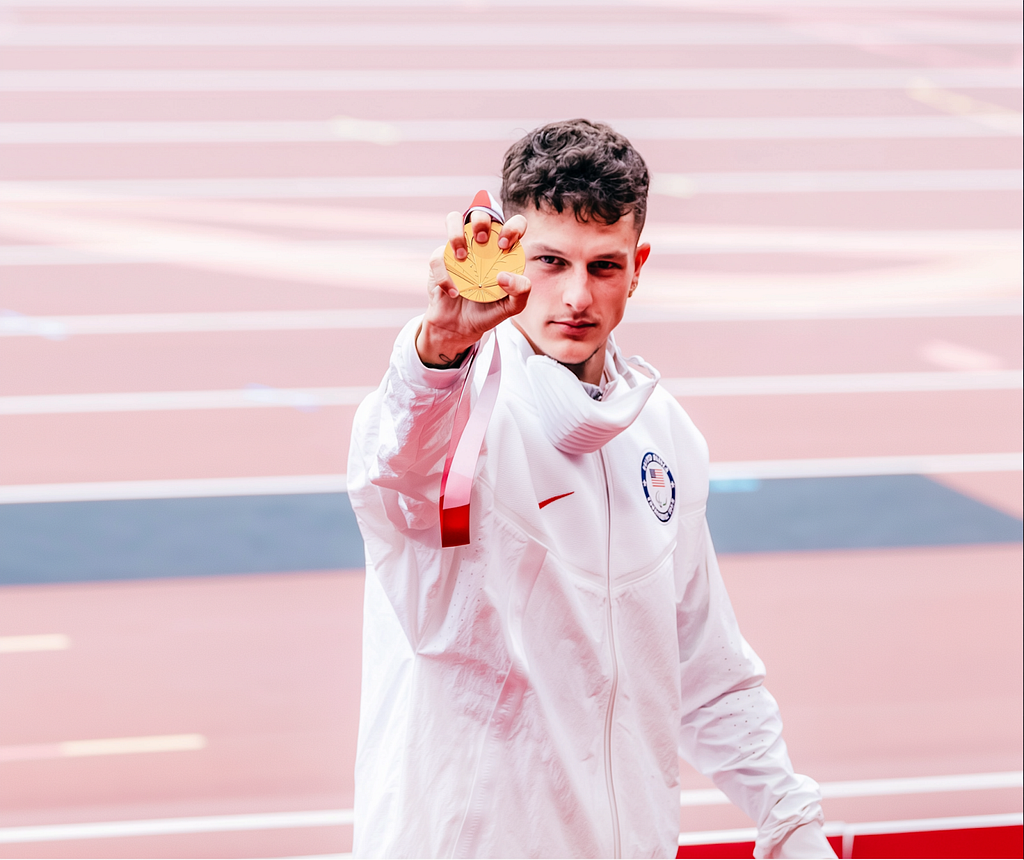
Within two years, Mayhugh qualified for the 2020 Tokyo Paralympics, where he delivered a breakout performance. He won three gold medals and one silver, setting world and American records in the 100m, 200m, and 400m sprints, as well as contributing to a world-best performance in the 4x100m Universal Relay. The results confirmed his status as one of the fastest para-athletes in the world and helped elevate public interest in adaptive track and field.
Off the track, Mayhugh has become an increasingly visible advocate for disability awareness, using his personal story to highlight the lived experiences of athletes with impairments. Through social media and public speaking, he often discusses the physical and psychological dimensions of life with a disability. He addresses misconceptions about Paralympic athletes, challenges the stigma surrounding disability, and works to broaden public understanding of adaptive sports.
Mayhugh has emphasized the difference between the Paralympics and the Special Olympics — two entities often conflated in public discourse — and frequently speaks about the elite nature of Paralympic competition. He trains full-time and competes at the highest international levels, underscoring that Paralympic athletes, while competing under different classification systems, are professionals in their own right. His advocacy includes efforts to bring greater visibility and resources to para-athletes ahead of major events like the 2028 Paralympic Games in Los Angeles.
Central to his message is a focus on normalization rather than exceptionalism. Mayhugh speaks candidly about the challenges he has faced, including moments of self-doubt and frustration, and insists that it is not only acceptable but necessary to acknowledge hardship. “It’s okay to not be okay,” he often tells others. His perspective is rooted in years of internal struggle, as he came to terms with a diagnosis that was, in many ways, both limiting and liberating.
Humor plays a notable role in his approach to advocacy. He frequently posts comedic videos on platforms like Instagram and TikTok that address disability with levity and openness, inviting others to laugh with — not at — those who navigate life with physical differences. By making disability part of everyday conversation, Mayhugh hopes to destigmatize difference and foster a culture of empathy and understanding.
While his medals sit tucked away in a shoebox at home, Mayhugh says the real reward of his work lies in impact. Whether through mentoring young athletes, educating the public, or simply offering a sense of representation to someone who has never seen themselves reflected in elite sport, he sees his platform as an opportunity — and a responsibility.
Now in his late twenties and continuing to train at the highest level, Mayhugh remains focused on future competitions, including world championships and the Los Angeles 2028 Paralympic Games. But just as important to him is what happens beyond the finish line: a growing movement of awareness, inclusion, and respect for disabled athletes and communities.
“I’m just getting started,” he has said of his career and his mission. For Mayhugh, speed may be his craft, but change is his purpose.
Yitzi: Nick, it’s awesome to meet you. Before we dive in deep, our readers would love to learn about Nick Mayhugh’s personal origin story. Can you share with us a story of your childhood and how you grew up?
Nick: Nice to meet you as well. I was born in Fairfax, Virginia, to my mom, my dad, and my older brother Thomas. I grew up loving sports. As much as I don’t want to admit it, I just wanted to be my brother growing up. He was five years older than me, super athletic, really good at everything he did, and I was envious in a lot of ways. I was younger, not as fast, not as strong — everything little brothers “hate” about their older brothers. He used to beat up on me growing up.
That said, he was, and still is, my number one fan and biggest supporter in everything I want to do. He’s been my coach, my best friend, my big brother — everything he could be. Growing up with such a great support system in my family was a huge help in everything I wanted to pursue.
As long as I can remember, I wanted to be a professional athlete. I dreamed of being a pro soccer player. But given the things I had to go through medically, pro soccer didn’t really pan out the way I imagined. I wanted to go overseas, play in Europe, like some of my best friends have had the chance to do. But I found my own path.
Growing up in Virginia, I played soccer at the highest level I could at every age group. I earned the opportunity to play Division I soccer and proved myself at that level. I was pretty successful in college. Then in my junior year, I found out about the Paralympics. I had been diagnosed with cerebral palsy at 14, but until then, I didn’t know the Paralympic world even existed.
It started with playing for the Para 7-a-side soccer team, which was the soccer side of the Paralympics. Unfortunately, soccer isn’t in the Paralympics anymore because there’s no female counterpart, so it became its own entity. In 2019, Team USA reached out and asked if I wanted to try running track. So I made the switch.
It’s been the most humbling experience. Learning to be as fast on the track as I was on the pitch was tough. I was quick and agile on the soccer field, able to create separation, but as a sprinter, I was really slow at first. That was a hard realization. But I put my mind to it and truly believed I could achieve what I set out to do — break three world records and bring home four medals from Tokyo.
My team and I set out to do just that, and we did. It’s still kind of crazy to say that out loud. Now we’re heading into year five of me being a sprinter, and I still don’t think I’ve reached my peak in this sport.
As much as I do on the track — and I’m very proud of it — I’m even more proud and fulfilled by what I can do off the track for the disabled community, for disabled athletes, and for disabled people in general. I love advocating for those who don’t have a voice or aren’t comfortable using theirs. I’ll be that voice. I use my social media to share my experiences and speak on their behalf, helping their stories — and the stories of everyone in the Paralympic community — shine through.
I think it’s an incredible opportunity I’ve been given through social media and through the people who look up to me or are crazy enough to call me a role model. That still feels strange to say, but it’s not something I take lightly, and I’ll never take it for granted.
I’m 29 now. I feel old, but I know I’m just getting started in this life. I’m excited to keep doing whatever I can to leave the Paralympics, the disabled community, and the world better than I found it.
Yitzi: Do you feel comfortable sharing with us the story of when you were 14 and first diagnosed?
Nick: Yeah, of course. It was very hard for me and my family. We were really confused because we just didn’t know what was going on. Ever since I could remember, my left side always felt different than my right. I could never really describe why or how. It kind of felt like when you hit your funny bone and get that tingling, TV static-type sensation. That’s what my entire left side felt like since I was born.
Trying to explain that to a teacher in elementary school, my PE teacher in middle school, or my counselor in high school — they didn’t understand, and honestly, neither did I. Growing up, not being able to kick a soccer ball as hard with my left foot as I could with my right, or not being able to do physical activities as well as my friends or family, really frustrated me. I didn’t know why, and it left me angry and confused.
Then one morning I had a seizure and was rushed to the hospital. I remember sitting in my neurologist’s office. They took one look at my MRI and kind of understood what was going on, but they didn’t really know how to explain it to me. Even they didn’t fully understand it because they had never seen anything to that extent before. Every neurologist I’ve ever seen has told me that my MRI is one of the most affected they’ve ever seen, and I’m one of the least affected patients they’ve ever had. That’s a strange contradiction. It’s confusing for them and hard for me to process. But I’ve come to see it as living on borrowed time, and I’m grateful for that.
When I was 14, sitting in that room and looking at my doctor, I asked her when I could play soccer again. She looked at me and said, “Nick, I don’t think you’ll ever be able to play soccer again.” That was right after I had finally been given a reason for why my body felt the way it did. All the dots connected and it made sense. It was very bittersweet. On one hand, I finally had answers. On the other, I was being told I couldn’t do the one thing I felt I was put on this earth to do — play sports, go pro, and do what I love.
That moment was incredibly hard. For the first time, I really started second-guessing things. The next few weeks and months were tough. I kept asking, “Why me?” I was frustrated with everything and didn’t know what I was going to do. But when I walked out of that doctor’s office, I knew I had a decision to make. Either give in to my disability and let it define me, or buckle up, put my head down, and get back to work. I had to learn to live within the parameters I was given, knowing my left side is biologically capped to a different degree than my right. And I had to deal with that — no excuses.
It always could be worse. My mindset has always been that if I set out to do something, I’m going to give it my all and achieve it. I don’t mind failing. I’ve failed more times than I’ve been successful in this career, both in soccer and in track. But I look at my diagnosis and my disability as a blessing in disguise. If I wasn’t diagnosed, if I didn’t have this disability, who knows where I’d be or what I would’ve accomplished. I’ll never second-guess that or take it away from myself. I’m proud of who I am and what I’ve done, but it’s been a long road — and there’s still a long way to go.
Yitzi: What advice, based on your experience, would you give to other people who have limitations or disabilities?
Nick: First, I always tell everybody that it’s okay to not be okay. That’s the biggest thing for me. Growing up, I was trying to make sense of everything, feeling frustrated because I didn’t have the knowledge to explain to myself or to anyone else how my disability affected me. At that point, I didn’t even know I had a disability, which made it all the more confusing. I just felt off, and I wasn’t okay.
I used to watch a lot of motivational YouTube videos. I’m really big on motivational speakers and pump-up songs. Every car ride to a soccer tournament on the weekends, I’d have music playing or videos downloaded to my phone to get me hyped up. Everything I consumed was about being tough — rub some dirt on it, stay strong, don’t be sad, push through. But over time, I realized it’s okay to not be okay. That’s something my diagnosis and everything I’ve gone through really taught me.
It’s okay to be upset. It’s okay to feel different, to feel out of place, to feel like something’s wrong. Because in the end, it’ll make sense. As long as you find something you love, and you’re doing something every single day to improve your situation, things will get better.
That’s the one piece of advice I always try to give to anyone who comes to me. No two people live the same experience. Anyone who asks me for advice is looking at my story, but I always like to turn it around and ask them what advice they’d give me — because they’ve lived a life I haven’t, and I can learn from them too.
So whether someone has a disability or not, no matter what they’ve been through, they’re special in their own way. I try to encourage people, especially disabled athletes, to look within and remember that it’s okay to not be okay. You’re not what society defines as “normal,” and that’s a good thing. Why would you want to be? That’s what makes you unique. That’s what makes you special. I try to bring light to what society often labels as a negative.
Yitzi: Can you share with us how you’re using your success and your platform to bring goodness to the world?
Nick: It depends on who you ask. I do my best. I try to have some fun with it and use humor. Growing up, I went through some terrible, really memorable and horrible things that, as a kid, you’re forced to deal with at such a young age — whether it’s death, a medical diagnosis, trauma, or anything like that. It’s incredible to look back and see how far I’ve come and to realize what I had to go through. Humor has always been my go-to.
No matter how dark or messed up it might be, it makes me laugh and helps me feel better about my situation. That’s the approach I like to take on social media. I’m not trying to make fun of anything, but I use humor to make people laugh and show that it’s okay to laugh at it — “it” being disabilities.
The community I’m a part of is incredibly humorous. There are so many good people in it, and everyone loves to laugh. Of course, there are people who are very emotional and sensitive because of the trauma they’ve gone through — whether it’s a car accident, something even worse, or if they were born with a disability and use a wheelchair, or if their arm or leg looks different. But the thing is, there’s probably nothing you can say to them that they haven’t already said about themselves or heard before. A lot of us use humor to cope and feel better.
So I try to shed light on that with my platform. I might post a funny video to grab someone’s attention, and once I have it, I use that moment to educate. I’ll talk about the Paralympics, about amputees, or explain why someone with one leg might be competing against someone with two prosthetic legs.
One example is a video that went viral of me running alongside my teammate Tatyana McFadden, who uses a wheelchair. People thought I was racing against her, but I wasn’t. I was racing with her, and I used that opportunity to explain that.
I love using humor to capture people’s attention because society often puts such a negative connotation on disability. Based on my own experience, people tend to talk down to those with disabilities. They feel bad for them. I understand it — it’s an awkward situation. Asking, “What happened?” or “What’s wrong with you?” sounds harsh, but most people don’t mean it that way. It’s just that something is “different,” and it’s hard to ask about that without it sounding wrong.
We get that, and that’s why I try to encourage people to start conversations, be open-minded, and be willing to learn about different disabilities. That’s the only way the world’s going to change or get better — by asking questions and being open to learning. And that applies to everything in life.
I try to do the best I can. But no matter how much positive stuff I put out, there’s always going to be just as much, if not more, negativity. That just comes with the territory. But like I said, I was given this platform, and it can be taken away just as easily as it was given to me.
As long as I have it — and as wild as it is to think that people want to follow me or listen to what I have to say — I’m going to have some fun with it. That’s how I like to educate and use whatever success I have.
My medals are sitting in a shoebox under my entertainment center in my room. They don’t do much for me. But the impact I’m able to have on someone’s life — if I can bring a smile to a kid who looks up to me or to a parent going through a tough time — that means more to me than any medal or world record ever will.
Yitzi: This is our signature question. Can you share five things that you wish more people understood about people with limitations?
Nick:
- Well, one, that we’re people. As someone who doesn’t have a visual disability and has just had to watch this from a different perspective, I’ve seen how people treat others with disabilities — whether they’re in wheelchairs, amputees missing a leg or an arm, or visually impaired and using a walking stick. People tend to stop and stare or treat them as somehow “less than.” And it’s usually not out of malice. It’s instinctive. We’re taught as kids not to stare, to help, to be careful around them. But the truth is, we’re people. Whether someone was born that way or went through a traumatic experience, the world isn’t really designed for people without all four limbs or for those who are blind. But we adapt. And it’s incredible to watch. I encourage people who are “normal,” who can walk unassisted, open a door with one hand, or move through life without thinking twice about it, to just be more generous with their understanding and stop treating people with disabilities any differently. Don’t rush to help unless asked. Most of the time, they don’t want help. They just want to live life the way they’ve adapted to live it. There’s a lot of joy in doing something simple that others take for granted — like opening a jar of peanut butter. Tying my shoes was the hardest thing for me until I was about nine years old, which is a little embarrassing to admit. But once I figured it out, I never stopped. I’m really proud of that. It’s those little things that mean a lot.
- Number two, especially within the Paralympics, is that we are elite athletes. A lot of people think the Paralympics and the Special Olympics are the same thing. They’re not. We don’t volunteer for these competitions. I train full-time. I invest a lot of time, money, and effort into my body, into my training, and into the team I’ve built around me. I’m preparing right now for US Nationals, and hopefully, I’ll qualify again to represent Team USA at the World Championships in India. We’re competing at an elite level. We don’t want to be mistaken for Olympians or treated like a novelty. We’re Paralympic athletes, and we deserve the same respect that Olympic athletes get. Sure, Olympic athletes might run faster. There’s only one 100-meter champion or one long jump champion. In the Paralympics, there are multiple champions across different classifications, but we’re doing the best we can with what we have. It’s just as demanding, and we deserve equal recognition for that.
- Three — and this might sound a bit edgy — I want people to feel comfortable laughing, enjoying, and even talking a little trash. If you see a Paralympic athlete fall in competition, it’s okay to poke fun or cheer them on harder next time. That kind of engagement motivates us. Watch the Paralympics with the same intensity and passion as you watch the Olympics, the NBA, the NFL, or MLB. Pick a country, pick an event, follow an athlete, get into the rivalries. If someone underperforms, let them hear about it, just like you would with any other athlete. Some of us do this professionally. Very few of us have pro contracts, but this is how we make our living. Social media can be brutal, but we know that comes with the territory. We just want to be treated like any other professional athlete. That’s how the sport will grow. When people invest emotionally and treat it like any other sport — with all the banter, the criticism, the excitement — that’s when we’ll start seeing real change. I had a rough performance in Paris 2024 — injuries, underperformance, all kinds of stuff — but the number of people who reached out and said things like, “I believed in you” or “I thought you’d win” really fired me up. I don’t take that negatively. I underperformed, and no one but my closest circle really knew what I was going through. But that’s part of being a pro athlete. People expect me to win, to set records, because that’s what I did in Tokyo. And I love that pressure.
- Number four is education. People need to learn more about the Paralympics. There are so many classifications — double leg amputees competing against other double leg amputees, single leg against single leg, arm amputees, visually impaired athletes. Learn about it. It’s fascinating. Even within track and field, there’s so much I still don’t understand. I just found out about wheelchair rugby, which is also called “murderball.” That name alone should be enough to get any rugby or football fan interested. It’s basically bumper cars meets rugby on a basketball court. They beat the heck out of each other, and it’s insane to watch. There are archers shooting with their feet. That blows my mind. Things I couldn’t even imagine doing. Honestly, I think the Paralympics are more incredible than the Olympics. Olympic athletes are “normal.” That’s boring. You’ve got two legs, two feet. Sit in a chair and try to shoot a bow and arrow with your big toe. You can’t do it. Neither can I. But some people can, and it’s unbelievable to watch. I’m a little biased, of course, but the point is, educate yourself. Whether it’s Paralympic sports or anything else, take the time to learn about the things you don’t understand.
- And number five really ties all this together. I’d just encourage people to support us in any way they can. With LA 2028 coming fast, now’s the perfect time to get involved. It’s going to be here before we know it. Qualifiers will begin, momentum will build, and people are going to start paying attention. But don’t wait until the ads start showing up in your city or you stumble onto a broadcast during the Olympics and think, “Oh, maybe I’ll watch the Paralympics too.” Go to an event. Learn about the sport. Be front row with a sign telling me I better win — and if I don’t, tell me you’re upset. Push me to be my best. I’m excited about where this community is headed. By LA 2028, it’s going to reach new heights, and I’m proud to be part of it. Anything you can do to support — whether it’s big or small — makes a difference. And come 2028, it’s going to be a lot of fun. Team USA’s going to sweep all the medals again.
Yitzi: This is our final question, aspirational question. Nick, because of your amazing work and the platform that you’ve built, you’re a person of enormous influence. If you could put out an idea, spread an idea, or inspire a movement that would bring the most amount of good to the most amount of people, what would that be?
Nick: Oh, that’s a great question. Create a movement… I think, keeping with the LA 2028 idea and the Paralympic movement, and anything revolving around disabled athletes and people in general, I think Team USA, NBC, and I myself should go out and find an athlete in each of the 50 states. Have them put on a seminar or some sort of event, no matter what sport they play, in the city or state they live in. Whatever they’re able to do.
That would be the movement — find one person per state. And if there are more than one in a city, have them put on an activation or a seminar to encourage people to come out, learn, listen, and participate in the sport they play. Whether it’s track and field, soccer with me in Virginia, or wheelchair rugby like my good friend Chuck Aoki, who plays wheelchair rugby — I think he lives in Minnesota or Minneapolis, one of those. I would encourage people to do that.
The goal would be to raise awareness, build support, and educate people on these sports that many might not even know exist. I think that would be really powerful. Whether NBC gets behind it or another network or journalist, just getting the word out about the Paralympics could give communities the chance to support someone in the upcoming 2028 Games.
I really think that could be a great way for people to step out of their comfort zones and teach their peers about something they’re passionate and knowledgeable about, especially when others aren’t. It would be a good thing for the general public and for Americans overall.
And in doing so, I think it would help shift how people treat those with disabilities. It’s hard to put into words, but when people see someone with a disability, they often react differently — maybe they lower their voice or change their tone. But if you see these Paralympic athletes — these elite athletes — perform live, right in your city or state, I believe it would really shift that mindset. It would change how you see and interact with people with disabilities.
They’re incredible people and incredible athletes. That would be the movement I’d start. I might even go ahead and lead it myself. I just want to make a difference, and I want to include others in the process. I think this could be a great way to involve Team USA, everyone who qualifies for 2028, and even those who don’t.
Just being able to compete at nationals, having the chance to qualify to represent your country at an event that happens only once every four years — that’s an incredible achievement on its own. I think it would do a lot of good for a lot of people, and I’m excited for these next three years.
Yitzi: Nick, you’re so inspiring. How can our readers continue to follow your work? How can they support you in any possible way?
Nick: You can follow me at Nick Mayhugh — just my name, plain and simple — on Instagram, TikTok, anywhere. Support the videos I put out, whether they’re educational or even if you find them offensive. Let me know, leave a comment, give me some feedback, and we can have a conversation about it. Repost, share it with your friends.
I encourage you to start by Googling the Paralympics, find out what it is. If you’ve played a sport that’s part of the Paralympics, look up that sport within the Paralympic context. Find some of the athletes who compete in it. Learn about them, learn how the sport is different. For example, able-bodied soccer is 11v11, but in Para 7-a-side, it’s 7v7.
In track and field, there are no hurdles for obvious reasons — although I think we should have hurdles. I think it would be very funny and a good way to get people engaged.
There’s a lot people can do, and you can start there. Follow me, and I’ll do my best to educate you the right way. You can watch the videos I’ve already put out and learn a bit about the relay and other Paralympic events within track and field. Once you find me, you’ll find another Paralympic athlete, then another Paralympic sport, another country — you might even find someone you like better than me.
But they’re not faster than me, so stay right here at Nick Mayhugh. I’ll do my best to keep a smile on your face and educate you in the best way I know how — and that’s by making you laugh.
Yitzi: It’s been awesome meeting you. Thank you for this amazing conversation, and I wish you continued success and good health. I hope we can do this again next year.
Nick: Thank you very much. We will.
Paralympic Gold Medalist Nick Mayhugh Talks Track, Advocacy, and the Power of Laughing Through… was originally published in Authority Magazine on Medium, where people are continuing the conversation by highlighting and responding to this story.