Roger Craig Smith on Sonic, Batman and the Unexpected Path From Stand-Up Comedy to Voiceover Stardom
“I remember asking her, ‘I was fascinated to hear that you love comedy because I’m hoping to be a comedic character actor at some point,’ and I started to continue. She cut me off and went, ‘Oh, sweetheart, you don’t get to choose.’ I remember thinking, ‘What?’ She said, ‘You don’t get to choose. The industry will let you know what they see in you and what they prefer you to do. If you start going out for auditions and you land a bully character, then Hollywood loves you as the bully. If that’s where you start working, that’s where you’re going to go. If you’re wise, you will gobble up as many opportunities to work as you can, regardless of whether it’s your passion work. Then you get to finance and fund your passion work by doing the comedy roles — maybe you produce a film, maybe you join an improv troupe.’ I remember at one point I was kind of bummed out, but then I realized that was the best advice anybody ever gave me. That’s how I wound up where I was. I was thinking I’d be a writer and a standup and maybe get a comedic character supporting role, but I kept hearing people asking about voiceover. After the Aspen Comedy Festival tryout, I decided to listen and bark up a different tree. I did, and I fell in love with it, and it also paid, which was nice, unlike screenwriting at the time.”
I had the pleasure of talking with Roger Craig Smith. You might not know his face, but you definitely know his voice. It’s the sound of a blue hedgehog breaking the sound barrier, the gravelly command of a caped crusader in the dead of night, and the charming Italian accent of a Renaissance assassin. For over two decades, Roger Craig Smith has been the invisible force behind some of the most iconic characters in video games and animation, a chameleon-like talent whose journey began not in a sound booth, but on the comedy club stages of Southern California.
Growing up in Orange County, Smith wasn’t plotting a course to become the voice of a generation’s digital heroes. He was just a kid trying to get a laugh. “I think early on, I was interested in entertaining people and making my friends laugh,” he recalls. He found an outlet in theater, but after high school, he was, in his own words, “completely directionless.” Like many kids with a dream, he thought he might be a rockstar, pounding the drums in a band. That path eventually led him to a different kind of stage: stand-up comedy.
While finishing his screenwriting degree at Chapman University, Smith honed his act, peppering his routines with characters and voices. The industry started to notice, but not in the way he expected. The real turning point came during a showcase at the Improv in Irvine. An evaluator from the Aspen Comedy Festival was in the audience. After the show, she critiqued the performers one by one. When she got to Smith, she didn’t talk about his jokes or his timing. She cut right to the chase. “Hey, who represents you for voiceover?” she asked. Smith was stunned. “I said, ‘Oh, no one.’ She said, ‘Oh, you do so many voices and characters in your act. I thought you were a cartoon guy.’”
It was a lightbulb moment. “I started realizing the industry hears me as something, and maybe I should pay attention,” he says. He took classes, fell in love with voice acting, and soon landed his first gig — a McDonald’s radio spot. That was the beginning.
But the most crucial lesson didn’t come from a director or a casting agent. It came from actress Mary Steenburgen. At a college event, Smith got the chance to pick her brain, telling her he hoped to be a comedic character actor. She stopped him cold. “Oh, sweetheart, you don’t get to choose,” she told him. “The industry will let you know what they see in you and what they prefer you to do… If you’re wise, you will gobble up as many opportunities to work as you can.”
At first, he was bummed out. But the advice proved to be a guiding star. “That’s how I wound up where I was,” he admits. He listened to what the industry was telling him and leaned into voiceover. The path wasn’t what he planned, but it was the right one. This idea that “the path is never linear,” a phrase from his high school theater instructor, became a recurring theme. It all clicked on one of his dream jobs, voicing the villain Ripslinger in Disney’s Planes. During a recording session, he saw an opportunity to connect a story element with a line of dialogue. He suggested Ripslinger say, “That’s why we call them Sky-Slicers!” after using his propellers as weapons. The director loved it. “To me, it was a screenwriting tactic, a plant and payoff,” Smith explains. “There’s screenwriting, standup comedy, trying new things, and here it all culminates in this dream gig.”
Even with a filmography that includes Batman, Captain America, and Sonic the Hedgehog, Smith remains grounded, viewing his missteps as his greatest teachers. He shares a story from early in his Sonic career, when legendary director Jack Fletcher pulled him aside after an audition. “He was like, ‘Hey, you’re trying really hard… but I can tell your instinct is to just come into the room and give them everything,’” Smith remembers. Fletcher advised him to pull back, to give 125% and let the director bring him down to 75%, rather than starting at 1000%. It’s a lesson he still carries. “To this day, Jack will still tell me… ‘I’m going to give Roger the usual direction… which is to slow down just a little bit.’”
Looking back, if Smith could give his younger self any advice, it would be simple. “Relax,” he says. “Understanding that being inspired by others and holding yourself to their achievements as a litmus test is such an exercise in futility.” He’s learned to embrace his own unique journey, a winding road from class clown to stand-up comic to one of the most prolific voice actors of his time. “You’re never going to have my career,” he says with a knowing calm. “And I’m never going to have yours.”
Yitzi: Roger Craig Smith, it’s so delightful to meet you. Before we dive in, our readers would love to learn about your personal origin story. Can you share with us the story of your childhood, how you grew up, and the seeds for all the amazing things that have come after that?
Roger Craig Smith: Thank you for the kind words. My childhood, I don’t know that it was anything special or abnormal. I grew up in Orange County, California. I was born in Michigan, but we moved out there when I was a year old, so I had only ever known Orange County, California as a kid. I think early on, I was interested in entertaining people and making my friends laugh. I found my way into theater and did some theater programs as a kid, Musical Youth Artist Repertory Theater, known as My Art, in Southern California. I did that for a number of years.
I got into high school, did theater arts, and then got out of high school completely directionless. I thought I was going to be a rockstar and play drums in bands. Then, I found my way into standup comedy while wrapping up junior college and matriculated to finish my four-year degree at Chapman University in Orange, California. I majored in film and got a BA in screenwriting from Chapman. I was still doing standup comedy at that time, and I would do characters and voices in my act.
The industry took notice. We were doing a showcase evening at the Improv in Irvine, California. There were about eight or ten of us selected to perform that night for the benefit of a woman who was there to evaluate us from the Aspen Comedy Festival. At the end of the show, after the audience left, we all took the stage again, and she sat there and critiqued us in front of our colleagues. When she got to me, she just said, “Hey, who represents you for voiceover?” I said, “Oh, no one.” She said, “Oh, you do so many voices and characters in your act. I thought you were a cartoon guy.”
At that point, I had been in college, majoring in things, doing standup for a number of years, and started to realize I was hearing more and more people asking me about voiceover and voice acting because I would do voices, accents, and characters. We would host events, and people would say, “Oh, you have a radio voice,” or “Are you a radio guy?” I started realizing the industry hears me as something, and maybe I should pay attention. I took some classes and fell in love with voice acting. My big break was Bob Bergen’s animation workshop. There happened to be someone from an agency evaluating students that night, and myself and another young lady were both selected to be considered for this agency. We came in a couple of weeks later, tried out, and about a week after that, I got a phone call saying, “We’d love to represent you. Your first audition is on Monday.” I just went, “All right.” I think I booked a McDonald’s radio spot, and that was well over 20 years ago at this point. That’s where it all began.
Yitzi: You probably have some amazing stories from your successful career. And maybe this is very hard to boil down, but can you share with our readers one or two stories that most stand out in your mind from your career?
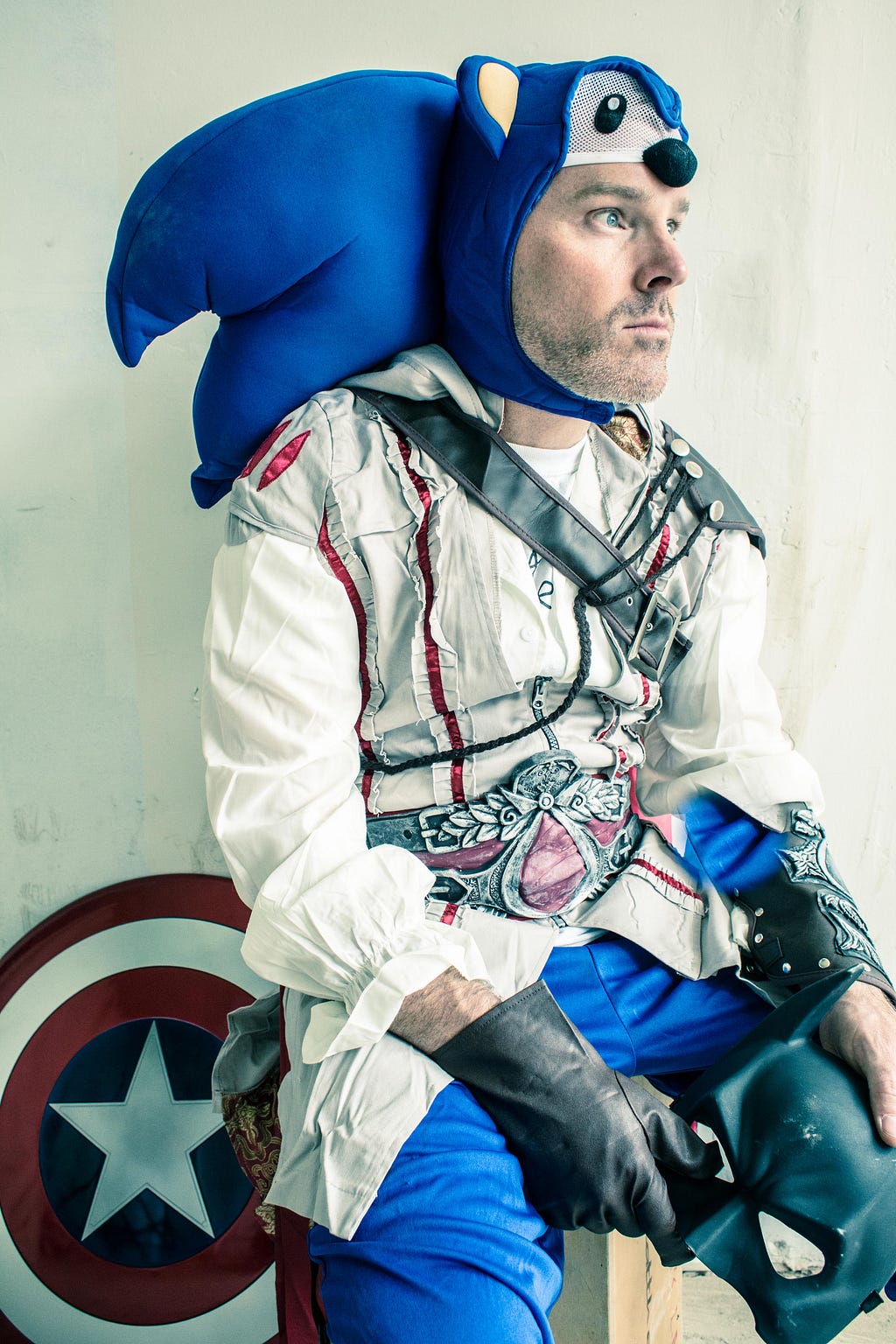
Roger Craig Smith: Yes, gosh, there are so many. Lightning has struck so many times in my career. I’ve been so fortunate and lucky to have a chance to be a part of so many massive franchises and legacy characters. It’s one thing to say Sonic the Hedgehog; it’s another thing to say Ezio, Batman, Mirage, Captain America, Gudetama, and Kyle Crane. There have just been so many, it’s crazy. So, it’s tough to narrow down.
I’ll go back to essentially before my career. One of the best things that anybody ever told me — and I’ll name drop, not that she would remember this — but Mary Steenburgen and Ted Danson came to participate in a show we were doing at the very end of my college career. It was a nighttime talk show at the university, and they were nice enough to be guests. Afterwards, they joined us for a dinner with the whole crew. At one point, I sat down next to Mary Steenburgen and said, “May I pick your brain about something?” I was interested to hear that she had a passion for comedy and over-the-top, silly stuff, yet we knew her more as a dramatic actor, at least at that time.
I remember asking her, “I was fascinated to hear that you love comedy because I’m hoping to be a comedic character actor at some point,” and I started to continue. She cut me off and went, “Oh, sweetheart, you don’t get to choose.” I remember thinking, “What?” She said, “You don’t get to choose. The industry will let you know what they see in you and what they prefer you to do. If you start going out for auditions and you land a bully character, then Hollywood loves you as the bully. If that’s where you start working, that’s where you’re going to go. If you’re wise, you will gobble up as many opportunities to work as you can, regardless of whether it’s your passion work. Then you get to finance and fund your passion work by doing the comedy roles — maybe you produce a film, maybe you join an improv troupe.”
I remember at one point I was kind of bummed out, but then I realized that was the best advice anybody ever gave me. That’s how I wound up where I was. I was thinking I’d be a writer and a standup and maybe get a comedic character supporting role, but I kept hearing people asking about voiceover. After the Aspen Comedy Festival tryout, I decided to listen and bark up a different tree. I did, and I fell in love with it, and it also paid, which was nice, unlike screenwriting at the time.
That advice really did become indispensable in my career. There are times I’d love to be more of a bad guy character or do something more dramatic, but I think people enjoy my background in standup, and that comedy and more broad, over-the-top stuff suits me. I’m happy to be doing that kind of work. It doesn’t mean I’m not interested in the other stuff, but I think by and large, the industry likes me as this guy or that guy, and I say, “Okay, I’ll go that way.” This is a dream come true, and I’m not about to act like I’m not getting hired to do the projects I want to do. You’re getting hired, shut up, hammer the check, and have fun. What she said was a very pivotal moment for me.
Another of my favorite moments was blending things together. I had a high school theater arts instructor, and we were throwing a retirement party for her. At her party, I was telling her how crazy it was that I had a career. I took a long time after high school; I didn’t go straight to college. I was all over the map, trying to figure out what I was going to do. And she said, “The path is never linear.” I remember thinking that’s very true.
Suddenly, I found myself going from drums to standup comedy to screenwriting as a major. I didn’t graduate college until I was 27, so I felt like I was all over the map. Then I land this dream-come-true job as Ripslinger in Disney’s Planes. I was such a Disney fan and an aviation buff as a kid, so these two worlds colliding was unbelievable. I got to be in a Disney animated movie as a bad guy and as an airplane. It was the best thing ever.
Towards the end of our initial production, they called me back in for a pickup session. At one point, Ripslinger flies down and uses his propeller to attack another airplane, Skipper, and he cuts his tail. What they had written was that I would do that and then fly off, and we would hear Ripslinger do a bad guy laugh. I looked at Clay Hall, our director, and said, “Clay, this is a perfect opportunity. Instead of me just laughing — we’ve been referring to his propeller throughout the script as Sky-Slicers — how about I fly away and go, ‘That’s why we call them Sky-Slicers’?”
Clay snapped his fingers and was like, “Yes, that’s it!” I was told they went back and actually spent the money to animate Ripslinger’s mouth to that sequence. To me, it was a screenwriting tactic, a plant and payoff. We planted the name Sky-Slicers early on, but we never really paid it off. Suddenly, here’s Ripslinger using it to be a devious jerk. I remember leaving that and hearing later that they had reanimated it.
I had that moment in my life where I was like, “Wow, the path is never linear.” There’s screenwriting, standup comedy, trying new things, and here it all culminates in this dream gig. It was a fun moment of being good at your job, having a background, understanding things, and being an asset to a production.
Yitzi: It’s been said that sometimes our mistakes can be our greatest teachers….
Roger Craig Smith: Oh, without a doubt. I don’t know about sometimes; I think they always are. Comedian Bill Burr has a whole bit about how much you learn once you’ve been punched in the nose. You think you’re going down a path, and then all of a sudden somebody is telling you to stop, and they open up your nose. The second it hits, you start going, “Oh yeah, I probably shouldn’t have been saying what I was saying.” I think mistakes are where you get the most valuable lessons. It’s a shame we’re so afraid of them that we don’t bother trying. I think I heard a phrase, and I don’t know who it’s attributed to, but “more is lost from indecision than is ever lost from being wrong.” The idea that you’re just not going to choose because you’re so afraid of being wrong means you’re losing far more momentum, ground, and opportunity than you are by going for something, getting it wrong, learning, and trying again.
Yitzi: Do you have a funny mistake that you made when you were first starting and the lesson that you learned from it?
Roger Craig Smith: Today is the 15th anniversary of what is technically my first job as Sonic the Hedgehog. Sonic Colors premiered on this day 15 years ago. Jack Fletcher has been my director on all things Sonic the Hedgehog, except for the Wreck-It Ralph movies. Prior to us even working together on Sonic, I came into Disney to audition for a role. Jack pulled me aside afterwards and was like, “Hey, you’re trying really hard. And you’re really good at this, but I can tell your instinct is to just come into the room and give them everything. You could learn a little from just pulling back and letting them coax something different out of you, as opposed to hitting them so hard over the head with so much energy that it gets a little overwhelming.”
I remember thinking he was absolutely right. I do try to come in and just give 1000%. He was like, “Yeah, maybe give them 125%, let them pull you back down to 75%, and see if that’s where they want their project to sit. You’d be better served.” It was very thoughtful, solid advice. To this day, Jack will still tell me, even in Sonic the Hedgehog sessions, “I’m going to give Roger the usual direction that I have to give him from time to time, which is to slow down just a little bit.” I think the mistake serves me well. If I’m trying to go too fast, it’s nice to know that we can go quicker if we need to, but sometimes pulling back is just what the performance needs. Jack was instrumental in teaching that to me. I still get it wrong to this day — still try to go too fast because you gotta go fast, as Sonic would say.
Yitzi: It’s funny that you mentioned Bill Burr because you sound so much like him.
Roger Craig Smith: Bill Burr? Oh gosh. He’s so good. His mind — I love listening to anything Bill Burr has to say. It’s always very funny and biting. He’s a legacy.
Yitzi: You’re also up there with him.
Roger Craig Smith: Says you. No, there’s a reason why I do not do standup anymore. That is a tough road to hoe. I am so thankful that comedy is probably stronger than it has been in the last 20 years. We’ve got such great stewards of the industry out there making sure you listen to some contentious voices at times. It’s important to listen to people you disagree with and things you might find uncomfortable, and then figure out why and come up with a better counter-argument. I think the really solid comedians do that, and I think Bill’s up there with all of them.
Yitzi: You’re amazing. You have so much impressive work. Your filmography is unbelievable. Can you share with us the exciting new things you’re working on now and what you hope to be working on in the near future?
Roger Craig Smith: We have something that comes out November 14th, a new Lego Marvel movie called Lego Marvel Adventures: Strange Tales, I think is the name of it. I love doing anything that’s Lego and Marvel combined. Those stories are always so much fun. We, of course, just had Dying Light: The Beast come out, Sonic Dream Team came out, and I’ve had The Outer Worlds 2 come out, where I am the voice of Wireless Free Arcadia, which is a superbly written, wonderful satirization of democracy, capitalism, corporate culture, and entertainment.
There are more things on the way that I wish I could tell you about. I know that for DC Dark Legion, we’re voicing Batman and The Batman Who Laughs, as well as a couple of other characters. That is still going strong on mobile platforms. The VR game Arkham Shadow celebrated one year in October. There are a couple of things around the corner that I wish I could tell you about. I would imagine if people keep an eye on my socials, between X and Instagram, that’s where I’ll promote anything I’m allowed to speak about.
Yitzi: You mentioned The Outer Worlds. I played the first one and loved it. What do you think it was about that franchise that captured people’s hearts and minds?
Roger Craig Smith: I think it’s that so much of what we do in entertainment is about fantasy and transporting yourself. What I love about The Outer Worlds is how it shines a light on us as a species, on some of the things we hold dear that are a little silly at times, and vice versa. The game really makes you look at what it is to be a human by going into these otherworldly environments to poke fun at the things that we are so defined by, yet so unchanging in. That’s why I love the retro vibe of Wireless Free Arcadia; it has that old-school radio announcer vibe from the 40s. It just goes to show not much has changed. Maybe our cadence, vocabulary, and delivery are slightly different, but we’re still human beings that respond to some of the same things, like marketing, corporate culture, and power plays by politicians. I find it a very fun game to play in for that reason. It’s not only got great gameplay, but you’ve also got these narratives and stories that are just fun. They know how to entertain while also providing great gameplay, which is not an easy thing to do.
Yitzi: Beautiful. This is our signature question. Roger, you’ve been blessed with a lot of success. Looking back to when you first started, can you share five things you’ve learned over the years that would have been really nice to know back then?
Roger Craig Smith: Oh my gosh. Can I say “relax, relax, relax, relax,” for four and then come up with a fifth? Really, that to me is the biggest lesson. It can branch out into the five things, but I think it’s about easing up on yourself. Understanding that being inspired by others and holding yourself to their achievements as a litmus test is such an exercise in futility. You’re only going to wind up disappointed because you’re never going to be that other individual.
When people ask me for advice on joining the world of voice acting, I tell them, “You’re never going to have my career.” And then I wait and say, “And I’m never going to have yours.” The simple reality is you are going to bring something to this industry that others don’t. If you can discover what that is, hone in on it, and settle into the fact that you do you better than others could, then you’re probably going to be fine. So just relax, enjoy the ride, and don’t be as obsessed with where you aren’t. Be supportive of where you are, which is on a journey, and make it your own.
I say that as somebody who still suffers from jealousy, but it’s one of those things where you realize you’ll never be that other individual. I’m me, just like they can’t do what I do and I can’t do what they do. So instead of worrying about where I’m not, I should look at this and go, “Yeah, I’m a part of this industry.” I’m not going to get it right every single time. I’m not going to be perfect. But if I shoot for something I feel I’m good at, or even something I’m not good at but really want to try, I’ll devote the energy to it. Perhaps I’ll excel once in a while, and I’ll learn and grow. That’s about you, not about others and whether or not you measure up to them.
Yitzi: This is our aspirational question. Roger, because of your amazing work, you’re a person of great influence. If you could spread an idea or inspire a movement that would bring the most amount of good to the most amount of people, what would that be?
Roger Craig Smith: Oh my goodness. Well, I have to disagree with you that I am a person of influence. That’s frightening. Honestly, I think right now we’re at a time when we feel like shutting down that which we disagree with is somehow a solution, and I don’t know that that’s working for us. I think we see it on social media and in the way that we interact with one another. People just want to annihilate somebody that’s in opposition as opposed to finding a way of saying, “I vehemently disagree with this person’s stance on something. I should find out how I can propose a better counter-argument.”
Perhaps in that pursuit, I might find some common ground with this individual, and maybe somehow we both get closer to a truth, not the truth, but a truth that is always evolving. I don’t know what that inspirational request would be. It’s not tolerance; it’s an understanding that there’s always going to be conflict. We’ve got to get better at finding a way of engaging in conflict resolution that doesn’t just annihilate the other side. If we feel like blowing up the other side because we’ve deemed them not even worthy of listening to, it moves things underground and has things simmer and boil over in a way that’s unhealthy for all sides.
I guess if I could inspire people to take a second and, if there’s something we need to address, find a way of doing so that doesn’t just remove their ability to speak, but instead shows why our side is the better choice. That tactic of “if you’re not with me, you’re against me” seems to be not working very well for us as a species. So, what is that? Is it just “practice better conflict resolution?” See, this is why I’m not an influencer.
Yitzi: How can our readers continue to follow your work?
Roger Craig Smith: I guess just the socials. I’m at Roger Craig Smith on both Instagram and X. That’s where you will find out what I’ve got coming up and what weird pictures I’m taking of birds and stars if I can get back to that hobby. That’s easily the best way.
Yitzi: Roger, it’s been so great meeting you. I wish you continued success, good health, and blessings, and I would love to do this again next year.
Roger Craig Smith: Likewise. Thank you so much. I would be more than happy to. You are a fantastic interviewer. Thank you very much for your time.
Yitzi: It’s my pleasure.
Roger Craig Smith on Sonic, Batman and the Unexpected Path From Stand-Up Comedy to Voiceover… was originally published in Authority Magazine on Medium, where people are continuing the conversation by highlighting and responding to this story.