
‘Too Good’ Filmmaker Meron Alon on Life Pivots, Jean Smart’s Divine Role and Finding the Humor in Human Flaws
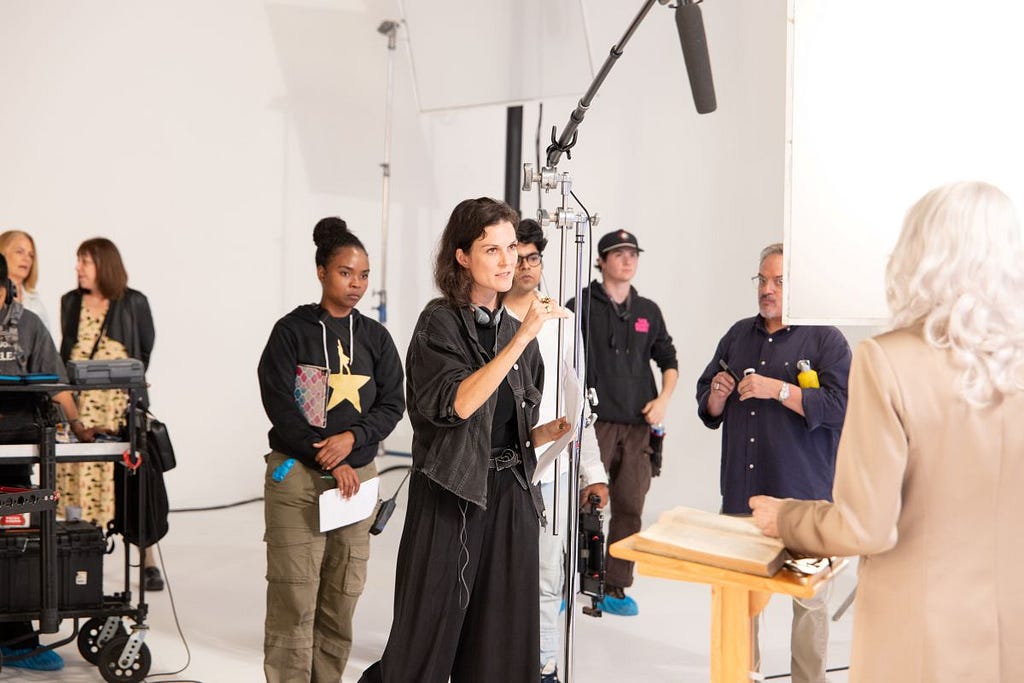
“I realized that I subconsciously ask myself a lot, ‘Am I a good person?’ I think that’s something a lot of people do. And while I try to be the best person I can, I’m not perfect. That brings up the question: what is good enough? If you ask what’s good enough, then you also have to ask, do those little selfish moments, or even the tiny things we do, tarnish the goodness within us? Do they make us bad people? That’s really what I’m exploring. Also, themes of forgiveness and redemption. No one’s perfect, and that imperfection is just part of life.”
When Israeli-born filmmaker and visual artist Meron Alon takes the stage at the 2025 HollyShorts Film Festival for the premiere of her short film Too Good, it will mark the latest chapter in a career defined by late pivots, persistent self-teaching, and an appetite for examining human imperfection. The seven-minute dark comedy, starring Jean Smart as a jaded God and Lil Rel Howery as a bewildered man at the Gates of Heaven, blends irreverent humor with moral inquiry , an approach that has become a hallmark of Alon’s emerging body of work.
Alon grew up in Israel, the daughter of an Israeli father and a Dutch mother. She studied at Tel Aviv University before opening and running a bar in the city, an entrepreneurial venture that foreshadowed her later willingness to build her own path. In her late twenties, she moved to the United States for graduate school, landing high-profile roles at companies including the Boston Consulting Group and Uber headquarters. On paper, the work was a success; privately, she recalls crying at night, sensing she was on the wrong trajectory. “Everything in my body was telling me I wasn’t living the life I was supposed to live,” she told me. That realization pushed her toward a longstanding interest in storytelling.
Without formal film school training, Alon began writing scripts in her off hours, initially for television, and painting in a corner of her San Francisco apartment. She shared early drafts, gathered feedback, and improved through repetition. A stint at Facebook’s now-defunct Watch platform provided an inside view of entertainment development, further sharpening her understanding of production pipelines. Yet it wasn’t until she decided to self-produce a short film that she began to feel firmly established as a filmmaker.
Her first short, Anxious, premiered two years ago and played the festival circuit. It taught her, she says, how to assemble a team and navigate the logistics of a shoot. That experience laid the groundwork for Too Good, which premieres on the Oscar-qualifying HollyShorts opening night this August. Produced by Arjun Yadav with executive producers Barbie Block, Robin Lippin, and Ben Escobar, the film was shot in a single day in Los Angeles and is already being developed into a feature-length project.
Securing Jean Smart for the role of God was, by Alon’s account, a turning point. Without a personal connection to the six-time Emmy winner, Alon worked with casting directors Block and Lippin, who agreed to join the project despite the modest budget. They got the script to Smart’s manager, and the actor quickly signed on. “She really gave us all a shot,” Alon has said, noting that Smart’s involvement made it easier to attract Howery, known for Get Out and The Carmichael Show.
Too Good opens with Howery’s character arriving at Heaven’s gates expecting solemn judgment, only to encounter Smart’s God, who interrogates him with pointed, often petty questions: whether he’s ever pressed the elevator “close” button on someone or pretended to like another’s children. The humor escalates into a quiet provocation about morality and redemption. Alon conceived it as an interactive viewing experience, prompting audiences to ask themselves how they might fare under similar questioning. The tone is sharp but not cynical, a balance she says was important: “No one is perfect… Looking inward is a good step toward trying to be better.”
Her fascination with the afterlife, and the moral accounting it implies, has roots in her own self-interrogations. “I subconsciously ask myself a lot, ‘Am I a good person?’” she says. The short’s premise evolved from that question into a meditation on the meaning of “good enough,” and whether small selfish acts undermine larger patterns of decency. In the feature-length version now in development, Alon faces the challenge of giving an all-knowing God a character arc without undercutting the character’s authority , a problem she admits is “really hard” to solve.
Alon’s professional shifts have given her a pragmatic approach to creative work. She advises aspiring filmmakers to gain practical experience in any form, whether as a production assistant or by writing scripts for feedback, and cautions that film school is not the only entry point. Her own start came piecemeal, without quitting her day job until she was ready to make a bigger leap. “Just start,” she says. “You can ease into it, see if it feels right, and keep going.”
Outside of filmmaking, Alon maintains a routine aimed at staying grounded. She spends time in nature, meditates, and prioritizes moments of presence. “Feeling alive is really important to me,” she says, describing a daily practice of assessing whether she is making the most of her time and adjusting accordingly.
As her profile grows, Alon hopes to encourage others , especially those who come to creative pursuits later in life , to take similar risks. She hears frequently from older women asking how she made her shift into entertainment. Her answer is consistent: creative expression is not reserved for the innately gifted or the young. “If you feel, even in a quiet, intuitive way, that you want to express yourself… then lean into it,” she says. “Don’t be afraid. It can bring so much joy.”
For now, Alon’s focus is on HollyShorts and the audience’s first encounter with Too Good. With Smart’s dry wit, Howery’s grounded humor, and Alon’s blend of comedy and philosophical inquiry, the film sits comfortably within the festival’s reputation for risk-taking. Whether in short form or, eventually, a full-length feature, the project reflects the ethos that brought her to filmmaking in the first place , that stories about human flaws can be as funny as they are revealing.
Alon shares updates on her work through Instagram, where she documents both her films and her visual art.
Yitzi: Meron Alon, it’s a delight and an honor to meet you. Before we dive in, our readers would love to learn about your personal origin story. Can you share with us a story from your childhood, how you grew up, and the seeds for all that came afterward?
Meron: Lovely meeting you, Yitzi. Of course. My dad is Israeli, my mom is Dutch from Holland, and I grew up in Israel. I had a beautiful childhood. I did my undergrad at Tel Aviv University, and then I started a bar in Tel Aviv, which I ran for a while. After that, I moved to the US for graduate school.
That was 12 years ago, and that’s when I really started my career in business. I worked for big companies like Boston Consulting Group and Uber HQ. I was doing well, climbing the corporate ladder, but I was really unhappy. I would cry a lot at night, and everything in my body was telling me I wasn’t living the life I was supposed to live. That pushed me to ask myself, what is it that I truly want to do?
The answer was clear, I wanted to work in entertainment. I wanted to tell stories, create stories, and bring them to life.
Yitzi: Please tell us the next chapter. Tell us how you began as a filmmaker.
Meron: The next chapter. This was in my late 20s. I was working in corporate, carrying a lot of student debt, but I also wanted to express my creativity in different ways. Going back to school didn’t make sense, so on weekends and after hours I started practicing my creative work. I began writing, and I had this one idea for a TV show that just wouldn’t leave me alone. It kept popping into my head until I finally said, “Okay, I’ll start writing it.”
That’s how it began. I’m also a visual artist, so I started painting as well, working in a little corner of my apartment in San Francisco. I kept writing scripts, one TV show idea turned into another, then into a film, and I taught myself as I went. I shared my work, got feedback, and kept improving. One of my projects even got a producer attached, which encouraged me to keep going. I also did some work for a producer in LA.
I still hadn’t gotten anything actually made, which is, of course, very hard. So I decided it was time to make my first film. That became my first short film, Anxious, which I made two years ago. I worked with a great producer who taught me a lot and helped me put all the pieces together. We made a short film we were proud of, and it played at several festivals. After that, I felt like I knew a lot more about what I was doing, and that led to my second short film, Too Good, which is about to premiere at the HollyShorts Film Festival. We’re really excited about it.
Yitzi: Amazing. We’ll talk more about that in a minute. You probably have some amazing stories from your entertainment career and from your career in general. Can you share one or two stories that stand out in your mind from your professional life?
Meron: My first step into entertainment came when I was trying to figure out how to transition from business. The advice I got was that many big tech companies were moving into entertainment, so I might want to start in an entertainment role at a tech company.
At the time, Facebook thought they were going to become like Netflix. They were investing heavily in Facebook Watch, which was a platform for original content. All the stars aligned, and I landed a role on that team. I got to see behind the scenes, how the creative and development teams worked to bring content into Facebook.
Seeing it from the business side made me realize I wanted to create my own work. But it also taught me how the process works from a production and development standpoint, which has been incredibly helpful now as I’m trying to make and sell my own projects.
Yitzi: Thank you. We love hearing stories where someone further along opens a door or creates an opportunity that changes another person’s career trajectory. Do you have a story where someone did that for you, or where you did that for someone else?
Meron: Yeah, I have to say that with Too Good, Jean Smart taking on a project of this size was exactly that kind of moment. She gave me, and the entire team that worked on this, a huge opportunity. When I first started thinking about casting for the short, I thought it would be nearly impossible to get actors of that caliber, especially without any personal connection. Neither I nor anyone on the production team knew her personally.
It really started as a dream. Me and Arjun, our producer, were very lucky to bring on two amazing casting directors, Robin Lippin and Barbie Block. They’re both incredibly experienced and successful, and they usually don’t take on short films. But they loved the script and took on the project for very little money.
Then they worked their Hollywood magic. Jean Smart was at the very top of my list to play God, and somehow they got her manager to read the script. She loved it and agreed to do it. As you can imagine, we were ecstatic.
I think a few things helped. The role was God, which is obviously a unique part. It was also a one-day shoot in LA, and we left the date open to accommodate her schedule. Of course, she wasn’t doing this for the money, it’s a small project, but she really gave us all a shot, and I’m incredibly thankful for that.
Once Jean was on board, it made everything else easier. We were then able to get an amazing actor like Lurell to join as well. I mean, who wouldn’t want to work with Jean?
Yitzi: Beautiful. Tell us more about the movie. Why do we have to watch it?
Meron: Too Good is a dark comedy, but it has a lot of heart. In the film, a guy dies and arrives at the Gates of Heaven, where God, played by Jean Smart, is waiting for him at her podium. She starts asking him a series of questions about his behavior during his life on Earth to decide whether he’s good enough to get into heaven.
But the questions are a little unconventional. Things like, “Have you ever pushed the close button on an elevator when someone was rushing to get in?” or “Have you ever pretended to like someone’s children?”
The idea is that most people would probably have to say “yes” to at least a few of these. The questions escalate, and I wanted the audience to laugh but also squirm a little, because they recognize themselves in these small, very human moments.
I imagined it as a bit of an interactive experience. As you’re watching, you’re mentally answering the questions yourself and maybe starting to worry whether you would make it into heaven.
Yitzi: Beautiful. What’s the takeaway you want people to leave with?
Meron: The takeaway, I think, is that no one is perfect. We live in a time when, especially with social media, everyone wants to point fingers and highlight other people’s flaws. I hope this serves as a reminder that we’re all a work in progress. Looking inward is a good step toward trying to be better.
Yitzi: Amazing. Is there a story behind what gave you the inspiration for this story?
Meron: Yeah. I try to make my work about my own feelings, or emotions that feel just under the surface, those gray area feelings that people don’t always talk about. I try to bring them into consciousness. A lot of times, that starts with personal excavation.
I realized that I subconsciously ask myself a lot, “Am I a good person?” I think that’s something a lot of people do. And while I try to be the best person I can, I’m not perfect. That brings up the question: what is good enough? If you ask what’s good enough, then you also have to ask, do those little selfish moments, or even the tiny things we do, tarnish the goodness within us? Do they make us bad people?
That’s really what I’m exploring. Also, themes of forgiveness and redemption. No one’s perfect, and that imperfection is just part of life.
Yitzi: It reminded me of The Good Place.
Meron: I love that. We’re actually turning this short into a full feature. I’ve written a script for it, and I’ve watched pretty much every movie about the afterlife. I just find it so fun, because we all think about what happens after death. We try to imagine it, and it’s interesting to see how different storytellers and directors interpret the afterlife. There’s so much comedy in it, so much you can do.
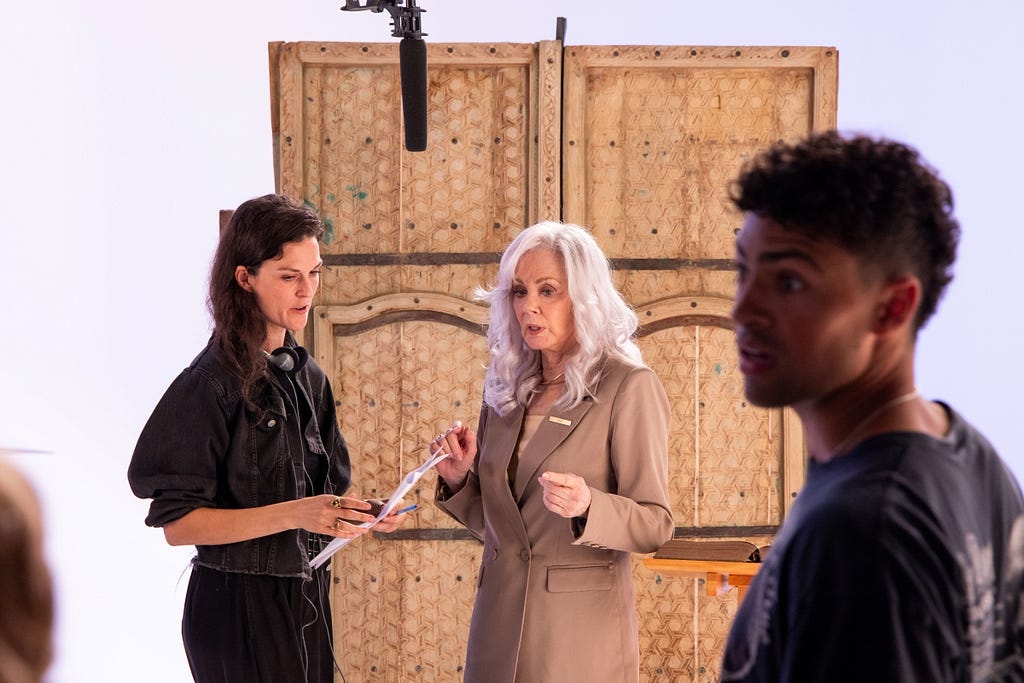
Especially when you’re writing a character like God and trying to imagine what that could look like, creating a version of God that’s not what people expect. In this short, the God character is a little bit of a bureaucrat. She’s kind of jaded, standing at the podium all day processing people. That was actually my directing note to Jean, she’s reading through her book, going over all the things humans do. She’s a little fed up with us, but she’s still rooting for us. She also wants to have a little fun.
That was a challenge in writing the full script. It’s easier in a seven-minute piece, but when you’re writing a 90-minute script for God, and you want her to have a bit of a storyline, then she needs to grow somehow. That’s really hard, trying to find a story for God that keeps her all-knowing but still gives her room for a bit of growth or a journey. That’s been a big challenge.
Yitzi: Fascinating. Okay, so this is our signature question. You’ve been blessed with a lot of success. Looking back to when you first started filmmaking, can you share five things you’ve learned from your experience that would’ve been great to know when you were starting out?
Meron: Five things.
1. You don’t need a formal education, and it doesn’t have to be all-in right away. Start by practicing during your off time. You can ease into it, see if it feels right, and when it does, take a bigger leap of faith.
2. Get as much practical experience as possible. If it’s screenwriting, keep writing scripts and have people read them. If it’s directing, try to get as much set experience as you can. Volunteer to be a PA on the set of a short film. Just being on set and around filmmakers will teach you a lot, help build relationships, and make it feel real.
3. Follow your intuition. If your gut is telling you to do something, have no fear. It will take you where you’re supposed to go.
4 . Have fun. Enjoy the process. It’s easy to obsess about the result, but it’s not just about the destination, it’s also about the journey.
5 . Create things you’re passionate about, and it will shine through.
Yitzi: Can you share with our readers the self-care routines that you do to help your body, mind, and heart thrive?
Meron: Self-care… I try to be in nature as much as possible. Meditation and taking time off, just taking time to center myself and have a spiritual moment every day, if I can.
I also try to make the most out of every day. Feeling alive is really important to me. I’m someone who constantly asks, “Am I making the most out of life? Am I making every day count?” And if I’m not, then I’ll make adjustments. But that sense of being present and alive, that’s something I really prioritize.
Yitzi: This is our aspirational question. So, Meron, because of your amazing work and the platform you’ve built, you’re a person of great influence. If you could spread an idea or inspire a movement that would bring the most good to the most people, what would that be?
Meron: I think people are afraid of being creative. I was like that too. It can feel like creativity is this magical thing that only some people are born with, and that you have to be really good at it to express it. Because of that belief, I think a lot of people who have creative tendencies are afraid to actually express them. They don’t know where to start, or they assume they won’t be any good. They don’t want to show anyone what they’ve made. They think, “If I’m not going to be a big artist, then why bother?” Or they feel embarrassed to start later in life, like people will make fun of them.
I’ve especially had a lot of older women ask me how I started, since I got into this a little later. They’ll ask about the practical steps, the specifics.
So I guess my message would be this: if you feel, even in a quiet, intuitive way, that you want to express yourself through painting or writing or anything creative, then lean into it. Don’t be afraid. It can bring so much joy. I really believe it can make people genuinely happy.
Yitzi: Amazing. Okay, how can our readers continue to follow your work? How can they watch the shorts or support you in any way?
Meron: Oh, thank you. I think the best thing is to follow me on Instagram, @MeronAlon. I update everything there.
Yitzi: Meron, it’s been so delightful to meet you. I wish you continued success, blessings, and good health, and I hope we can do this again next year.
Meron: Thank you, Yitzi. You’re such a great, sweet interviewer. You made me feel so comfortable. I really appreciate it.
‘Too Good’ Filmmaker Meron Alon on Life Pivots, Jean Smart’s Divine Role and Finding the Humor in… was originally published in Authority Magazine on Medium, where people are continuing the conversation by highlighting and responding to this story.